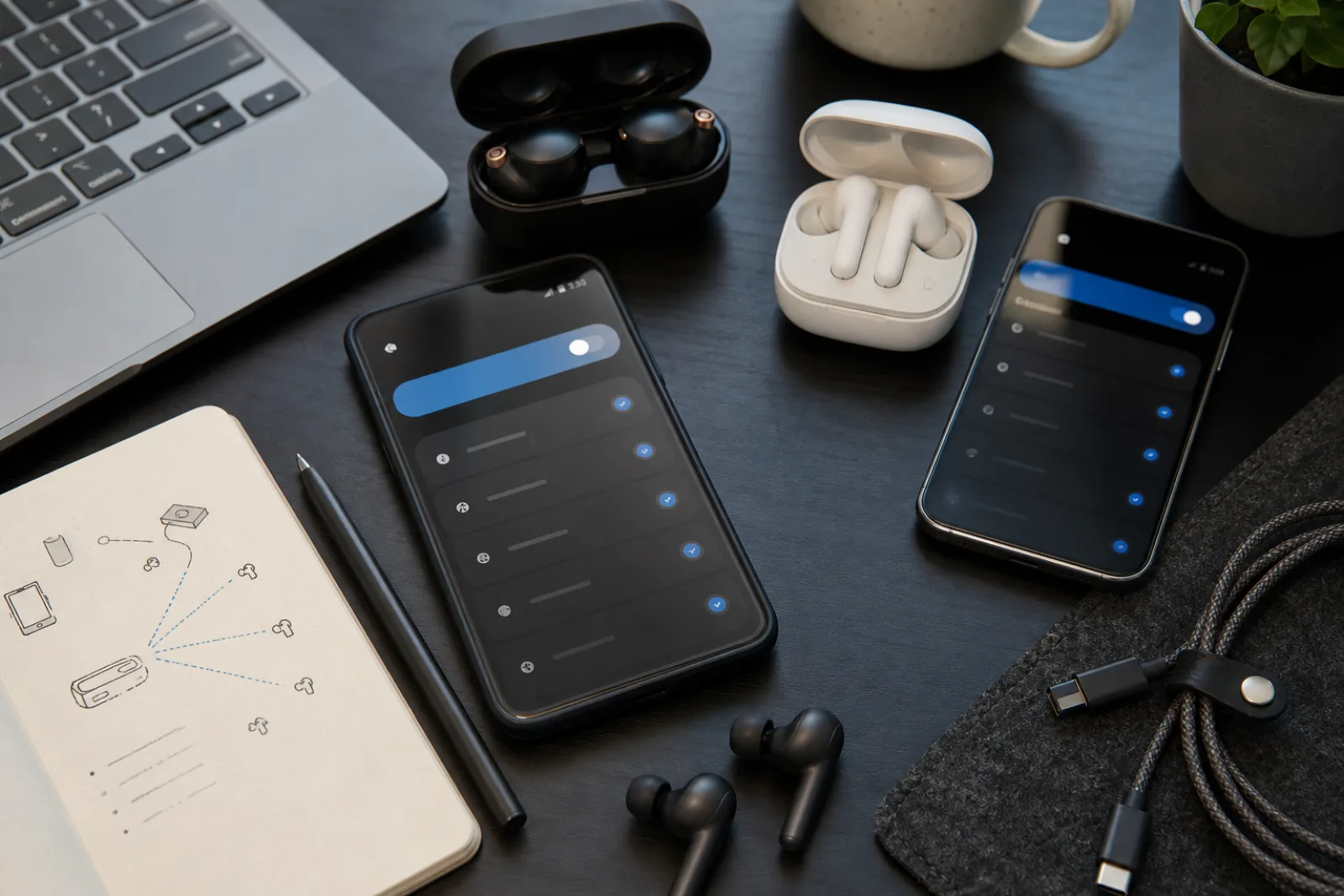
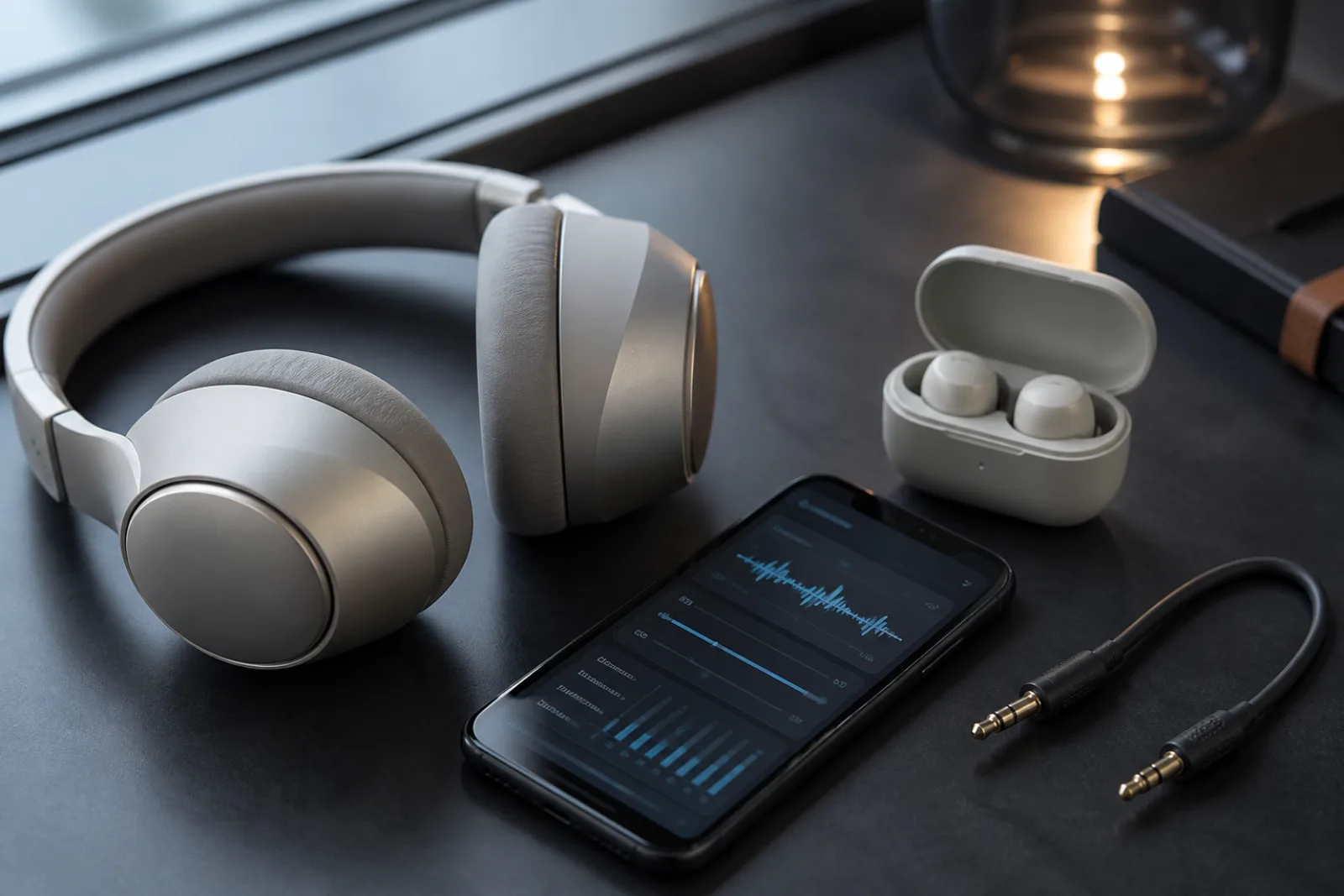
A 3.5 mm cable is a pair of analog voltages. Bluetooth is a conversation: chop the audio into frames, compress them, win a slot on a crowded 2.4 GHz band, hope the packets arrive, decompress, play. Every step is a trade. Spend more bits, sound better, drain the radio. Spend more buffer, survive a microwave oven, arrive late for a gunshot in a game. Spend a proprietary codec, sound great on one phone, fall back to SBC on another.
LE Audio is the industry's attempt to make a better conversation, not to become a cable. If you expected wireless to finish catching up in 2026, this is why the last gap is stubborn.
The wireless tax, in order
- 01Compress
SBC, AAC, aptX, LDAC, or LC3. Bits per second are limited by the radio and by battery. The SIG's LC3 tests show you can spend fewer bits than SBC for similar lab quality. You are still not sending the studio master.
- 02Contend
2.4 GHz is an ISM band. Wi-Fi, Bluetooth, and appliances share it. Bodies and walls absorb it. 5 GHz Wi-Fi does not rescue a Classic Bluetooth headphone, which does not live there.
- 03Buffer
Players delay playback so a lost packet can be repaired or concealed. That delay is latency. Lip-sync and games feel it. Music playlists mostly do not.
- 04Decompress and render
Each earbud must play at the same time. Classic true-wireless often relays from one bud to the other, which the SIG's Auracast overview calls out as extra latency. LE Audio multi-stream gives each bud its own synchronized stream. That is a real fix for one Classic hack, not for physics.
| Complaint | What changed | What a cable still uniquely avoids |
|---|---|---|
| SBC sounds dull | Optional Classic codecs, then LC3 in LE Audio with better bits-per-quality in SIG tests | No codec. The DAC in the headphone or interface is the remaining color. |
| One bud lags the other | LE Audio multi-stream, if both ends support it | A single analog path, or a wired USB DAC with no bud-to-bud radio. |
| Video is late, games are late | Low-latency modes and LE Audio's more tunable latency | Milliseconds instead of tens-to-hundreds. Competitive timing still prefers a wire. |
| Drops in a busy station | More efficient codecs leave headroom; LE Audio can be more robust at a given quality | No ISM-band neighbor. A wire does not retry. |
| Sharing audio with a friend | Auracast, when the transmitter exists | A splitter. Crude, immediate, zero protocol. |
High-bitrate Classic codecs already proved that 'Bluetooth sounds bad' was often 'SBC at a stingy rate sounds bad.' LDAC and aptX Adaptive can sound excellent on a supported Android phone and disappear on an iPhone that would rather use AAC. That fragmentation is itself a tradeoff: better optional codecs, worse certainty. LC3's political advantage is that it is mandatory on LE Audio, the way SBC was mandatory on A2DP. Interoperability might get less weird. It will not get analog.
Battery is the other hidden tax. Radios and DSPs draw power. ANC draws more. LC3's bitrate cut is how the SIG argues for smaller batteries or longer life. Using that headroom to crank quality back up spends the savings. Product managers, not physics, pick the point on the curve.
Use a cable when you are editing, playing an instrument to a click, or shooting in a title where 80 milliseconds is a miss. Use wireless when the commute is the product. LE Audio is worth tracking so the next pair of buds is not a dead end. It is not a reason to feel cheated that 2026 headphones still have a radio in them.
A better conversation, not a cable
- 01
Compression, congestion, and buffers are the remaining tax.
- 02
LC3 and multi-stream shrink parts of it. They do not delete 2.4 GHz.
- 03
Plug in for timing-critical work. Wireless for everything that can wait 50 milliseconds.
Questions
- 01Will Wi-Fi 7 or 5 GHz Bluetooth fix this?
Wi-Fi 7 is a different radio in the laptop, not in most headphones. Some proprietary dongles use other bands. Standard Bluetooth audio, Classic or LE, is still designed around the Bluetooth radios in phones and buds. Do not wait for your ANC headphones to become a Wi-Fi 7 client.
- 02Is wired always higher fidelity?
A cheap analog cable into a noisy phone jack can lose to a well-implemented LC3 or LDAC path into a decent headphone DAC. The structural point is the absence of a codec and a shared band, not that every 3.5 mm socket is a studio.
- 03Why do some wireless headphones include a cable?
Dead battery, airplanes, and mixing. It is an admission of this article in hardware form.