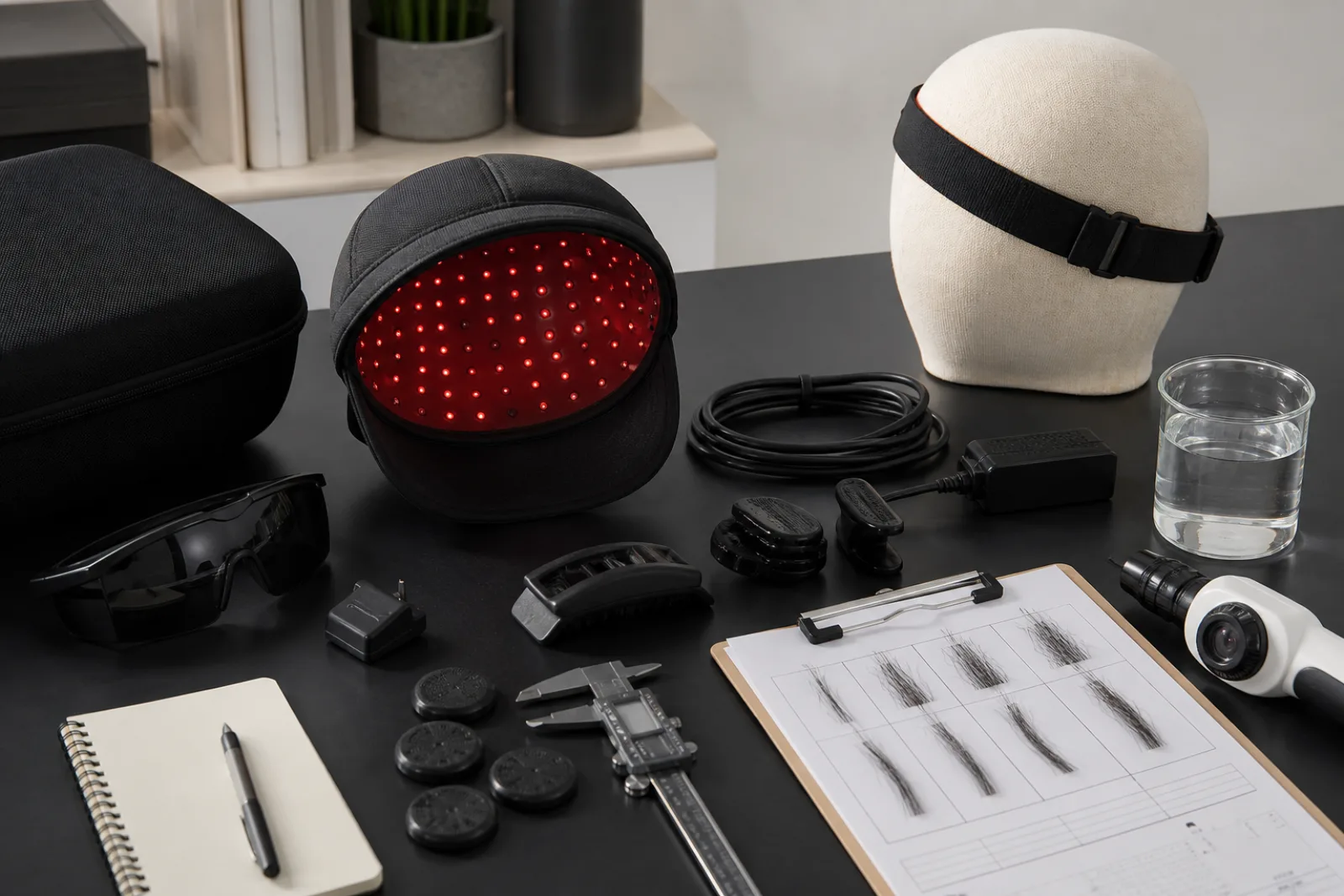
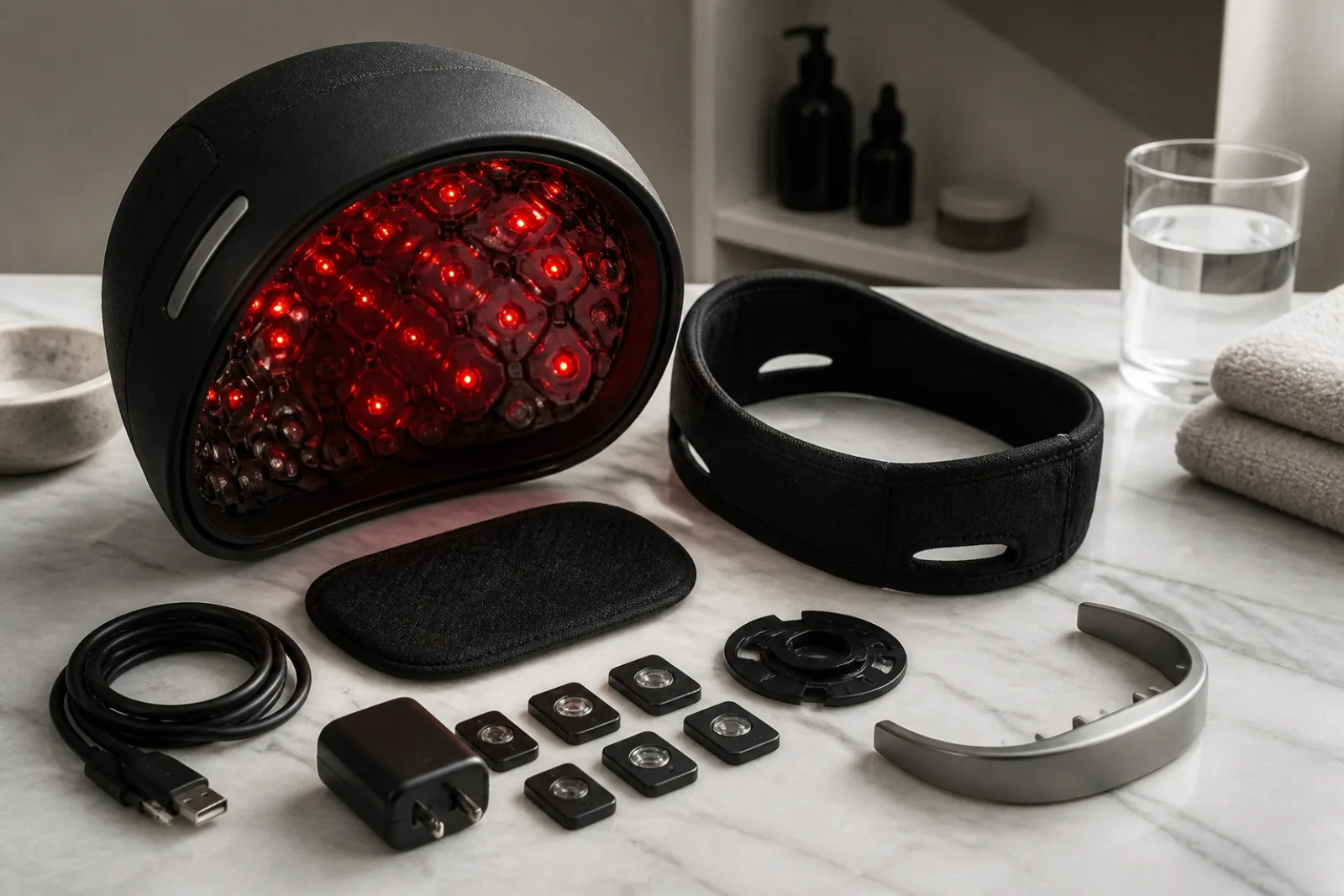
Hair routines are already crowded: wash, treat, style, pretend the serum is a personality. A laser cap does not slot in like conditioner. It is a medical-device session with a clock, used for a specific diagnosis, usually androgenetic alopecia. If you have not had that diagnosis, the cap is a guess. If you will not keep the schedule, the randomized trials that exist are not about you.
The companion research review covers what the LLLT category can claim. This page is order of operations, written under the same conflict of interest.
Sequence that matches the evidence, not the checkout flow
- 01Name the hair loss
AAD: a dermatologist can tell you the type. Pattern hair loss is not alopecia areata, not traction, not a crash diet shed. Wrong type, wrong tool.
- 02Talk through medications
For male pattern hair loss, AAD's FDA-approved options are topical minoxidil and oral finasteride, with months-long timelines and a rule that stopping undoes the gain. Women have a different map (topical minoxidil is the approved drug; other agents are specialist decisions). A cap does not cancel those conversations.
- 03Add LLLT only if the schedule is real
AAD: several treatments a week for many months to see a bit of growth. Put the sessions where a calendar already has a repeating block (commute is wrong; a chair with a charger is right). Dry, detangled hair. Follow the device's timed protocol, not a vibes-based extra 10 minutes.
- 04Do not skip wash-day hygiene
A cap on a scalp full of heavy leave-ins is a different optical problem. Clean enough for diodes to reach skin. That is not an excuse to strip daily. How often to wash is the AAD oil-calendar article.
| Element | Role |
|---|---|
| Diagnosis | Non-negotiable. A device routine should not delay evaluation of ongoing or unusual loss. |
| Minoxidil / finasteride (when indicated) | The FDA-approved drug lane AAD describes. Daily. Months. Loss of benefit if stopped. |
| LLLT cap or comb | Adjunct with a session clock. Category RCTs versus sham. Not a Culture Column product test. |
| Shampoo and styling | Cosmetic. They do not treat androgenetic alopecia. They can get in the way of light if they leave a thick film. |
| Hope and before-after photos on a product site | Marketing. Ours included, given ownership. Discount them. |
Adherence is the unglamorous finding hiding in every device paper. Protocols that look like 10 to 25 minutes, several times a week, for 12 to 26 weeks, only count if they happen. People who buy a cap to 'do something' without a chair, an outlet, and a repeating alarm are buying a sculpture. If that sentence describes you, spend the money on a dermatology visit instead.
Pregnancy, planned pregnancy, and breastfeeding change the drug map and should change the device conversation too. AAD flags finasteride as a birth-defect risk. Do not improvise a stack from forums.
If the shedding is sudden, the scalp burns, or you see bald patches, stop building a routine and get seen. A laser cap is not an urgent-care clinic.
Diagnosis, drugs, then a clock
- 01
Identify the hair loss. Then discuss proven medications. Then, maybe, a timed LLLT habit.
- 02
A cap you skip is not in the literature.
- 03
We share ownership with Regrowthy. This is not a test of that cap.
Questions
- 01Can I use a cap instead of minoxidil because I hate the grease?
That is a preference, not a substitution licensed by AAD's public pages. Ask a dermatologist. Foam minoxidil exists partly because of that complaint.
- 02Morning or night?
Whenever you will actually sit still for the full session, with a dry scalp, without turning it into a reason to skip. Consistency beats a theoretically perfect hour.
- 03How long until I quit if nothing happens?
Drug timelines AAD cites are on the order of 6 to 12 months. Device trials also run months. Quitting at week three is not a test of the category. Quitting without a diagnosis was the mistake.