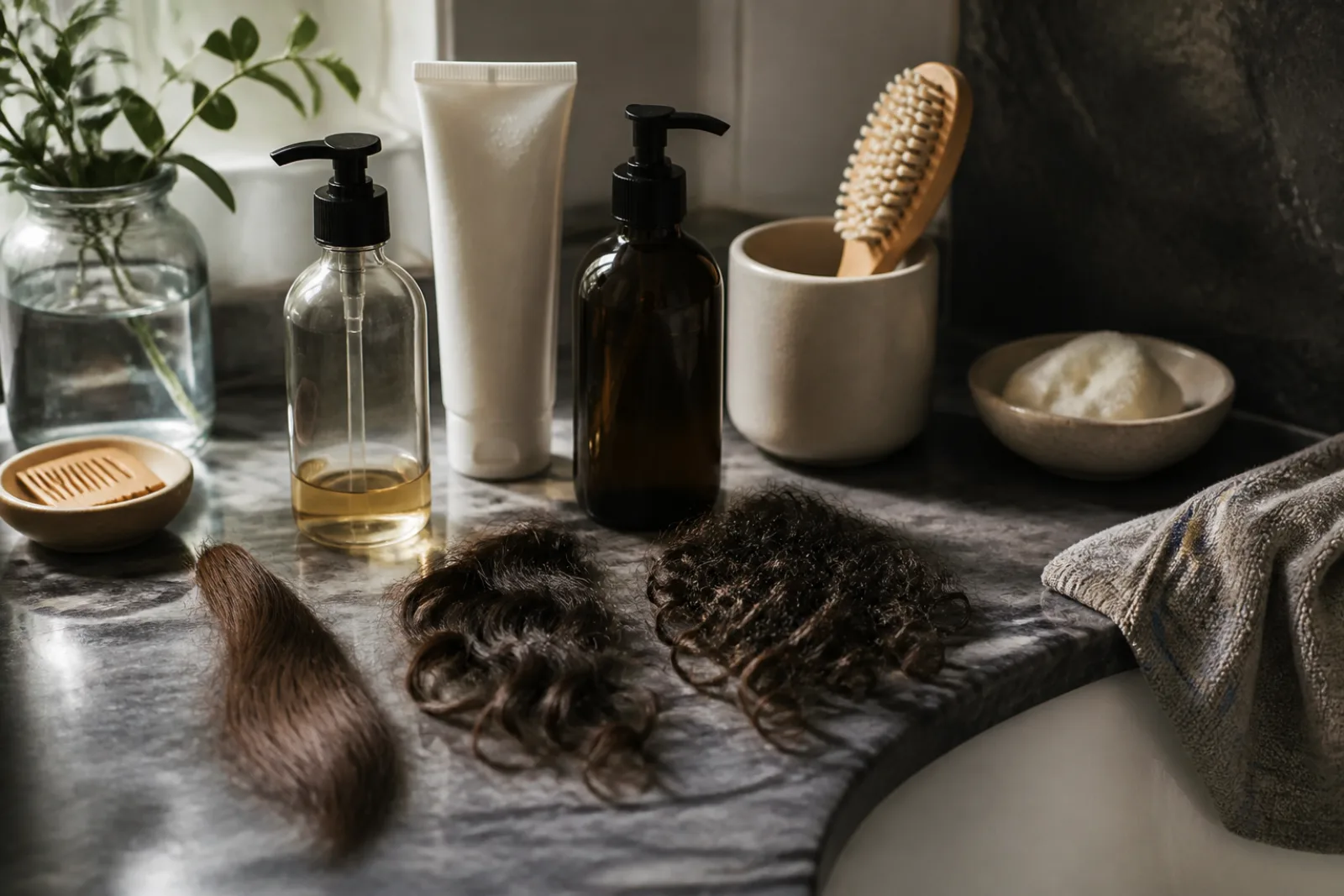
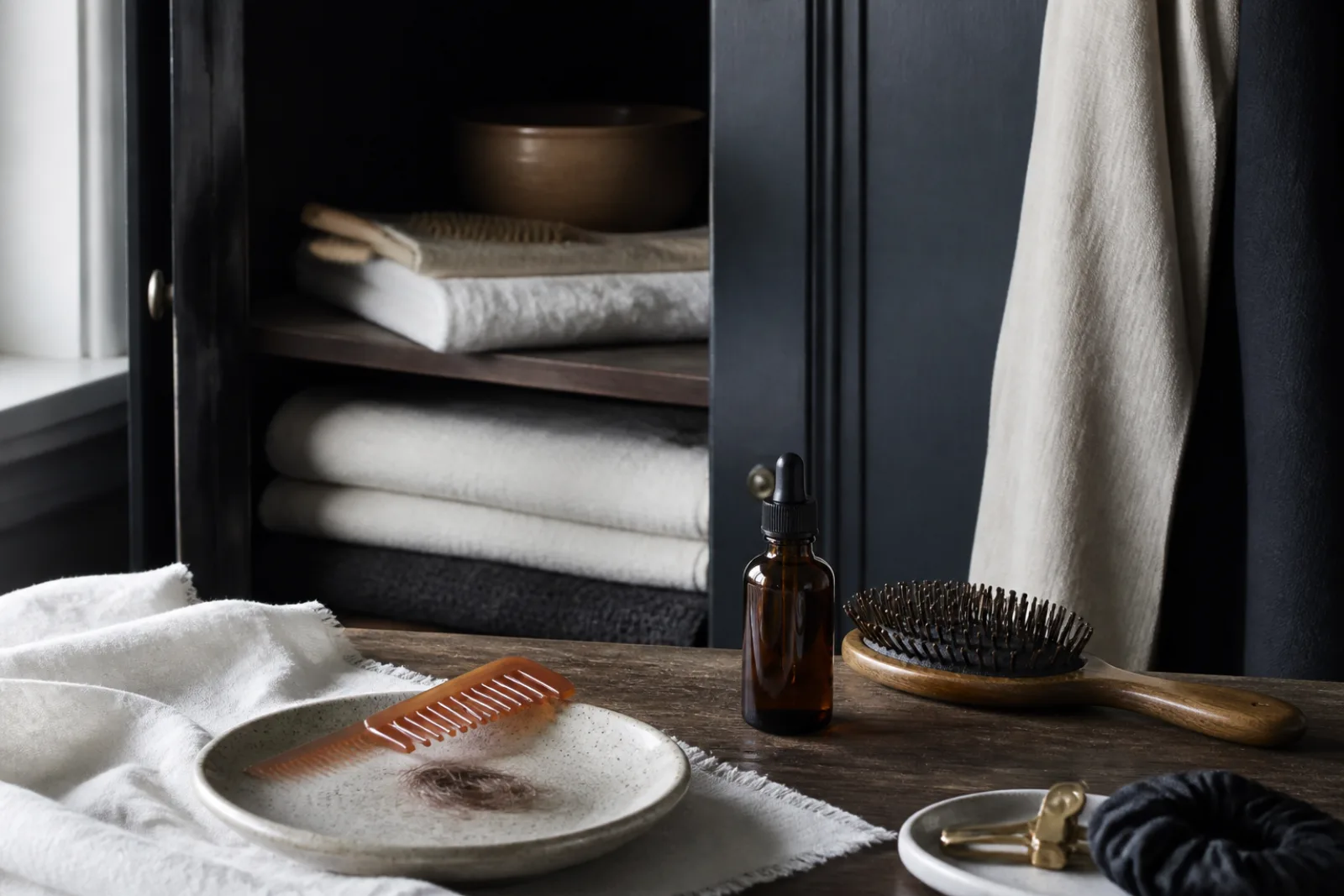
"Be gentler with your hair" is not specific enough to actually change anything. The American Academy of Dermatology's real guidance is more precise than that, and most of it is about technique rather than which products you buy. Hair that is fragile, whether from styling habits, chemical treatments, or the early stages of shedding, is more vulnerable to a specific kind of damage: friction and tension from handling, not just chemical exposure. AAD's recommendations target that mechanical damage directly.
AAD's specific gentle hair care recommendations
- 01Massage shampoo into the scalp, not the length of the hair
Let the rinse water carry shampoo through the strands rather than scrubbing it into the hair directly.
- 02Apply a moisturizing conditioner after every shampoo
Conditioner coats strands, reducing breakage and split ends from daily friction.
- 03Use a leave-in conditioner or detangler
Reduces breakage, split ends, and frizz between washes.
- 04Dry with a microfiber towel before blow-drying
Reduces total blow-drying time and heat exposure.
- 05Detangle gently, using conditioner if needed
Working through tangles dry, or with force, is a common source of breakage.
- 06Pause at-home coloring, perming, chemical straightening, and relaxing
These chemically stress hair that is already fragile.
- 07Skip hot-oil treatments on fragile hair
Heat further stresses hair that is already compromised.
Where friction actually happens
- 01Shampoo the scalp
AAD: massage shampoo into the scalp. The length is cleaned by the rinse, not by scrubbing. Direct friction on fragile lengths is the damage you can stop for free.
- 02Condition the lengths
A moisturizing conditioner after every shampoo, then a leave-in or detangler if hair still catches. The coat is what reduces breakage between washes.
- 03Blot, then less heat
AAD: dry with a microfiber towel before blow-drying so the dryer runs for less time. Detangle with conditioner in, not dry and not by force.
- 04Pause chemical load
Color, perm, relaxer, straightener, hot-oil: pause while hair is fragile. Resume after condition improves or a clinician has named the cause.
- 05If shedding persists, stop shopping
AAD draws a line: ongoing thinning or shedding is a dermatology visit, not a gentler bottle. Cosmetic technique cannot treat every cause.
The scalp-versus-length distinction in the first step is worth understanding, not just following. Shampoo's job is primarily to clean the scalp, where oil and product buildup actually accumulate; the length of the hair gets adequately cleaned by the shampoo simply flowing through it during rinsing. Scrubbing shampoo directly into the length adds friction to hair that did not need direct cleaning in the first place, and friction is exactly what breaks fragile strands. This is a small technique change, not a product change, and it costs nothing to adopt.
The chemical-treatment pause matters for a related reason: coloring, perming, relaxing, and straightening all work by chemically altering the hair's structure, which is inherently stressful to the strand even on healthy hair. On hair that is already fragile or shedding, that additional stress compounds whatever is already happening. AAD's guidance is not that these treatments are permanently off-limits, only that pausing them while hair is in a fragile state, and resuming once condition improves or a clinical cause is addressed, reduces the total mechanical and chemical load on hair that has less resilience to spare.
The short version
- 01
Gentle hair care is specific technique: shampoo applied to the scalp rather than the hair length, conditioner after every wash, and gentle detangling, not just switching to a "gentle" labeled product.
- 02
Pausing chemical treatments (coloring, perming, straightening, relaxing) and hot-oil treatments reduces the total stress load on hair that is already fragile.
- 03
Persistent shedding or thinning that continues despite gentler care needs clinical evaluation, since cosmetic technique cannot address every underlying cause.
Questions
- 01How long should I try gentler care before seeing a dermatologist about shedding?
AAD's guidance does not specify a universal timeline, but persistent or worsening shedding that does not improve with gentler handling, or shedding accompanied by visible thinning, scalp symptoms, or a sudden change, are reasons to seek a dermatologist's evaluation rather than continuing to wait.
- 02Are silicone-free or sulfate-free shampoos part of AAD's gentle-care recommendations?
AAD's published gentle-care guidance focuses on technique (where and how shampoo and conditioner are applied) rather than specifying particular ingredient categories to avoid; a general recommendation to use a gentle, moisturizing shampoo and conditioner is included, without a specific formulation requirement.