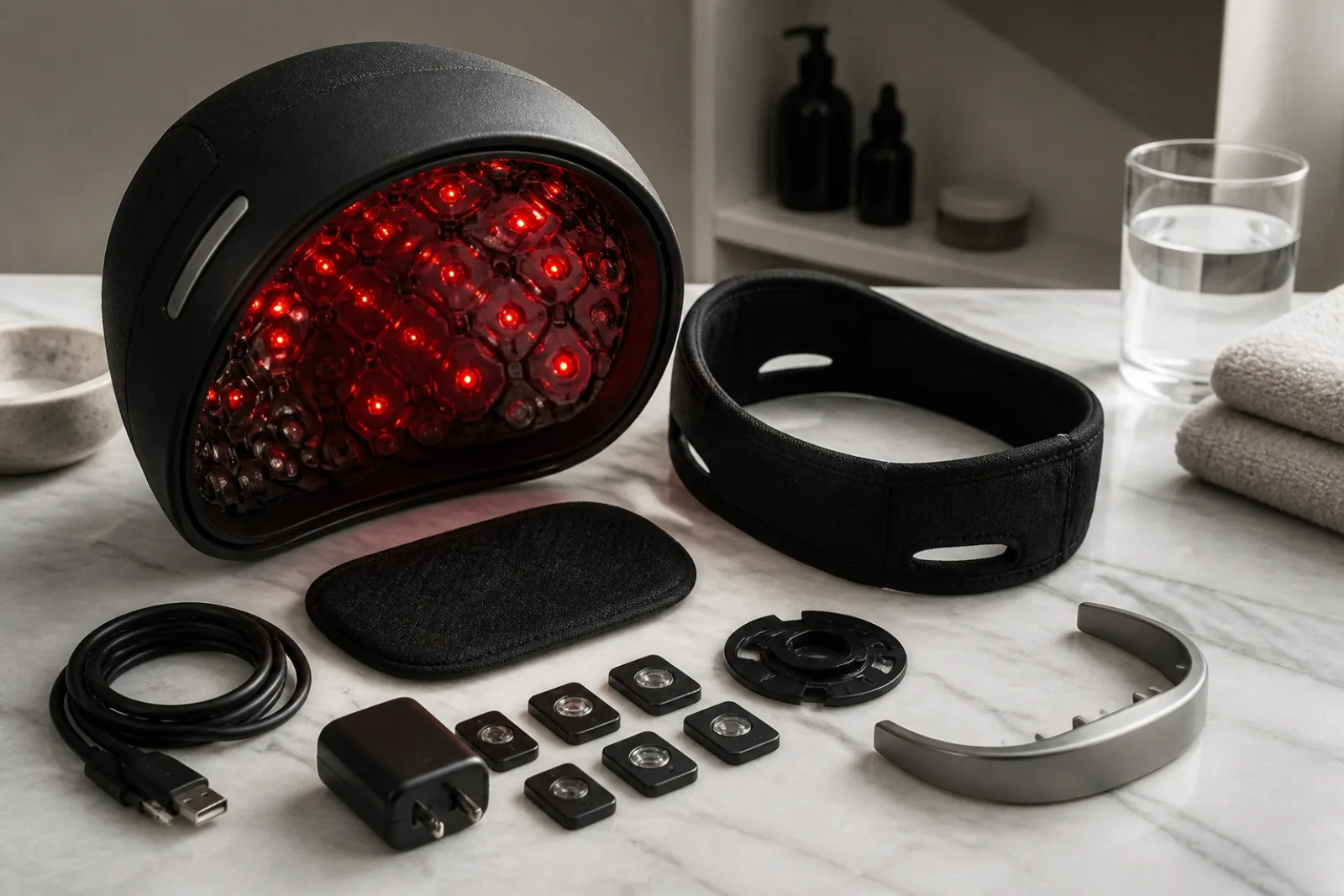
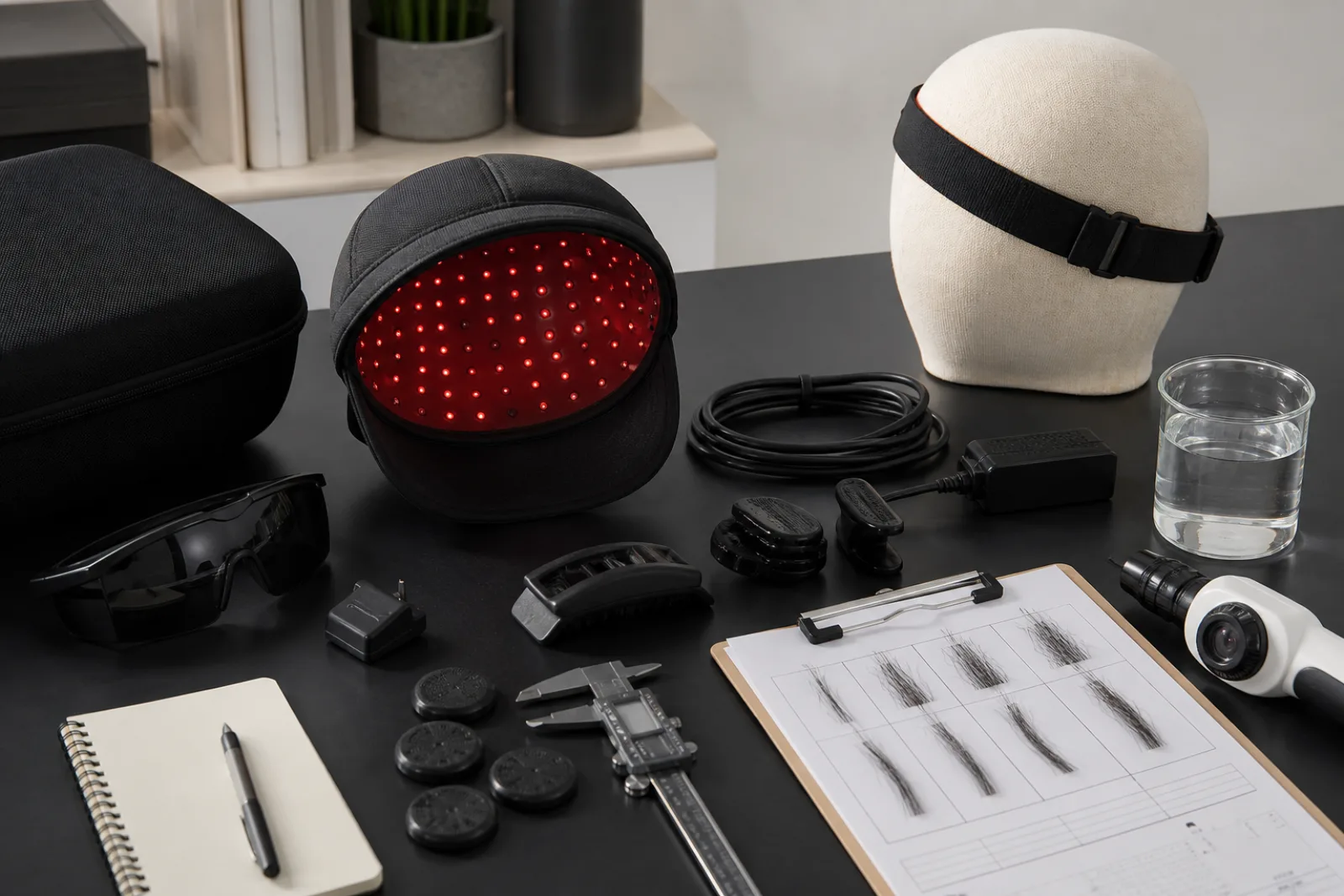
Laser caps sell a simple picture: red light, a schedule, thicker hair. The underlying idea, photobiomodulation of follicles, is not a 2024 invention. The first U.S. home LLLT device in this category was cleared in 2007. Randomized trials of some of those cleared combs and helmets show more hair density than sham devices. That is a real literature. It is also a literature about a class of red-light gadgets that the FDA treats as devices, through 510(k) clearance, not as drugs.
If you came here for a Culture Column road test of Regrowthy, stop. We share ownership with that company. We did not put the cap on a panel of scalps. What we can do honestly is separate three stamps people mash together: FDA-approved drugs, FDA-cleared devices, and a brand name on a box.
| Stamp | What it is | What it is not |
|---|---|---|
| FDA-approved drug (AAD: minoxidil, finasteride for male pattern hair loss) | A drug application with clinical evidence reviewed for that molecule and indication | A laser. AAD is explicit that drug approval and device clearance are different bars. |
| FDA-cleared LLLT device (510(k), product code OAP) | Substantial equivalence to a predicate already on the market. AAD: the agency recognizes the cleared laser as a safe treatment. Clearance is less stringent than approval. | Proof that this week's new cap was itself run through a large independent RCT. Many cleared devices, the 2021 JCAD review notes, have little or no published trial of their own. |
| This article | A category reading, with ownership disclosed | A verdict that Regrowthy works better than Brand X, or that you should skip a dermatologist |
Lueangarun et al., J Clin Aesthet Dermatol 2021. 95% CI 0.993 to 1.639. Standardized mean difference, not a promise of a visible head of hair. Authors asked for longer follow-up and head-to-head device studies. They labeled devices 'FDA-approved' in the title; their methods searched the 510(k) database, which is clearance.
JCAD 2021 LLLT meta-analysis
A 2024 review in the Journal of Clinical Medicine puts the typical hardware in a narrow optical window: red laser diodes or LEDs around 630 to 660 nanometers, as combs or helmets, with more than 80 510(k) clearances in the category. Helmets have looked slightly stronger than combs in some comparisons, which is a design hint (coverage and hands-free time), not a shopping ranking. There are still no adequate head-to-head trials that would let a reviewer crown a brand.
AAD's public male-pattern page is the sentence marketing copy hopes you will not read in full. Cleared means safety recognition at a lower bar than approved. Minoxidil and finasteride remain the FDA-approved medications they name, with timelines of months, daily use, and loss of benefit if you stop. Laser devices are listed separately, with the clearance caveat. A dermatologist's first job, AAD says, is to tell you which type of hair loss you have. A cap cannot diagnose scarring alopecia, telogen effluvium, or thyroid disease.
What a research-based review can still ask of any cap, including one we are not independent of: published wavelength and session schedule that match the studied devices; a fit that actually puts the diodes on the thinning area; a warranty and a replacement path; and an honest label that says cleared, not approved. We are not confirming those details for Regrowthy in this article, because that would pretend we audited the SKU. Where Regrowthy fits in a hair-care routine is the adherence and diagnosis page.
What the category evidence actually licenses you to do
- 01Get the diagnosis
AAD: different hair loss needs different treatment. Do not buy a cap to postpone a dermatologist if shedding is sudden, patchy, painful, or you are a woman with other hormonal signs.
- 02Treat LLLT as an adjunct with a schedule
Trials used repeated sessions over months. AAD: many treatments a week for many months to see a bit of growth. A cap in a closet is not photobiomodulation.
- 03Keep the drugs in their lane
If a clinician has you on minoxidil or finasteride, the device literature does not replace those molecules. Combination is a clinical decision, not a stack of Amazon tabs.
Class evidence, disclosed conflict
- 01
Some cleared home LLLT devices beat sham on density in RCTs. That is the category.
- 02
Cleared is not approved. AAD said so in public.
- 03
We share ownership with Regrowthy and did not test the cap.
Questions
- 01So should I buy a laser cap?
That is a conversation with a dermatologist after a diagnosis, with a clear view of cost, time, and the stronger evidence base for minoxidil and, in men, finasteride. This page will not convert a conflict of interest into a shopping cart.
- 02Is red-light therapy the same as a dermatologist's laser?
Home LLLT is low-level photobiomodulation. Ablative or fractional clinic lasers are different devices and different indications. Do not equate them.
- 03Why mention Regrowthy at all?
It is in the publication's planned reviews, and hiding the name while sharing ownership would be worse. The honest move is to review the category and say we are not independent of this brand.