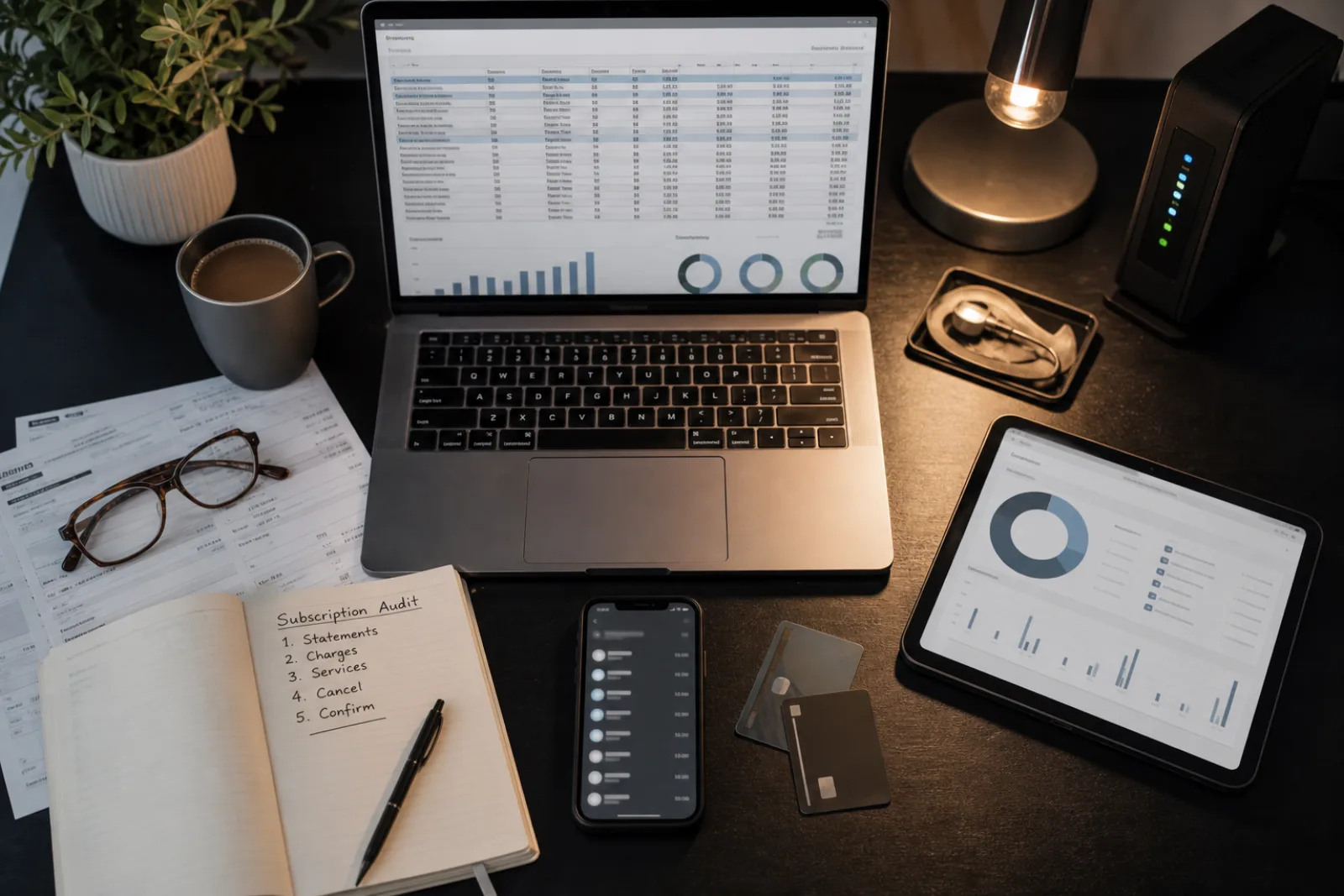

The pitch is a dashboard that loves you. Recurring charges, in a list, with a button that looks like goodbye. The legal system does not live in that button. The merchant does, or Apple does, or the card network does. A tracking app is a very motivated reader of your mail and your ledger. Sometimes that is worth a login. Sometimes it is a second subscription whose job is to scold you about the first twelve.
If you have two cards and a quiet month, three statements and a notes app will find the same $7.99. The app starts to earn its keep when the charges hide as 'Apple.com,' 'Google *,' a gym that changed its DBA, and a free trial that learned your ZIP code.
| Access model | What it can find | What you hand over | What it cannot promise |
|---|---|---|---|
| Bank or card connect (aggregator) | Recurring amounts across accounts the connection covers, including merchants with no app icon | Transaction history, and sometimes account and routing details, to a third party | Canceling every merchant. Seeing cash, a spouse's card, or a store card you did not link. |
| Email or receipt scan | Subscriptions that still email invoices to that inbox | The contents of that mailbox, or at least the commercial slice | Charges that never email, or that email an address you do not scan. |
| App Store lists only | Apple or Google billing, which statements often show as a generic line | Whatever those stores already know | The streaming site you paid on the web, the newspaper, the cloud backup on a Visa. |
| Manual (spreadsheet or notes) | Whatever you copy from PDFs | Nothing to a startup | Catching a new charge unless you look again. That is a calendar problem, not an API problem. |
App, or an afternoon?
How many places charge you, and how much access will you tolerate?
- 01One or two cards, I can open PDFs
Do the audit article once: three months of statements, Apple and Google subscription screens, a list with renewal dates. Set a twice-a-year reminder.
- I already know I will not look twice a yearThen a tracker is a nag, which is a product. Pay for the nag only if you will grant the access it needs.
- 02Many cards, family plans, and 'Apple.com' mysteries
A bank-connect tracker can cluster those lines. Read the aggregator's privacy policy as if it were a roommate.
- I will not link a bankUse email scan plus the two app stores, and accept the holes. Or stay manual.
- 03I want the app to cancel for me
Some will open a flow or a chat. Many will hand you a link. FTC: use the company's method and keep proof. If charges continue, dispute with the card issuer.
- The tracker wants its own monthly feeAnnualize it. A $4 app that finds one forgotten $15 charge a year has paid for itself. A $4 app that finds nothing is another subscription.
Open banking is the hope that your bank must hand a clean feed to an app you authorize, through an API, with rules. Section 1033 of Dodd-Frank is the statute. The CFPB's 2024 Personal Financial Data Rights rule tried to implement it. As of the Bureau's own compliance page, a federal court stayed that rule's compliance dates on 29 October 2025, and the CFPB has been reconsidering the rule since an August 2025 advance notice. In August 2026 the Bureau was still in a rewrite, not in a world where every tracker can assume a free, standardized bank pipe. Screen-scraping and commercial aggregator contracts are still how a lot of this works. That is a security and bargaining story, not a reason to panic, and not a reason to believe the App Store screenshot.
ROSCA still sits under online sign-up: disclose, consent, simple stop. The stricter Click-to-Cancel rule is not in force after the 2025 vacatur. State automatic-renewal laws may be tougher. None of that lets a tracker reach into a merchant that only takes a phone call during business hours.
How to audit digital subscriptions is the method if you want zero new vendors. How to compare recurring subscriptions is the contract you should have read before the trial. Why everything has a membership now is the culture. This page is only the standing app.
If you do install one
- 01List every account it will see
Old student checking, a store card, a partner's joint account. If you will not link it, the dashboard is fiction.
- 02Name the aggregator
Plaid, MX, Finicity, or 'we collect it ourselves.' Revoke from the bank's connected-apps screen when you quit.
- 03Turn off data sales in the settings that exist
If they do not exist, that is an answer.
- 04Keep FTC-style proof anyway
Screenshot, email, reference number, stored outside the app you might delete.
Detection is not cancellation
- 01
Statements remain the source of truth. The app is a highlighter.
- 02
Access is the price. Pay it only if the highlighter beats a PDF.
- 03
Cancel where you subscribed. Keep the receipt. Dispute with the card if they keep charging.
Questions
- 01Will the app see my salary?
A full bank connection often sees deposits as well as charges. If that bothers you, do not link that account. Use a card you only use for software, or stay on statements.
- 02Is a free tracker safer?
Free means the product is you, or a trial, or a limited scan. Read permissions. Price is not a security rating.
- 03Can I dispute a charge from inside the tracker?
Usually no. The FTC path is the merchant, then the card issuer. The app may remind you. It is not the network.