
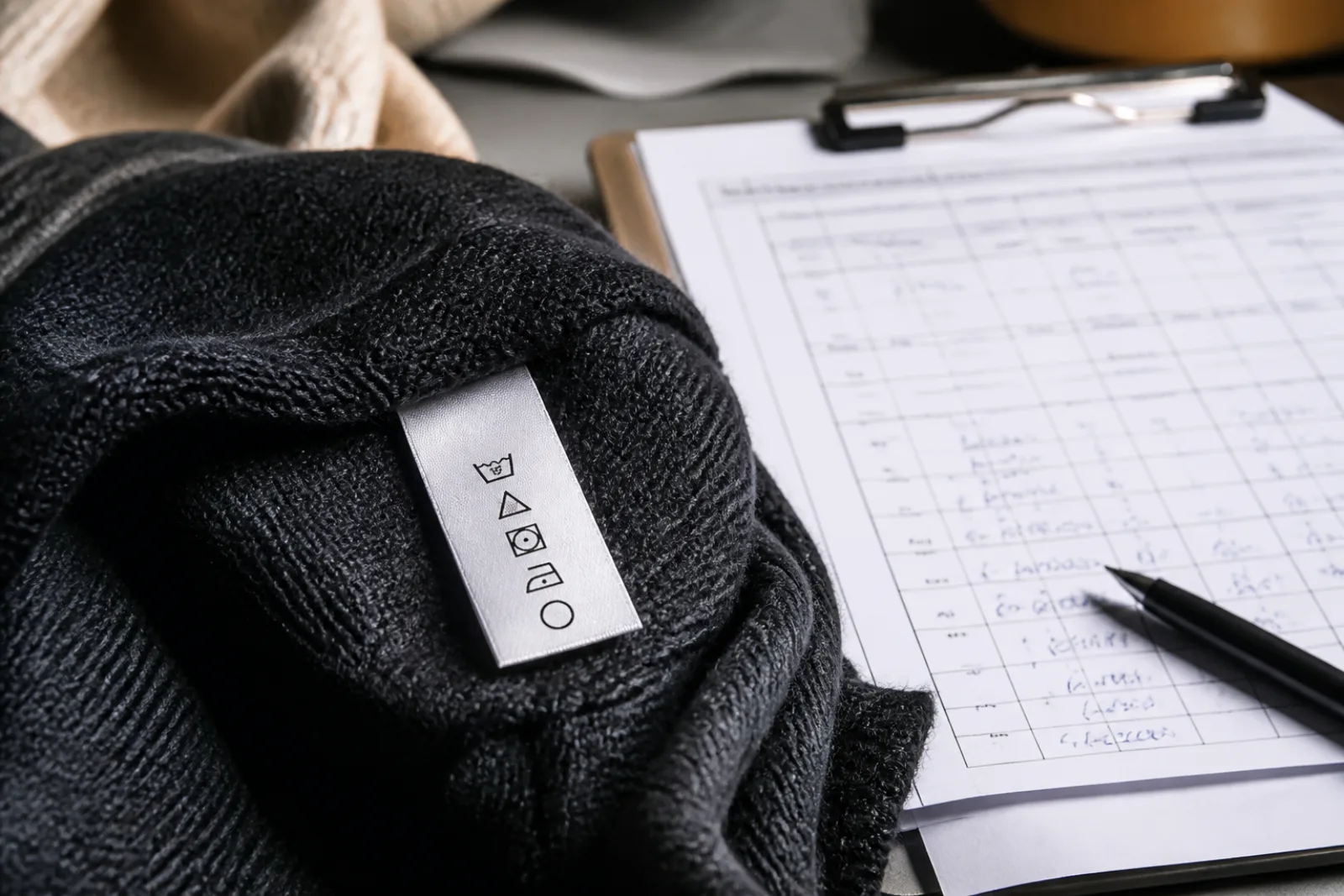
A care label reads like a short list of instructions, but it exists because of a specific federal rule, the FTC's Care Labeling Rule (16 CFR Part 423), and the manufacturer is legally required to have real evidence behind it. The FTC's own guidance is direct about this: care instructions need a reasonable basis, which in practice means actual wash and dry testing on the fabric, or reliable data from the textile mill, not a default instruction picked because it sounds safe.
- Washing or dry cleaning
- Required on every label: whether the garment can be washed, and if so, water temperature and machine cycle, or whether dry cleaning only is required.
- Bleaching
- Required to state one of three things: bleaching is allowed, only non-chlorine bleach is allowed, or bleaching is not allowed at all.
- Drying
- Required to specify the method: tumble dry (with heat level if relevant), line dry, lay flat to dry, or do not tumble dry.
- Ironing
- Required if the garment would reasonably need repeated ironing: whether ironing is safe, at what temperature, or an explicit "Do Not Iron" if ironing could damage it.
- Warnings
- Required if any part of the normal care process could reasonably harm the garment or other items washed with it, even if that process is otherwise standard.
FTC, Clothes Captioning: Complying with the Care Labeling Rule; 16 CFR Part 423.
The "reasonable basis" requirement is the part most shoppers never hear about, and it is the reason a care label is worth trusting as a floor, not just boilerplate. The FTC does not require manufacturers to test every possible cleaning method and report the best one; it requires them to have genuine evidence that the specific instructions on the label will not substantially harm the garment when followed. That is typically established through actual wash and dry cycle testing on the finished fabric, checking for shrinkage, color loss, and structural damage, or through reliable data supplied by the textile mill that produced the fabric.
This is why a care label should be read as a tested safe minimum, not necessarily the single best or only method that would work. A garment labeled "dry clean only" might, in reality, survive gentle hand washing without damage, but the manufacturer has not necessarily tested that alternative and has no legal obligation to. "Dry clean only" is the instruction they can substantiate. Treating the label as the floor of what's been verified, rather than the ceiling of what's possible, is the more accurate way to read it.
Reading a care label
- 01Check for all four required elements
Washing/dry cleaning, bleaching, drying, and ironing (if relevant) should all be addressed, in words or standardized symbols.
- 02Treat it as a tested minimum, not the only safe method
A gentler method might also work but likely was not the one tested and substantiated.
- 03Note explicit warnings
A stated warning (like color bleeding or shrinkage risk) reflects a specific tested finding, not generic caution.
- 04Consider trims and linings separately
The main fabric's care instructions may not account for a different, less durable trim or lining material.
The short version
- 01
The FTC's Care Labeling Rule requires care labels to cover washing/dry cleaning, bleaching, drying, and ironing, with a manufacturer required to have real evidence behind each instruction.
- 02
A care label represents a tested safe minimum process, not necessarily the only method that would work or the gentlest possible option.
- 03
The label cannot account for every risk from trims, dyes, or prior damage specific to an individual garment beyond the standard fabric tested.
Questions
- 01Can a garment legally be sold without a care label?
With limited exceptions (such as certain remnant fabrics or some products explicitly exempted by the rule), the Care Labeling Rule requires a permanently affixed care label on textile wearing apparel sold in the United States.
- 02Does a care symbol mean the same thing as the written instruction it replaces?
Standardized care symbols, generally following the ASTM D5489 symbol system, are permitted as an alternative to written English instructions and are intended to convey the same required information; both are subject to the same reasonable-basis evidentiary requirement.