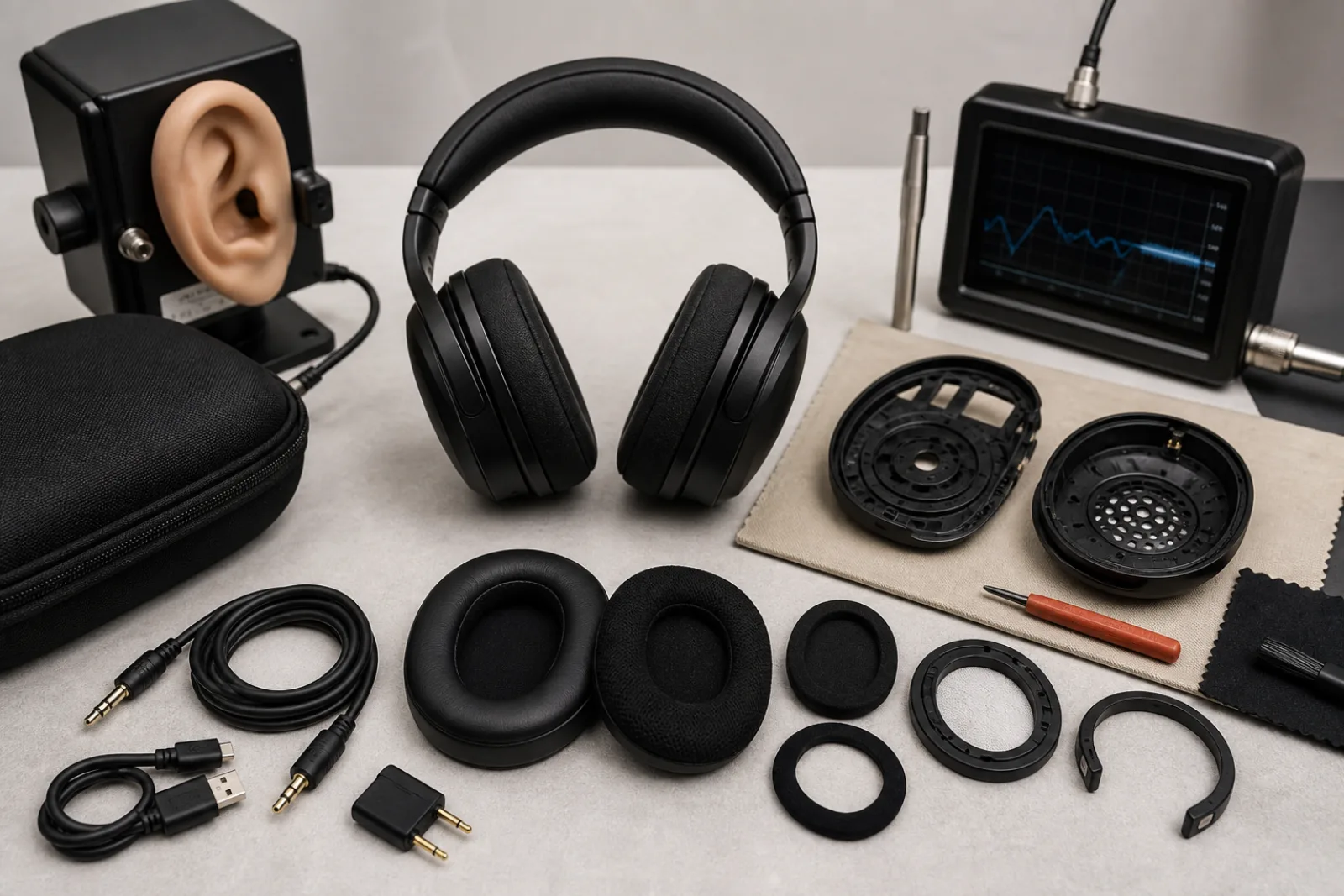
Noise-canceling headphones sell a number that is not on most boxes: how much of the world disappears. Manufacturers sometimes quote attenuation in decibels. Those figures are not standardized the way ENERGY STAR lumens are, they are not measured the same way from brand to brand, and Culture Column has not measured any of them. This piece will not rank named models by a fake dB leaderboard. It will describe what active noise cancellation physically does, what Bluetooth codec names actually guarantee, and which spec-sheet details (replaceable pads, multipoint, battery, wired fallback) you can check without pretending a listening preference is a fact.
If you need headphones for a long flight, the useful question is not 'which pair cancels the most.' It is whether the cancellation is aimed at the noise you actually have (a jet cabin is a different problem from an open office), whether the pads will still be sold in two years, and whether the pair can stay connected to a laptop and a phone without a pairing ritual every time a call comes in.
Active noise cancellation is destructive interference with a battery. Microphones on the earcup or earbud sample the incoming sound. A processor generates a waveform of opposite polarity. The driver plays that anti-noise so that, at the ear, the original wave and the inverted wave cancel. Bose, which has published a plain-language account of its own implementation, describes two microphones analyzing surrounding sound and emitting opposite signals when the waves collide. The same Bose explainer is specific about the frequency limit that shopping copy usually skips: ANC generally works best for steady low-frequency sounds, such as the hum of an air conditioner or passing traffic. It still reduces mid- and high-frequency sounds, but not as effectively, especially against sudden, sharp noise such as a dog barking or a horn. Office chatter and speech sit in that harder band. A jet engine's rumble sits in the easier one. That is physics and product documentation, not a review score.
A spec sheet that boasts ANC without describing the seal is describing half of the system. Fit is the other half, and it cannot be read off a codec list.
- 01Passive seal
Over-ear cups that fully enclose the pinna, or in-ear tips that seal the canal. This is what reduces higher-frequency sound. A wrong tip size or worn pad leaks, and ANC cannot fully paper over a leak.
- 02Feedforward microphone
A mic on the outside of the cup or bud that hears the world before it reaches the ear. Useful for predictable external noise. Wind hitting this mic is a common artifact.
- 03Feedback microphone
A mic inside the cup or canal that hears what remains at the ear and corrects it. Together with feedforward, this is hybrid ANC. The labels vary by brand; the idea is a loop that includes the ear.
- 04Anti-noise driver
The same speaker that plays music also plays the inverted waveform. ANC can run with no music playing. That is why a quiet airplane cabin is a fair demo and a noisy cafe is a harder one.
Because ANC is a real-time loop, it wants a stable seal and relatively stable noise. A plane cabin, a train, a bus, and an HVAC drone are the textbook cases: low frequency, ongoing, not full of consonants. Voices, keyboard clatter, dishes, and announcements are shorter, higher, and less periodic. You will still hear them. Transparency or awareness modes intentionally leak some of that band back in so you can hear a gate change or a bicycle. Those modes are a workflow feature, not a failure of cancellation.
Comfort over an hour is the constraint that turns a good ANC design into a paperweight. Clamp force, cup depth, pad material, and weight do not have a federal label. A spec sheet can tell you weight in grams, whether the cups rotate for a bag, and whether the manufacturer sells replacement earpads as spare parts. That last item is a longevity spec. Protein-leather and foam pads compress, crack, and get grimy. If the pads are glued on and the model is discontinued, the headphones are done even if the battery and the ANC board still work. If the manufacturer lists earpads in a parts catalog, you can budget for them the way you budget toothbrush heads. Culture Column has not worn these products for an hour and will not pretend a weight number predicts your hotspot on the mastoid.
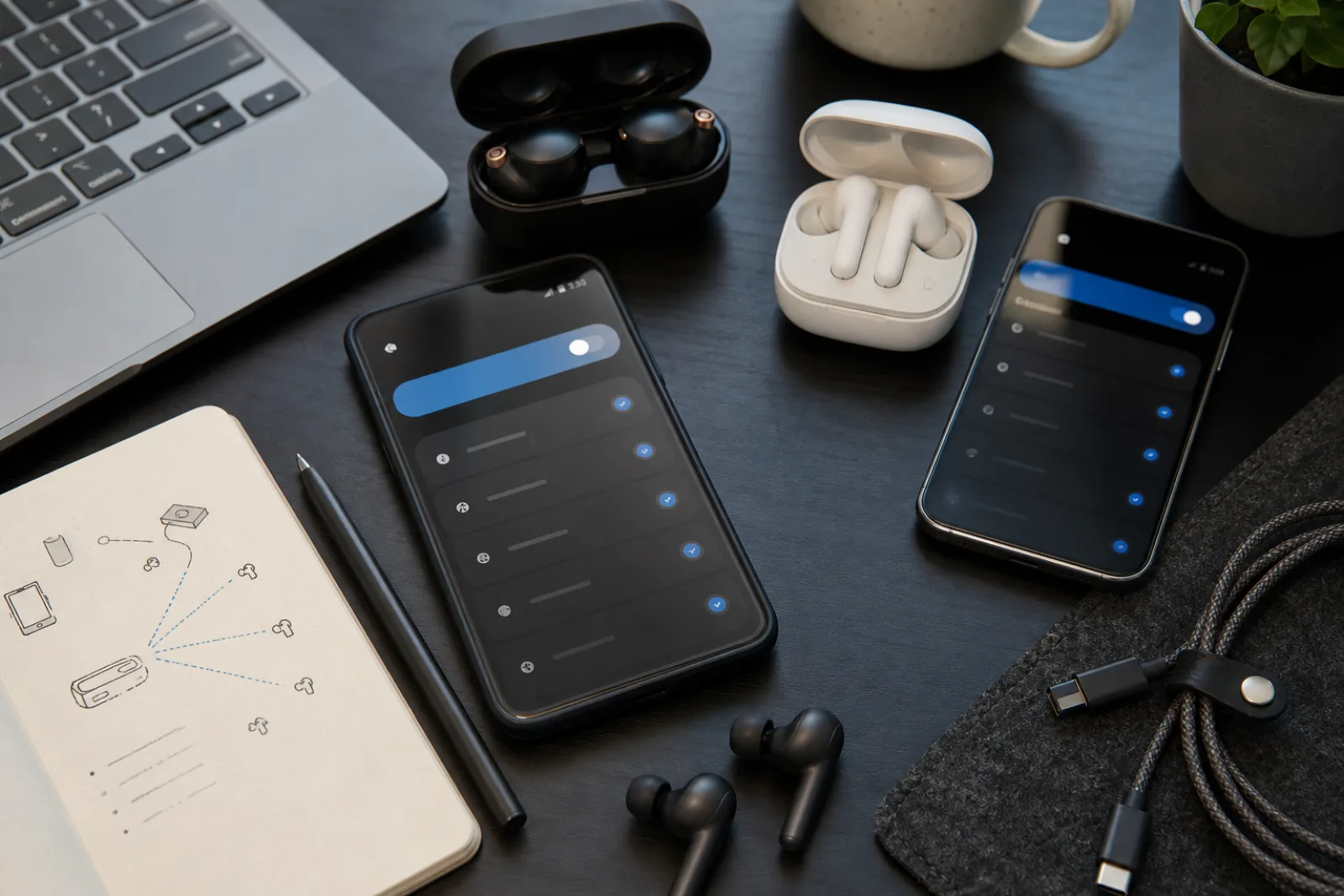
Bluetooth codecs are where spec sheets impersonate a hi-fi magazine. A codec is a compressor that fits audio into the Bluetooth pipe, then a decompressor on the headphones. Both ends have to support the same one, or they fall back. The Bluetooth SIG's A2DP profile made SBC (Low Complexity Sub-band Codec) the mandatory common language. If a pair of headphones connects at all for stereo music on Classic Bluetooth, SBC is the safety net. AAC is widely used as an additional codec, especially in Apple's ecosystem, but it is not a universal requirement. Sony's LDAC is a licensed codec that Sony documents at a maximum of 990 kbps, with a Best Effort mode that steps among 330, 660, and 990 kbps depending on radio conditions. If the phone does not implement LDAC, the headphones' LDAC logo does nothing. LC3 is the Bluetooth SIG's codec for LE Audio, designed to replace SBC in that newer architecture. The SIG's own characterization work reports that LC3 can match or beat SBC quality at a lower bitrate. That is a codec-lab statement. It is not a ranking of headphone models, and it only applies when both devices actually use LE Audio and LC3.
| Codec | Who specifies it | What a spec sheet can honestly claim | What it cannot claim |
|---|---|---|---|
| SBC | Bluetooth SIG, mandatory in A2DP | If Classic Bluetooth stereo works at all, this is the fallback both ends share | That the headphones 'sound like SBC' as a defect. Implementation bitrates vary. |
| AAC | Optional A2DP codec, common on Apple sources | Both the phone and the headphones must list AAC or it will not be used | A guaranteed quality win over SBC on every Android phone. Encoder quality varies by platform. |
| LC3 | Bluetooth SIG, LE Audio | Applies when both devices implement LE Audio. SIG characterization finds better quality than SBC at lower bitrates in lab tests. | That any LC3 headphone sounds better than any SBC headphone. Product tuning still dominates. |
| LDAC | Sony, licensed | Sony documents 330/660/990 kbps and Best Effort switching. Both ends need an LDAC license implementation. | Lossless audio, or that 990 kbps is what you get on a crowded radio. Best Effort may step down. |
Multipoint, sometimes described as dual connection, is a workflow spec rather than an audio spec. It means the headphones can maintain links to two sources, typically a phone and a laptop, and switch when a call arrives. Implementation quality varies and is not something a codec table captures. If your day is a laptop for music and a phone for calls, look for the manufacturer to document two-device connection, then read the caveat: some products pause one device awkwardly, or drop LE Audio features when multipoint is on. The spec sheet should say whether it is supported. It will not tell you whether the switch feels polite.
The rest of a honest spec review is ordinary: claimed battery life with ANC on versus off (these are manufacturer numbers, not ours), whether a 3.5 mm or USB-C cable can run the headphones with a dead battery, whether the mic array is described for calls at all (call quality in wind is not a paper spec), and whether firmware updates exist. None of that substitutes for wearing the pair. If a store will let you sit with them for twenty minutes in the noisiest corner they have, that test is more informative than a codec logo. If you are buying sight unseen, prioritize return policy, pad replacements, and a documented ANC mode you can turn down, because maximum cancellation is not always the most comfortable setting for a full workday.
Battery life with ANC on is a manufacturer claim, usually measured with a specific codec and a mid volume. Treat it as a relative hint (this model is advertised for long-haul versus short commute), not as a stopwatch result you will match. If you fly, a wired fallback (3.5 mm or USB-C analog/digital) is the spec that still works when the battery is dead or when a seat-back screen has no Bluetooth. Some airlines still hand you a two-prong adapter. None of that appears in a codec logo, and none of it is a sound-quality score.
What a spec sheet can settle
What is the noise you actually need to reduce?
- 01Match ANC to the noise band
Steady low-frequency rumble (plane, train, HVAC) is what ANC is documented to handle best. Voices and sudden noise need a good passive seal and realistic expectations.
- Mostly engines, road, or air conditioning
- Mostly voices, an open office, or mixed street noiseExpect partial reduction, not silence. Prioritize a seal you can wear (over-ear with fresh pads, or in-ear tips in the right size) and a transparency mode. Do not buy from a dB boast.
- 02Over-ear or in-ear?
Over-ear cups do more passive isolation for many people and usually have replaceable pads. In-ear buds depend on tip size and will not share pads with a cup-style pair.
- Over-ear, and I will wear them more than an hour
- In-ear, for a bag or workoutsConfirm multiple tip sizes, a documented ANC/transparency toggle, and a case battery claim you can live with. Codec lists still only matter if your phone supports them.
- 03Are earpads sold as replacement parts?
If the manufacturer lists pads, you can keep the headphones after the foam dies. If not, treat the pads' life as the product's life.
- Replacement pads are listed
- Pads are not sold separatelyOnly proceed if you accept a shorter service life. Comfort over an hour still has to be tested in person or against a return window.
- 04Do you need two devices at once?
Multipoint is a documented feature or it is not. Codecs must match each source independently.
- Phone plus laptop, or I travel with a dongleRequire documented multipoint or an easy wired fallback. Confirm SBC plus whatever extra codec your phone actually implements. Ignore dB rankings.
- One device onlyMultipoint is optional. Still confirm a wired fallback if ANC-on battery life is a manufacturer claim you do not want to trust on a long flight.
Before you buy
- 01
Use ANC for cabin and HVAC rumble. Do not expect it to erase speech. Buy the seal (pads or tips) as carefully as the chip.
- 02
Read codec lists as 'will this phone handshake?' SBC is the common fallback. LDAC and LC3 only run when both ends support them.
- 03
Check replacement earpads, multipoint, and a return window. Those are the specs that survive after the unboxing.
Questions
- 01Do more codecs mean better sound?
No. They mean more possible handshakes. A pair that lists SBC, AAC, LC3, and LDAC can still sound like a preference you dislike. The unused codecs do not play.
- 02Should I buy around a published dB cancellation figure?
Not from a spec review. Those figures are not a single public test method the way Lighting Facts lumens are. Without a shared protocol, a bigger number is not a fair comparison.
- 03Can I use noise-canceling headphones as hearing protection?
Consumer ANC is not a substitute for rated hearing protection (such as NRR-labeled earmuffs) in industrial noise. It is a comfort feature for travel and offices. If you need protection, look for a hearing-protection rating, not an ANC logo.