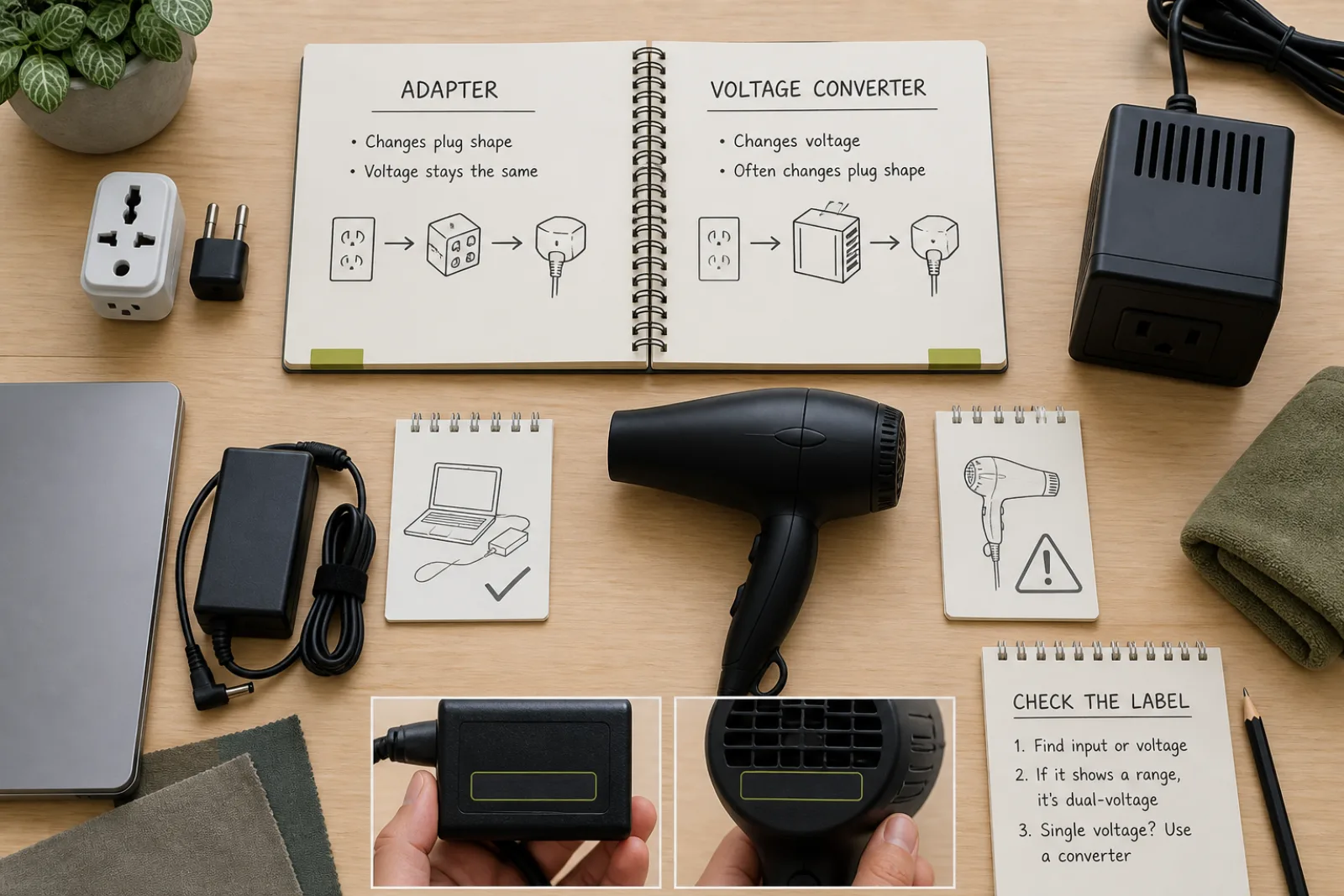
A plug adapter and a voltage converter often sit in the same aisle, sometimes in the same blister pack, and the difference between them is the single most consequential thing a traveler can get wrong about international electronics. A plug adapter reshapes a plug so it physically fits a foreign socket. It does not touch the voltage, frequency, or current coming out of that socket, it passes all of it through unchanged. A voltage converter does something different and additional: it uses a transformer to step the voltage up or down before it reaches your device. Treating the two as interchangeable is how a single-voltage hair dryer ends up smoking in a hotel bathroom, and it is also how travelers waste money buying a bulky converter for a laptop charger that never needed one.
Culture Column has not hands-on tested the specific adapters and converters in this comparison. What follows is grounded in plug-type classification standards, the real mechanics of voltage conversion, and a documented safety failure in this exact product category, so a purchase can be based on what a device actually needs at the destination, not on what a package labeled universal implies.
The two devices solve different problems and are not interchangeable. Confusing them is the most common way travelers damage electronics or start a fire.
- 01Plug adapter
Changes only the physical pin shape and layout so a plug fits a foreign socket. Voltage, frequency, and current draw from the wall pass through completely unchanged. Safe on its own only for devices already rated for the destination's voltage.
- 02Voltage converter
Uses an internal transformer to step voltage up or down (for example, 230V down to 120V) before it reaches the device, in addition to whatever plug shape it also provides. Needed for single-voltage appliances, and rated to a specific wattage ceiling that must not be exceeded.
- 03What neither one does
Neither a plug adapter nor a typical portable voltage converter meaningfully changes electrical frequency (50Hz vs. 60Hz) for most modern electronics; that mostly matters for devices with motors or mechanical timers, which are increasingly rare among travel electronics.
Checking whether a device is dual-voltage takes about ten seconds: look at the small print on the charger brick or power supply, not the device itself. If it lists a voltage range, most commonly 100-240V, it will accept the mains voltage of essentially any country and only needs its plug reshaped. If it lists a single fixed voltage, 120V only or 230V only, it needs a voltage converter sized to its wattage whenever the destination's mains voltage differs, and using a plug adapter alone on that device is the actual mechanism behind most travel-adapter horror stories: a 120V-only appliance plugged, via an adapter, straight into a 230V socket draws roughly double the current it was built for.
Underneath the voltage question is a separate, purely mechanical one: does the plug fit the socket at all. Electrical standards organizations classify the world's mains plugs into a set of types identified by letter, and a compact travel adapter's entire job is bridging a handful of these shapes. The plug on a device only needs to physically fit; it says nothing about voltage compatibility, which is why an adapter that fits perfectly can still be paired with the wrong voltage assumption.
- Type A / Type B
- 2-pin ungrounded (A) or 3-pin grounded (B), 15A rated; standard across the U.S., Canada, Mexico, and Japan
- Type C
- 2-pin ungrounded "Europlug," 2.5-16A depending on version; the most widely compatible shape, used across Europe, parts of Africa, South America, and Asia
- Type D
- 3 large round pins, grounded, 6A rated; used in India and neighboring South Asian countries
- Type E / Type F
- 2 round pins, grounded, 16A rated; France, Belgium, Poland, Slovakia, and Czechia use Type E, most other continental European countries and Russia use Type F ("Schuko")
- Type G
- 3 rectangular pins, grounded, 13A rated with a fuse built into every plug; UK, Ireland, Malta, Malaysia, Singapore, and much of the Arabian Peninsula
- Type I
- 2 or 3 flat pins in a V-shape, 10A rated; Australia, New Zealand, mainland China, and Argentina, though the exact standard differs slightly between them
- Type M / Type N
- 3 round pins, grounded, 10-20A depending on version; South Africa uses Type M and Type N, Brazil uses its own version of Type N
Plug type classification and amperage ratings: World Standards, accessed 2026-08-11
Grounding is where a mechanically fitting adapter can quietly stop protecting a device the way its original plug did. Type C is genuinely ungrounded, no earth pin, no earth clip, nothing, which is fine for double-insulated electronics like most phone and laptop chargers but is not a substitute for a real earth connection on anything that needs one. Type E, F, and G all provide grounding, but through different physical mechanisms: Type E carries the earth connection on a pin inside the socket itself, Type F grounds through metal clips on the sides of the plug, and Type G carries its own earth pin on the plug. A universal adapter that mechanically accepts several plug shapes does not automatically route all three of those grounding mechanisms straight through to its output socket; some budget models pass only live and neutral and leave the earth pin on the output side unconnected to anything. That detail rarely appears in an online listing's bullet points, and it is worth checking directly for any grounded appliance being packed.
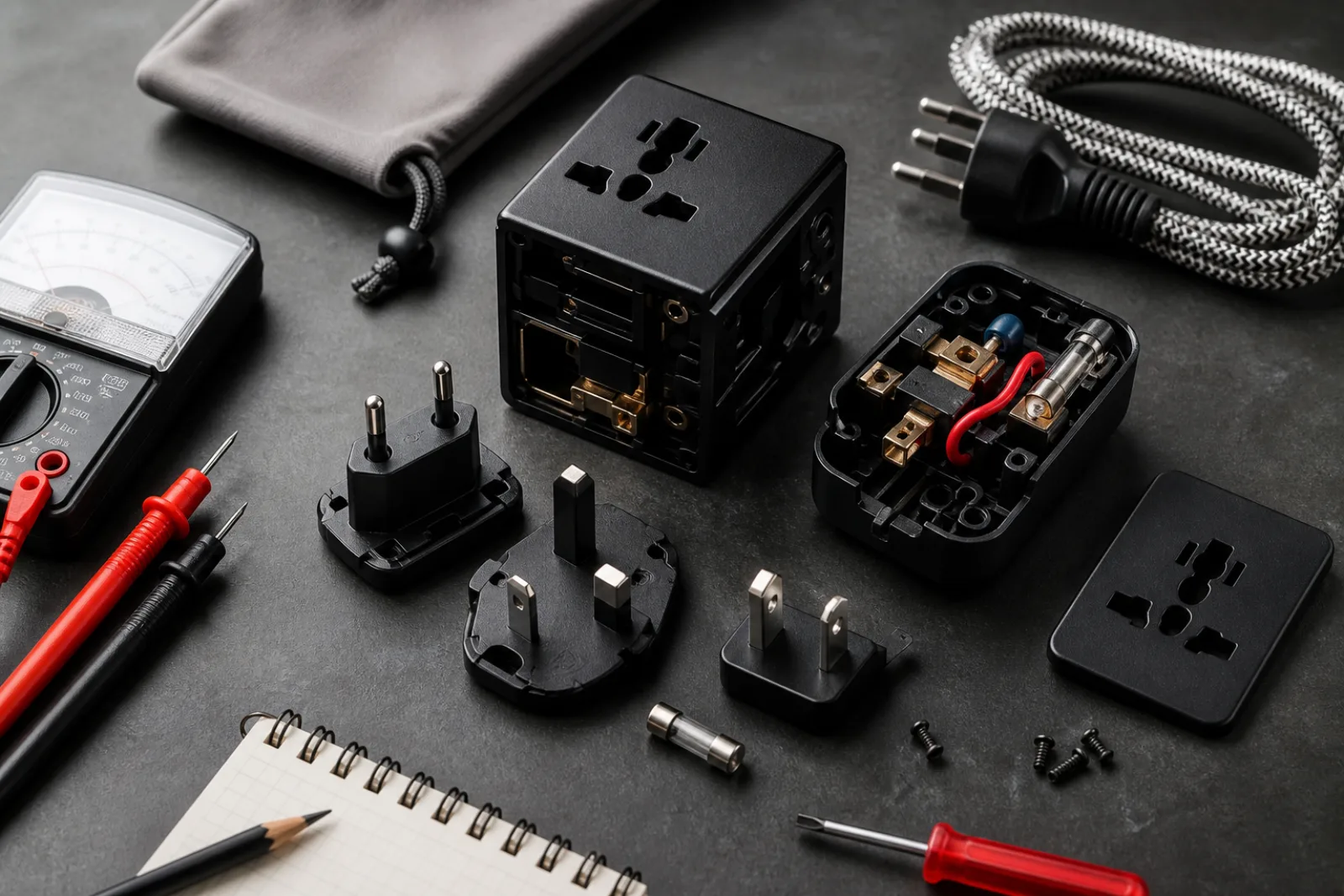
The UK's Type G standard, formally BS 1363, is unusual in building a replaceable cartridge fuse into every single plug, not just the household circuit breaker. A correctly wired BS 1363 plug carries a lower-amperage fuse for smaller loads and a higher-amperage fuse for loads up to roughly 3,000 watts, so a fault in the connected appliance blows a small, cheap fuse inside the plug itself rather than relying entirely on a breaker several rooms away. Generic universal adapters sold for UK travel often skip this fuse design and bridge the connection directly, which works fine electrically for low-draw electronics but removes a layer of protection the original UK standard was specifically built around. An adapter meant for regular use with UK plugs, built to genuine BS 1363 specifications, is a meaningfully different product from an unfused universal pass-through, even if both look identical in a listing photo.
Many travel adapters now build in their own USB output, which makes them a small charger in addition to a plug adapter, and the same power-sharing caveats that apply to any multi-port charger apply here too. Legacy USB-A ports on travel adapters commonly top out around 12 watts (5V at 2.4A), fine for older phones but slow for anything modern. Adapters with a USB-C port increasingly support USB Power Delivery, commonly in the 18-65W range, with a growing number of GaN-based combo units pushing higher; as with any multi-port charger, that wattage is typically a shared ceiling across every port on the adapter, not a per-port guarantee, so plugging a laptop and a phone into the same adapter at once usually means both get less than the adapter's headline number.
| Marketing Claim | What It Actually Means | What to Verify Separately |
|---|---|---|
| "Works in 150+ countries" | The plug pins mechanically fit that many countries' sockets | Whether it changes voltage (it almost never does) and whether grounding passes through |
| "Built-in surge protection" | Some level of protection exists against voltage spikes | The specific joule rating and let-through voltage, not just the phrase itself |
| "4-in-1 USB charging" | Four USB output ports exist on the device | The shared total wattage across those ports, not four independent full-speed ports |
| "Grounded / earthed design" | An earth pin or clip is present on the input side | Whether that earth connection is actually wired through to the output socket |
Skip any adapter or converter with no printed amperage or wattage rating at all; that omission usually means the manufacturer either doesn't know the real number or would rather it not be compared. Skip converters advertised only by a peak or surge wattage rather than a continuous rating, a hair dryer running at full heat is a continuous load, not a brief spike. And skip grounded-looking adapters for grounded appliances, space heaters, some kitchen appliances, older electronics with a 3-prong plug, unless the listing explicitly states the earth pin is wired through; a mechanically-grounded-looking adapter that isn't actually earthed is arguably worse than an obviously ungrounded one, because it looks safe.
Before you buy
- 01
A plug adapter changes only the physical shape of the plug; it never changes voltage. Only a voltage converter does that, and only up to its printed wattage ceiling.
- 02
Check the input rating printed on the charger brick, not the device body, for "100-240V" before assuming a device is dual-voltage and adapter-only.
- 03
Grounding and fuse protection vary by plug standard and by adapter build quality; a mechanical fit is not proof that earth or fuse protection actually carries through.
Questions
- 01Can I use a plug adapter with any phone or laptop charger?
Almost always yes, because nearly all modern phone and laptop chargers are dual-voltage (look for "100-240V" printed on the brick). The adapter just needs to physically match the destination's socket type.
- 02Do I need a voltage converter for a hair dryer or curling iron?
Usually yes, unless the packaging or the tool itself explicitly states dual-voltage support. Most hair styling tools are single-voltage and draw enough continuous wattage, often 800-1,800 watts, that a compact converter sized for electronics won't be rated to handle them safely.
- 03Is a universal adapter with USB ports enough for a full trip?
For charging phones, tablets, cameras, and laptops, generally yes, provided the plug pins match the destination and the device is dual-voltage. For any single-voltage appliance drawing real wattage, a universal adapter with USB ports doesn't solve that problem; it still needs a separate, properly rated voltage converter.