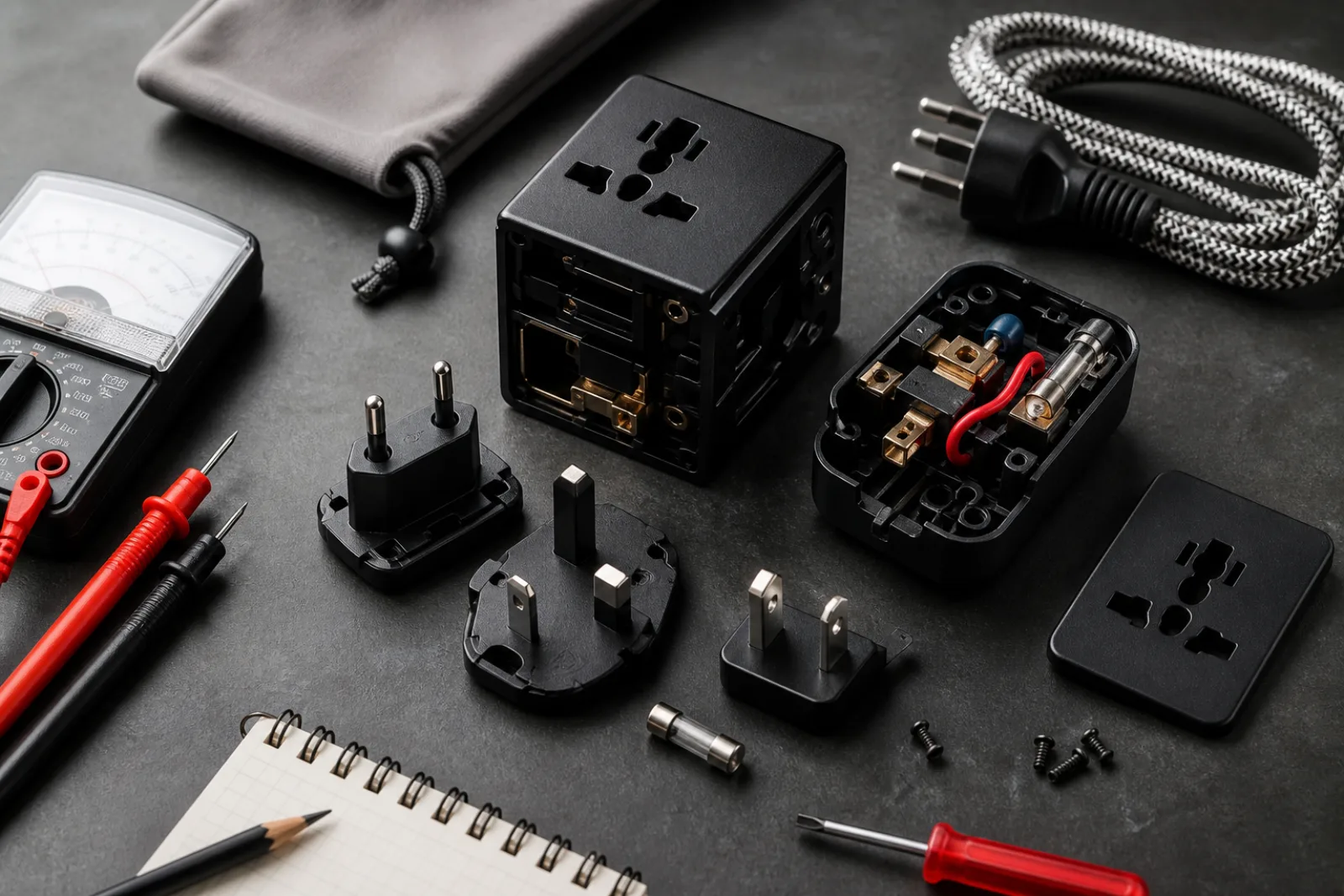
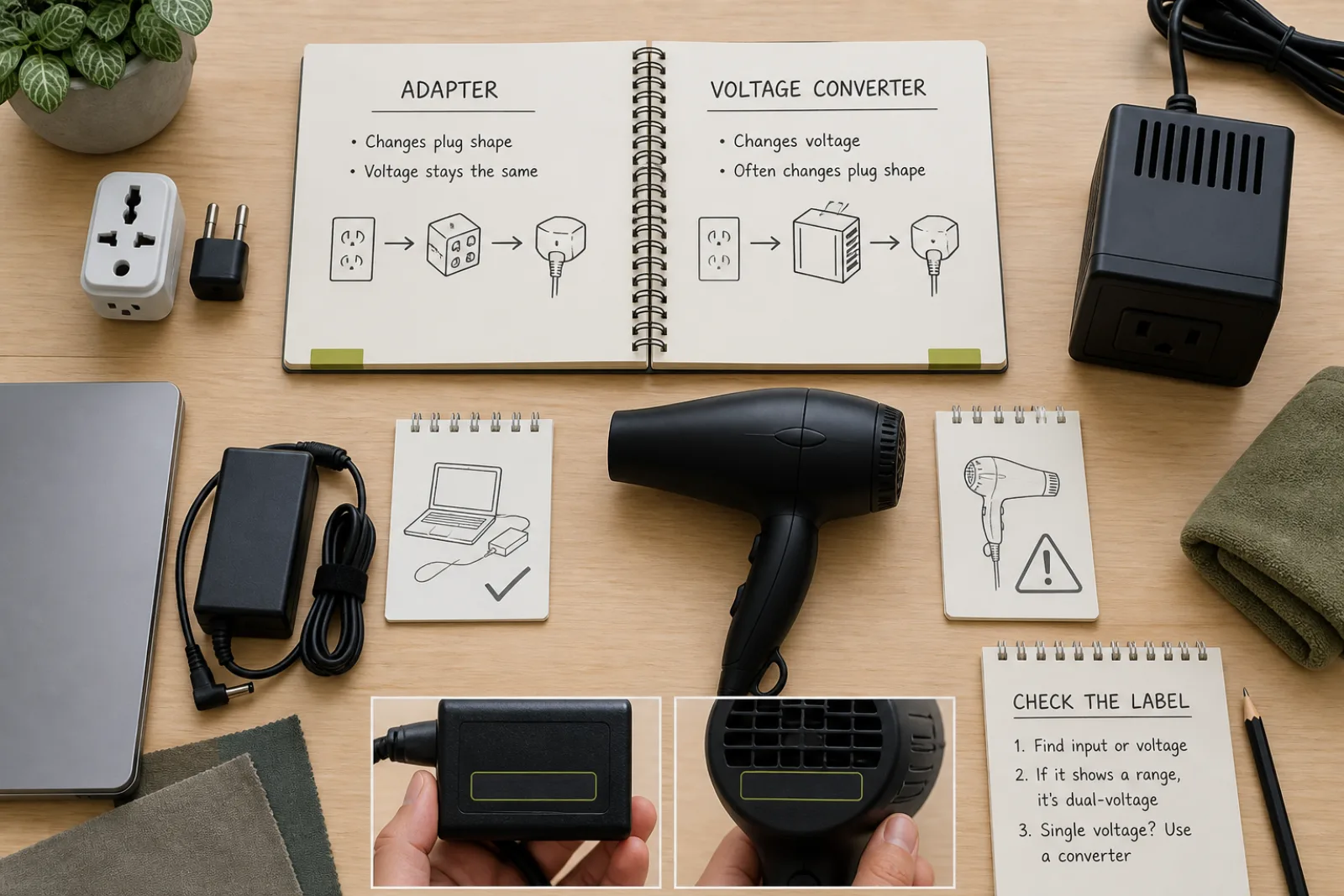
The plastic block in a travel kit does one job: it lets a plug physically enter a foreign socket. It does not step 230 volts down to 120, it does not 'convert European power,' and the USB ports on the side of a universal adapter are a separate, low-voltage circuit. The AC socket on that same adapter is a pass-through. Whatever voltage is in the wall is what comes out of the adapter's outlet.
That is why a laptop charger and a hair dryer, plugged into the same adapter in the same hotel, are not in the same situation. The charger almost certainly says INPUT 100-240V on the brick and will accept either mains. The dryer almost certainly says 120V, will try to pull twice the current it was designed for, and will smell like a mistake within seconds. The difference is printed on the device. It is not a property of the adapter.
Mains voltage is not a local quirk. IEC 60038 is the standard that names the usual values. Most of the world delivers a nominal 230V at 50Hz to ordinary wall outlets (older national figures of 220V or 240V were harmonized toward 230V). The large exception is the 100-127V, usually 60Hz, band: the United States and Canada at 120V, Japan at 100V, and a set of countries in the Americas. Plug shape is a different standard. IEC's World Plugs reference lists types A through O. Type A/B can appear at 100V or 120V; Type C/F is the common 230V European pair; Type G is the UK's 230V rectangular-pin plug. Fitting the socket and matching the voltage are two separate checks.
Read the INPUT line on the power supply, not the voltage printed on the gadget body, and not the output line (OUTPUT 5V, 20V, and so on is what the charger sends to the device after it has already done its job). A typical phone or laptop brick reads something like INPUT: 100-240V ~ 50/60Hz. That range covers Japan through the UK. Pack an adapter for the pins. Leave the converter at home.
| Object | Changes plug shape? | Changes voltage? | What it is for |
|---|---|---|---|
| Plug adapter | Yes | No. Passes wall voltage through. | Dual-voltage chargers and appliances when only the pins differ. |
| Voltage converter | Sometimes includes plug faces | Yes, usually 230V to 120V or the reverse, up to a printed wattage. | Single-voltage heating tools, for short use, if you insist on bringing them. |
| Transformer | Usually no | Yes, via windings. Heavier, meant for longer or stationary loads. | A device that will sit on a desk for weeks, not a hair dryer in a suitcase. |
Start with the INPUT line
What does the device or its charger brick print next to INPUT?
- 01What is printed as INPUT?
Look at the brick, the nameplate, or the molded text on the appliance. Ignore OUTPUT.
- 100-240V, or 110-240V, often with 50/60HzDual-voltage. You need a plug adapter only if the pins do not fit. A converter is unnecessary and, for electronics, a bad idea.
- A single voltage (120V, 100V, 230V)Single-voltage. If the wall matches that number, you need an adapter only for pin shape. If it does not, you need a converter rated above the appliance's watts, or a different appliance.
- 02If it is single-voltage, is it a heating appliance?
Hair dryers, straighteners, curling irons, travel irons, kettles.
- Yes, and it draws hundreds of wattsA travel converter's wattage ceiling is easy to exceed. Buying a dual-voltage or destination-voltage tool is usually lighter, cheaper, and safer than packing a converter sized for 1,200-1,800W.
- No, it is electronics (an older console, a clock, a single-voltage appliance)Do not use a cheap heating-element converter. Those often output a chopped waveform that electronics do not tolerate. Use a transformer rated for electronics, or do not bring the device.
Converters are sold as if they were a second adapter. They are not. A step-down converter takes 220-240V and produces something near 110-120V. A step-up converter does the reverse. Both have a wattage ceiling printed on the case, and that ceiling has to sit above the appliance's draw with margin. A 1,800W dryer on a 1,000W converter is an overload, not a clever packing choice. Many inexpensive 'travel converters' are built for resistive heating loads and produce a modified waveform. That can be survivable for a simple heating coil and hostile to motors, clocks, and anything with a switching power supply. If the device was sensitive enough to need clean power, the converter in the travel aisle is the wrong tool; a heavier transformer is the right one, and at that point you should ask whether the device belongs on the trip.
USB ports on a universal adapter are a third category. Those ports contain their own small supply that takes whatever mains you feed the adapter and puts out USB voltage. They will charge a phone. The AC socket next to them will not protect a 120V appliance. Marketing photos that show a hair dryer and a phone sharing one 'universal converter' are mixing the two paths on purpose.
- 100-127V, typically 60Hz
- United States and Canada (120V), Japan (100V), and a set of countries in the Americas. Plug types are often A/B, but plug type is not a voltage guarantee.
- 220-240V, typically 50Hz
- Most of the rest of the world, with 230V as the IEC 60038 harmonized nominal. Common plug families include C/E/F (continental Europe), G (UK, Ireland, several others), I (Australia, New Zealand, Argentina), and others in the IEC A-O list.
- What 100-240V on a charger means
- The supply already spans both bands and both common frequencies. Pin shape is the remaining problem.
- What a 120V-only nameplate means in a 230V room
- The appliance will be fed roughly double its design voltage if you only change the plug. That is a damage and fire path, not a 'it might run hot' path.
IEC 60038 (standard voltages) and IEC World Plugs, accessed 2026-08-12
The practical packing list follows from the labels, not from the destination's reputation. Phones, laptops, tablets, camera chargers, electric-toothbrush chargers, and most modern laptop-style power supplies: adapter only. A 120V-only heat tool: leave it home, buy a dual-voltage or local version, or pack a converter you have actually sized to the wattage. A CPAP or other medical device: read the specific input rating and the manufacturer's travel note; do not generalize from a phone charger. If nothing you are bringing is single-voltage, you do not own a converter problem. You own a pin-shape problem, which is smaller, lighter, and cheaper.
The whole distinction
- 01
Adapter: shape. Converter: voltage. The USB ports on an adapter are not a converter for the AC socket.
- 02
INPUT 100-240V: pack an adapter. INPUT 120V: pack a different appliance, or a converter rated above its watts.
- 03
Most trips with modern chargers never need a converter. Heat tools are the exception, and they are the items worth replacing rather than converting.
Questions
- 01My adapter has a USB-C port. Doesn't that mean it converts voltage?
It converts voltage for the USB port, which outputs USB power. The AC receptacle on the same body still passes mains through. A 120V dryer in that receptacle in a 230V country still sees 230V.
- 02Can I use a converter with a laptop charger 'just to be safe'?
If the charger is already 100-240V, a converter is unnecessary. Putting a switching laptop supply on a cheap heating-load converter can add heat, noise, and a bad waveform without adding protection. Plug the dual-voltage brick into an adapter.
- 03Japan is 100V and uses plugs that look like North American ones. Do I still need anything?
Many North American plugs will physically fit. A 100-240V charger will accept 100V. A 120V-only appliance will run under-voltage, which is a different failure (motors and heaters performing poorly) than the 230V over-voltage case. Read the INPUT line anyway; pin compatibility is not the same as voltage compatibility.