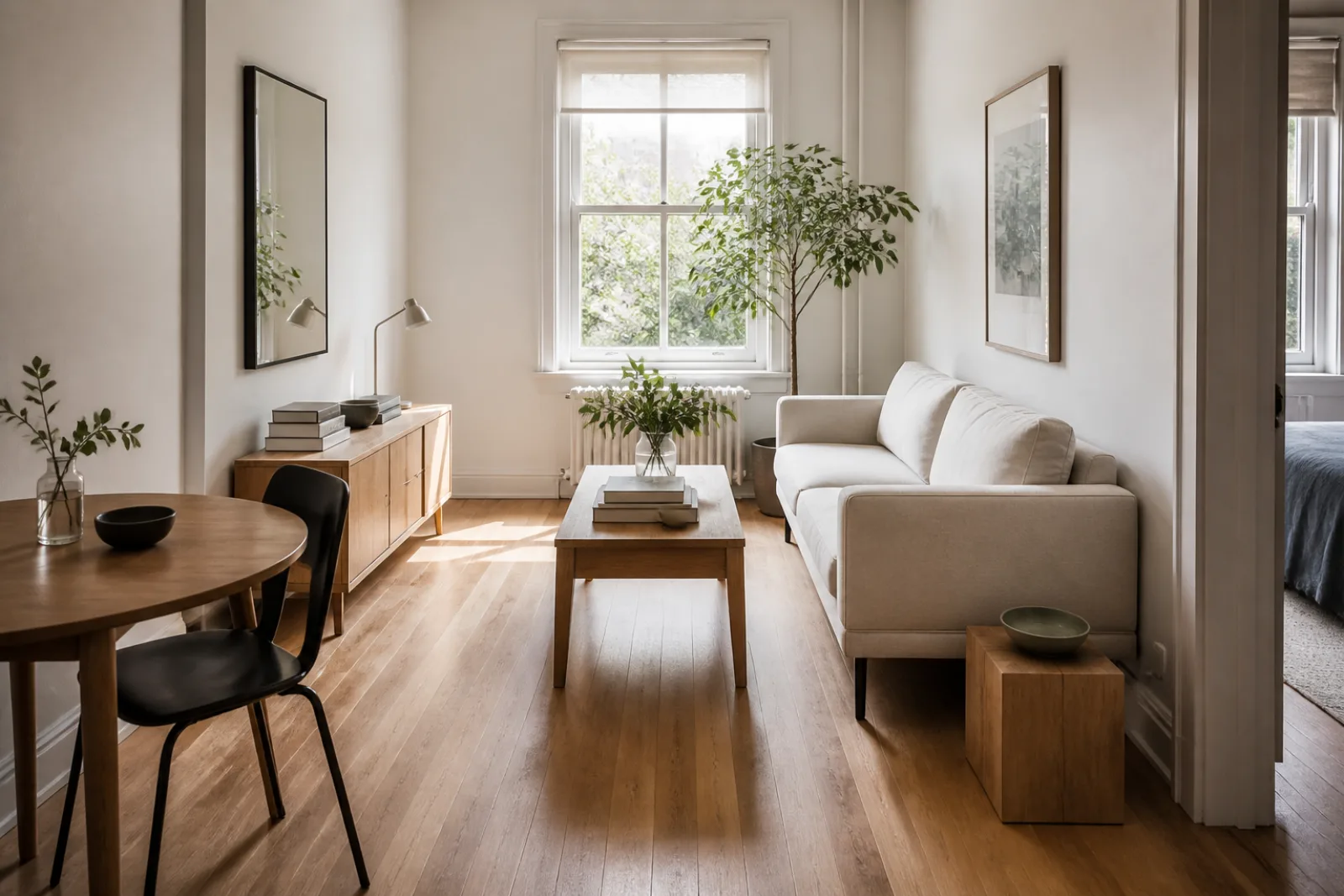
Small-room advice is a pile of unfalsifiable tips: hang curtains high, buy a round table, add a plant. Some of those change what your eyes can measure. Many of them change a photograph. The difference is worth being literal about, because a 10-by-11 room will not become a loft, and treating it like a puzzle of accessories is how it becomes a storage unit with a theme.
What you can change is how much of the room's actual surfaces you can see at once. Floor, walls, and the window are the three. If those read as continuous, the room feels larger than the same square footage chopped into dark rugs, busy shelves, and a sofa shoved against the only glass.
You are not adding square feet. You are reducing the number of times the eye stops.
- 01Floor
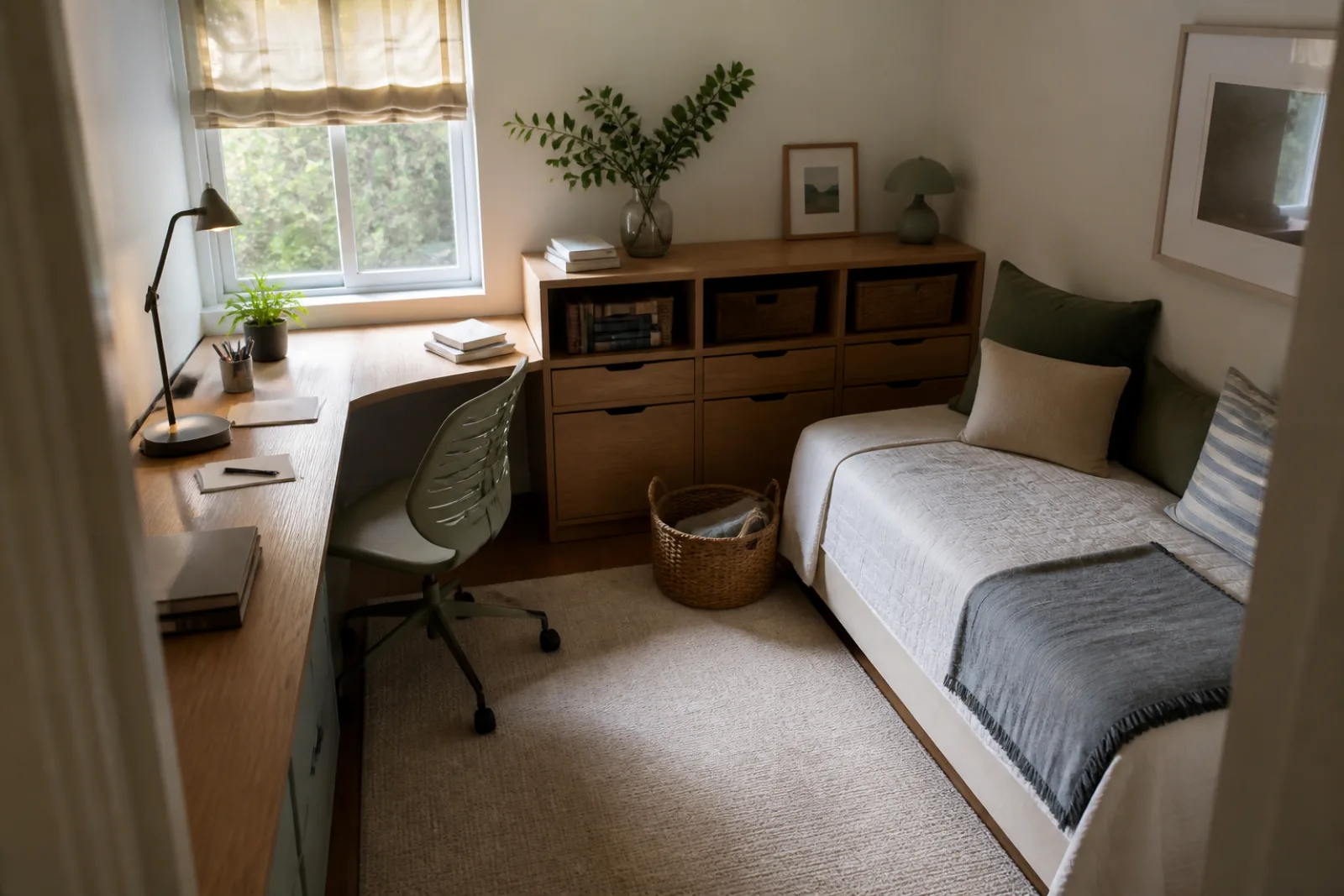
The largest plane. A continuous finish (same wood, same tile) to the walls, furniture that shows the floor underneath, and at most one rug that nearly reaches the walls. A postage-stamp rug in the middle is a smaller room drawn in fabric.
- 02Walls
One light color, including the ceiling if you can live with it. Fewer competing frames. Storage that is a closed plane (a run of cabinets, a closet) rather than a scatter of open boxes. Open shelves display your lack of space.
- 03Window
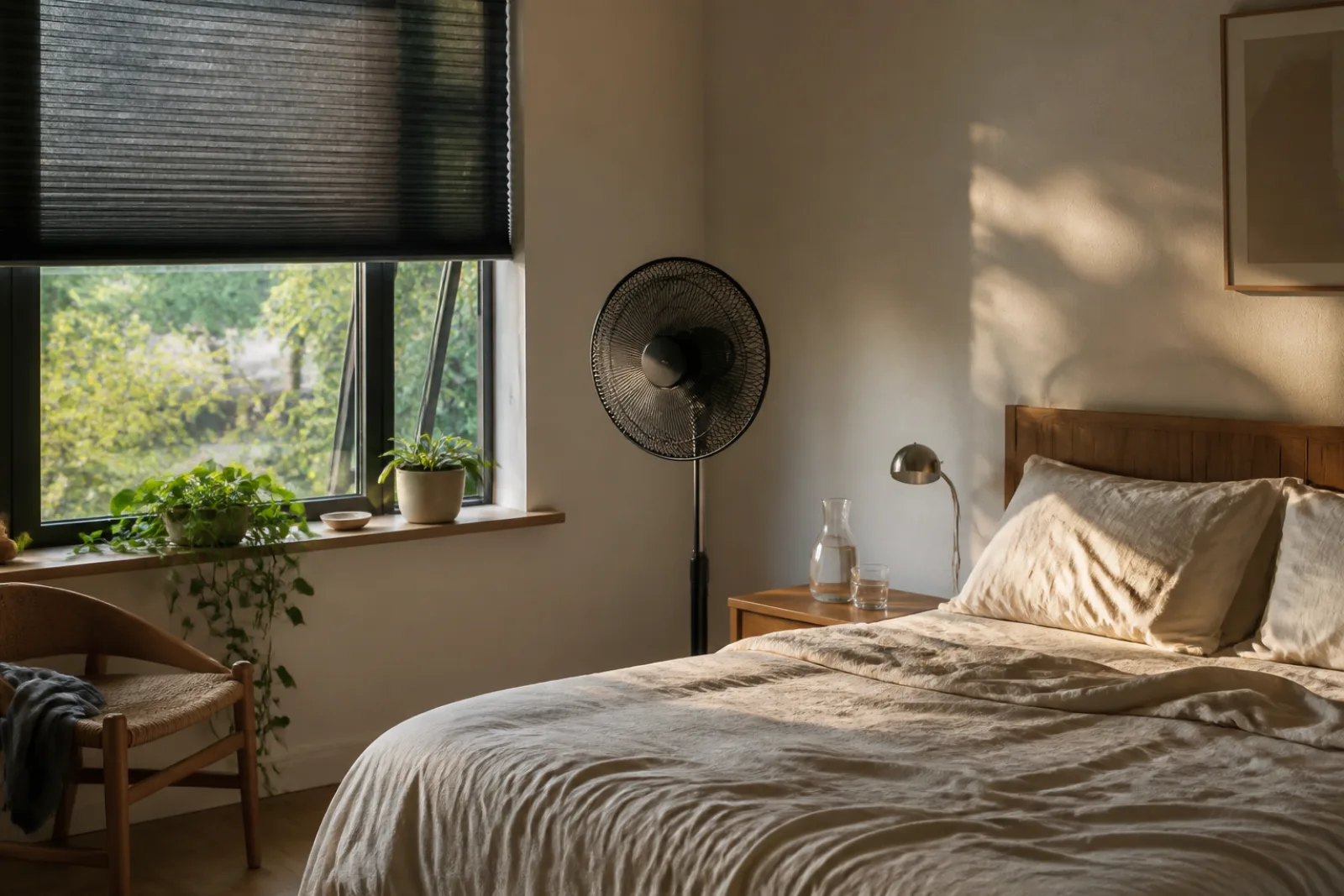
The brightness source. Do not put a sofa back against it if you have another wall. Keep the glass clean and the covering able to go fully open in the day. A blocked window is a cave with a view of upholstery.
Furniture scale is where the 'tiny pieces for a tiny room' advice fails. A chair you cannot sit in, a table that cannot hold a plate and a laptop, and a bed that makes you feel you are camping will all photograph as 'edited' and live as a waiting room. Match the largest object to the room's job: a real bed in a bedroom, a table you can work at in a studio. Then cut the extras, not the primary object. One proper sofa and a floor lamp will feel bigger than a loveseat, two poufs, a console, and a plant stand.
Legs are not a style. They are a view of floor. A skirted sofa or a platform that sits as a solid block to the floor hides the plane that tells you the room continues. If you need storage under the bed, drawers on a frame that still shows a gap at the sides are a compromise. A captain's bed that is a wooden cube is a smaller room with a mattress on a box.
Curtains hung high and wide can make a window feel larger because they change the proportion of the wall, not because they add height to the building. That trick works when the curtain is the same light family as the wall and can stack off the glass. Heavy dark drapes that cover half the wall when open are a smaller, darker room. Hang them if you like them at night. Do not leave them eating the window all day.
| Move | What it actually does | When to skip it |
|---|---|---|
| Show the floor (legs, fewer rugs) | Lets the largest plane read as one | If you need a wall-to-wall rug for warmth or acoustics, keep it large, not tiny |
| One light wall color | Fewer visual stops | A dark room you love at night; then accept it will feel smaller |
| Mirror opposite a window | Bounces light into the room | A mirror facing clutter or a blank door; you have duplicated the problem |
| Undersized furniture | Makes the room look like leftover space | Always, if the piece cannot do the job |
| Many small 'multifunctional' objects | Adds edges and decisions | If each object is not used weekly, it is clutter with a job title |
| Paint the ceiling a shade lighter than the walls | A mild lift; not a new floor | If you cannot paint, skip it. Lighting and floor will do more. |
Clutter is not a moral failing and it is the fastest way to shrink a room. Every object is an edge. A small room can hold a life. It cannot hold a life plus the staging of a life. Closed storage, even ugly closed storage, will make the room feel larger than beautiful open storage of things you do not use. The guest-room piece in this section is the same idea: empty volume you can see beats a styled surface you cannot use.
There is no reliable clinical literature that says a specific throw pillow arrangement adds square feet. There is ordinary visual perception: contrast, interruption, and light. Use those. Ignore the rest until the floor, the walls, and the window are doing their jobs.
See more of the room you have
- 01
Floor, continuous walls, and an unblocked window do more than accessories.
- 02
Size the main furniture to the job. Cut extras, not the bed.
- 03
A mirror is for light. Closed storage is for stuff. Neither is optional if the room is actually small.
Questions
- 01Will a glass coffee table make the room feel bigger?
It shows more floor, which helps, if you like living with a glass table. A wood table on visible legs does similar work and hides fewer fingerprints. The legs matter more than the transparency.
- 02Should everything be white?
Light and simple is the point, not a showroom. A warm off-white with the same color on trim will do what a gallery white does without the operating-room feeling. Many competing colors will not.
- 03What about vertical stripes or a tall bookcase?
A tall closed cabinet can read as architecture. An overloaded open bookcase reads as stuff stacked to the ceiling. Stripes are a graphic. They will not outrun a blocked window.