Spare rooms accumulate the household's undecided objects because they have a door. By the time a guest is on a train, the bed is under winter coats, the 'desk' is a folding table with a printer on it, and the only empty surface is the windowsill. Hosting then becomes a storage project with a deadline, which is why people swear they will set the room up properly and then do not.
The room that works is slightly worse at being a show bedroom and much better at being two ordinary rooms. You should be able to sleep a person in it without relocating a dresser. You should be able to work in it the other weeks without living out of boxes. That is a furniture and storage problem, not a linen problem.
If any zone only exists after a rearrange, it does not exist.
- 01Clear floor
A path from the door to the bed and from the bed to the closet or hooks. Wide enough to walk with a suitcase. Nothing stored in that path, including the vacuum, the guest's 'temporary' bags, and the ironing board.
- 02Closed guest storage
One drawer, one shelf, or one lidded bin that is empty when nobody is visiting. Your overflow does not live in it. A guest should not have to unpack onto a chair that is already holding your coats.
- 03Reversible work surface
A desk or a table that is already at sitting height, with the computer able to close or slide aside. Not a folding banquet table. Not the bed. The bed can be a daybed you sit on; it cannot be the only desk.
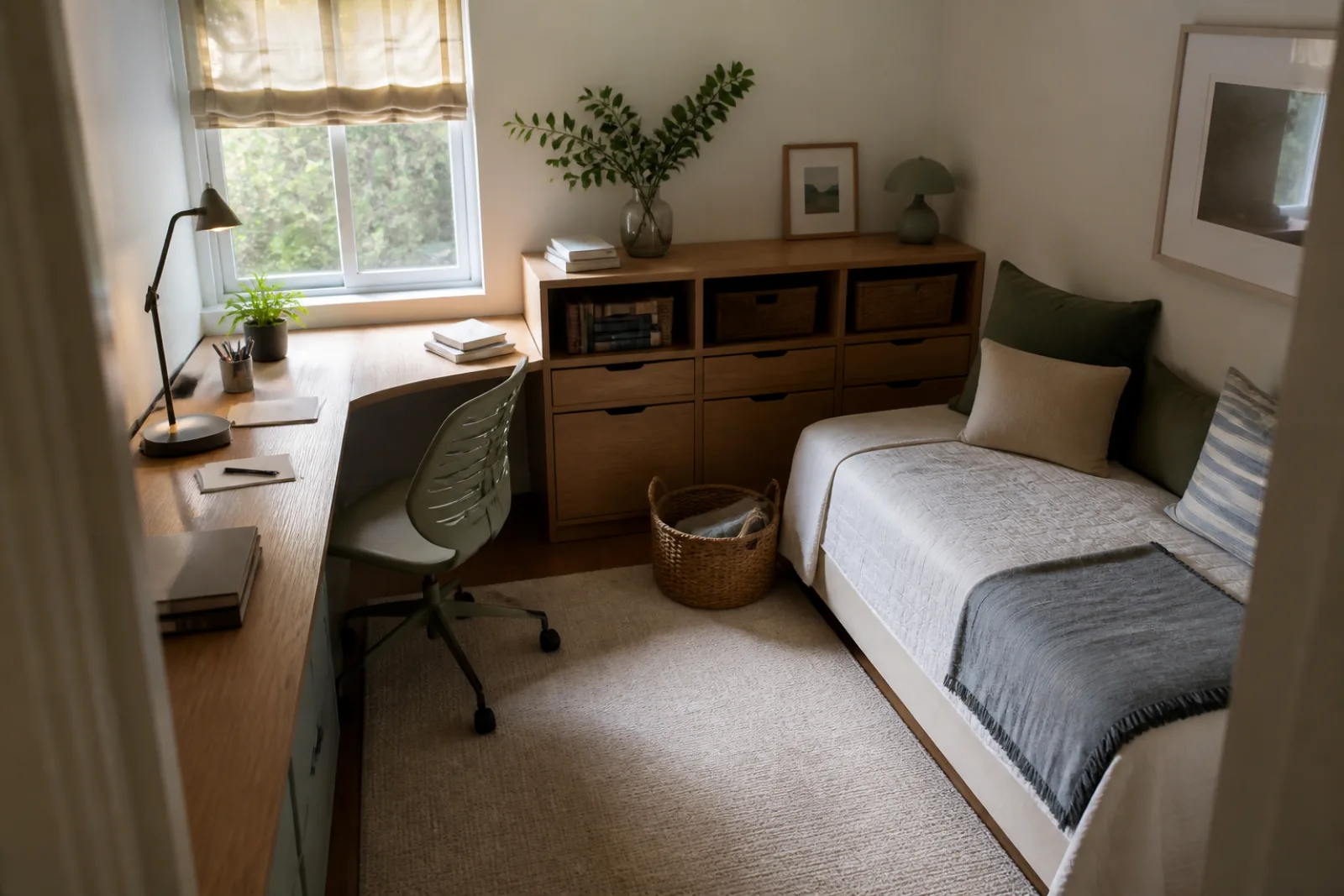
Start with the floor, because everything else is furniture theater if you cannot walk. Measure the room as a circulation problem: door swing, bed, and the path to a place to hang a coat. In a small room the bed should be the largest object and also the one that does not move. A queen that leaves a 14-inch alley is a hotel room you will hate cleaning. A full or a twin-XL with space to set a bag down will host more comfortably than a jammed queen. Daybeds and murphy-style wall beds exist for a reason; they are worth the money only if you will use the floor they free on ordinary Tuesdays. If the wall bed stays closed for months because the desk is in the way of the drop, you bought a sofa that is harder to sit on.
Closed storage is the difference between a guest room and a storage unit you apologize for. Open shelves full of your files tell a visitor they are sleeping in your warehouse. A dresser with one empty drawer, a closet with 18 inches of hanging rod kept clear, or a single under-bed box that is actually vacant gives them a place to put clothes that is not the floor. The rest of your overflow can live in labeled closed bins on a high shelf. The rule is simple and easy to break: the guest volume must be empty in the default state of the room, not emptied as a project.
| Setup | Guest-night work | What usually happens |
|---|---|---|
| Bed always made, desk already there, one empty drawer | Sheets if you use a coverlet, towels, clear the desk surface | You will do this. It is 15 minutes. |
| Sofa bed with a coffee table that must move, plus a closet full of off-season clothes | Move table, pull bed, find sheets, relocate clothes | You will do this once, resent it, and then book them a hotel in your head. |
| Office with a heavy desk where the bed should go, bed stored in pieces | Disassemble work, assemble bed, hide the office | The bed will not be assembled. The guest will be on an air mattress in the living room. |
| Daybed or always-deployed bed, wall hooks, rolling file that tucks under the desk | Change the pillow arrangement, roll the file out of the path | This is a room. Treat it like one every week so the conversion stays small. |
The work surface is where dual use usually dies. A 'desk' that is a folding table against the wall will collect boxes because folding it away is a decision. A real desk, even a shallow one, with a lamp and a closed cable situation, lets the room be an office without looking like a warehouse. When a guest comes, you close the laptop, drop the papers into the rolling file, and the surface becomes a place to set a book. If your work needs two monitors, mount them on an arm that swings aside, or accept that this room is an office that can sleep someone, not a bedroom that can host a job. Those are different primary uses. Pick one as the default.
Light, a hook, and a outlet within reach of the pillow are the hospitality details that cost little and prevent guests from living out of a suitcase on the floor. A hook on the door or a few hangers on an emptied rod beats a full dresser they will not unpack into. A lamp they can operate without your explanation beats a clever overhead on a switch by the door they will not find at 1 a.m. None of that requires a matching guest-linen aesthetic. It requires that the path, the empty volume, and the surface already exist.
A 15-minute conversion, if the room was set up for it
- 01Floor
Remove whatever drifted into the path this week. If this step takes more than two minutes, the default storage plan has already failed.
- 02Work surface
Close or dock the computer. Drop loose paper into the closed file. Leave the lamp.
- 03Guest volume
Confirm the empty drawer or bin is still empty. Add hangers. Put a spare outlet strip where a phone can reach the bed.
- 04Sleep
Sheets and towels. If the bed is a daybed, swap the extra pillows off. Do not move the frame.
- 05Door
A hook, a working lamp, a note for the Wi-Fi. You are done. If you are still sliding furniture, stop and change the furniture later, not tonight.
Default state of a working spare room
- 01You can walk from the door to the bed without moving an object.
If you cannot, the room is in storage mode.
- 02One closed volume is empty and labeled for guests even when the house is empty.
A sticky note on a drawer is enough.
- 03The desk is usable today, at sitting height, without unfolding anything.
Folding furniture counts as not having a desk.
- 04The bed frame does not move for either mode.
Linens can change. The heaviest object cannot.
Earn the square footage
- 01
Keep a path, keep an empty closed volume for the guest, and keep a desk that already exists. Those three beat nicer pillows.
- 02
If conversion requires moving heavy furniture, it will not happen, and the room will default to storage.
- 03
Choose a primary weekday use (work or sleep) and make the other use a 15-minute overlay, not a rebuild.
Questions
- 01Is a sofa bed a good dual-use solution?
It can be, if the sofa is what you already sit on every day and the coffee table is light enough to move alone. If the sofa bed is in a room you never sit in, you have bought a worse bed that is also a worse sofa. A real bed that stays deployed plus a decent chair often hosts and works better.
- 02Where do the extra pillows and the winter clothes go?
Closed, up high, or in another closet. They do not go on the guest bed and they do not go in the guest drawer. Vacuum bags are fine in a labeled bin on a shelf. They are not fine as a pile.
- 03What if the room is also the only place for a treadmill or a crib?
Then it has a third job, and something has to lose. Put the treadmill on a mat that is the 'floor' in office mode, or admit this is an exercise room with a bed and size the bed down. Three primary uses in one small room is how all three fail.