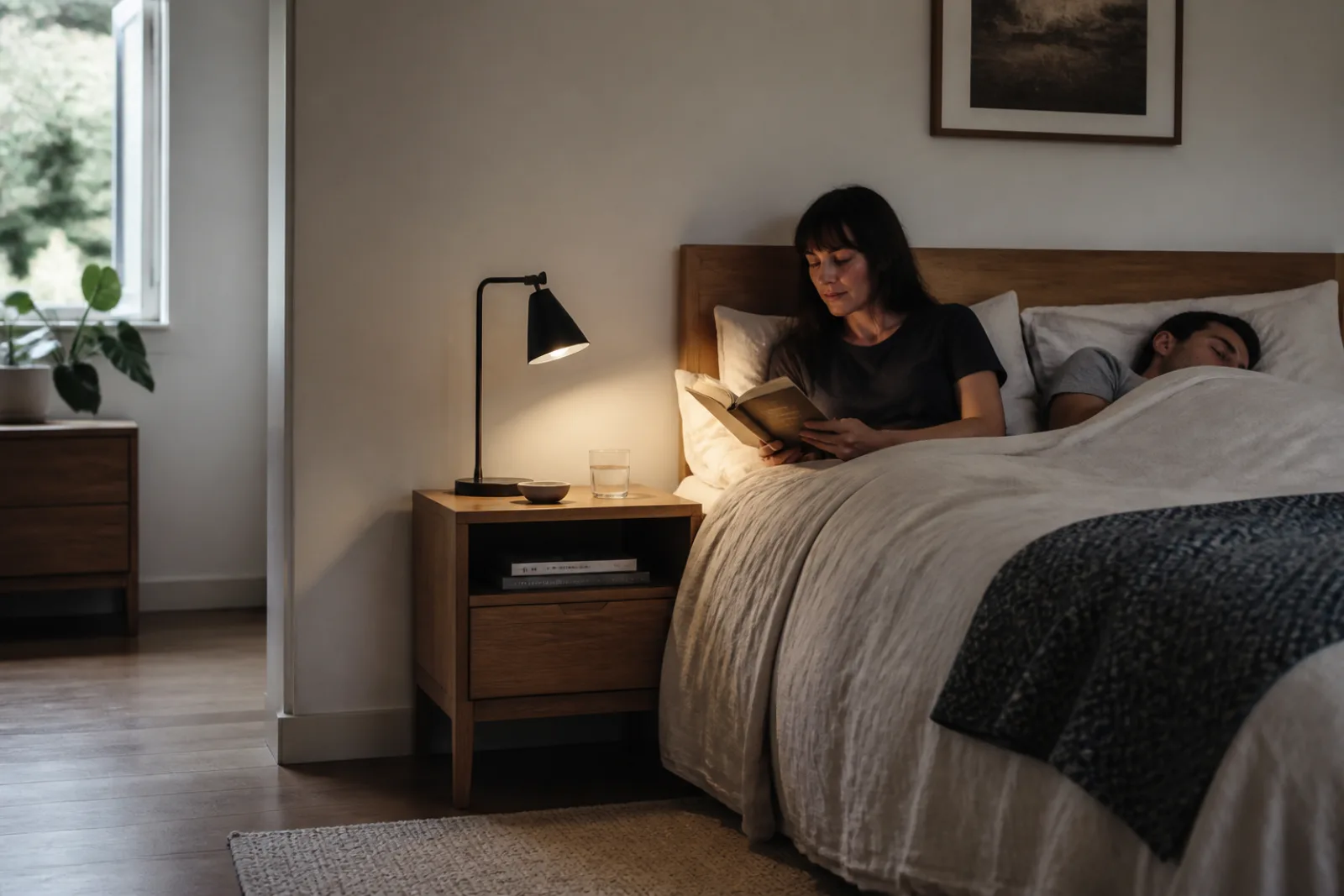
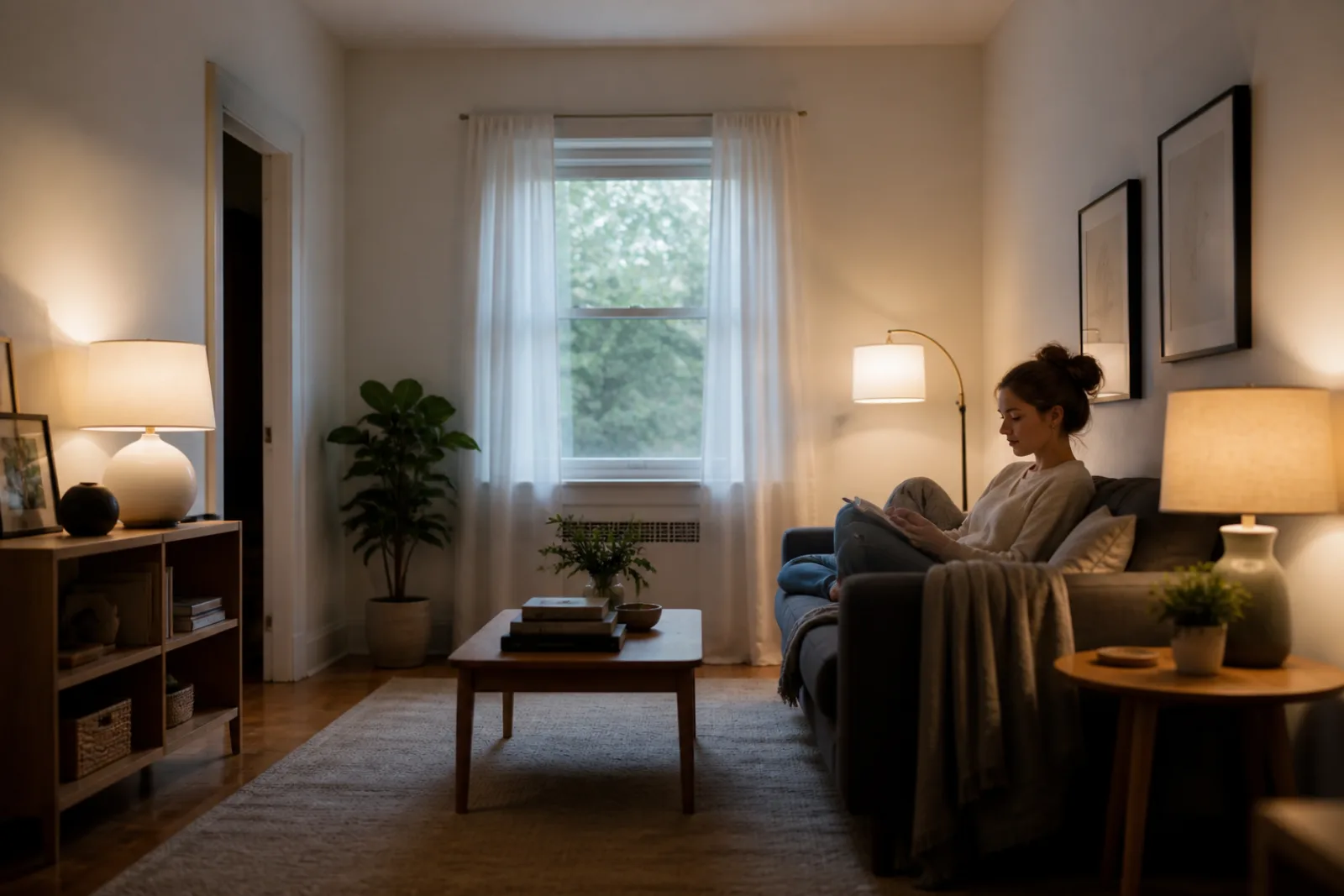
Most rentals are lit as if nobody sits down. A single ceiling fixture, often a flush-mount with a 60-watt-equivalent LED stuffed into a yellowing shade, is asked to light the kitchen, the sofa, and the hallway at once. It cannot. The box is in the middle of the ceiling because that is where the electrician ran the cable in 1987, not because that is where you read, cook, or put on shoes.
You do not need permission to plug in a lamp. You usually do need permission to add a hardwired pendant. So the useful work in a rental is portable: replace the bulb in the fixture you cannot move, then add light that lives on the floor and the desk, aimed at the surfaces you actually use, in a brightness and color you can read off the package.
The FTC requires a Lighting Facts label on general-service lamp packages. It lists brightness in lumens, estimated yearly energy cost, expected life, light appearance on a warm-to-cool scale, wattage, and whether the bulb contains mercury. Light appearance is correlated color temperature, in Kelvin. Lower Kelvin looks more yellow (about 2700K is the old incandescent living-room color); higher Kelvin looks whiter, then bluer (5000K and up reads as daylight). ENERGY STAR's purchasing checklist still maps the old wattage habit to lumens: about 450 lumens to replace a 40W incandescent, 800 for 60W, 1,100 for 75W, 1,600 for 100W.
That mapping is for a bulb in a decent shade, in a room that is not painted charcoal. A dark wall absorbs light. A narrow opaque shade throws most of the lumens into the shade, not the room. The label is necessary and not sufficient, which is why the second purchase in a dim rental is often a lamp with a light-colored, open-top shade rather than a second 1,600-lumen bulb for the ceiling.
- About 450 lumens
- Old 40W incandescent. Accent, a small lamp, a hallway that should not glare.
- About 800 lumens
- Old 60W. The default ceiling-fixture swap in a small room, or a floor lamp used as fill.
- About 1,100 to 1,600 lumens
- Old 75W to 100W. Useful in a living room floor lamp or a kitchen fixture if the shade can take the heat and the glare.
- Kelvin (appearance)
- 2700-3000K for rooms you sit in at night; 3500-4100K for kitchens and desks if you want a cleaner work light. Mixing both in one sightline looks like two different apartments.
ENERGY STAR Light Bulb Purchasing Checklist and FTC Shopping for Light Bulbs, accessed 2026-08-12
Hardwired cans and pendants are a landlord conversation. These three are not.
- 01Existing overhead
Swap the bulb for the lumen and Kelvin you actually want. Check the fixture's maximum wattage only as a heat/safety limit; an LED at 10W is almost never the constraint. If the fixture is a closed globe, pick an LED rated for enclosed fixtures so it does not overheat and die.
- 02Portable ambient
A floor lamp or a plug-in uplight that throws light at the ceiling or a light wall. This is what makes the room feel occupied instead of cave-like. Place it where you sit, not under the existing ceiling box.
- 03Task
A desk lamp, a clamp light at the counter, a reading lamp at the chair. Beam aimed at the work, shade shielding your eyes. This is the layer that makes cooking and laptops possible when the overhead is behind you.
Plug location decides more than people admit. A beautiful lamp whose cord cannot reach a outlet without a trip hazard will live in a closet. Before you buy, look at where the outlets actually are: along the sofa wall, beside the bed, under the kitchen cabinets. A floor lamp with a switch on the socket is useless if the only outlet is behind a bookcase you cannot move. A cheap plug-in dimmer or a lamp with a dimmer in the base is worth more than a smart bulb you will not set up.
Beam direction is the other half. An uplight that hits a white ceiling turns the ceiling into a big, soft source. The same lumens aimed down from a black metal shade make a pool of light on the floor and leave the rest of the room dark, which is fine in a hallway and miserable in a living room. Task lamps should sit beside the page or the cutting board, slightly in front of you, so you are not working in your own shadow. If the only overhead is behind the stove, a clamp light on the underside of a cabinet (no drilling if you use a padded clamp) does more than a brighter bulb in that overhead.
What you usually cannot do in a rental: add recessed cans, move a ceiling box, install a hardwired pendant over the table, or replace a builder-grade bathroom bar without asking. What you usually can do: change bulbs, add plug-in pendants that hang from a hook and cord to an outlet (check the lease), use tension-rod or clamp fixtures, and take every lamp with you when you leave. Spend on the portable layer. Treat the ceiling fixture as a bonus fill, not the design.
| Change | Typical permission | What it actually does |
|---|---|---|
| LED swap in existing fixtures | Almost always allowed | Fixes color and efficiency. Does not fix a fixture in the wrong place. |
| Floor lamp or plug-in uplight | Yours to take | Adds ambient fill where you sit. Highest impact per dollar in a dim living room. |
| Desk or clamp task lamp | Yours to take | Makes a counter or desk usable. Overhead behind you cannot do this job. |
| Plug-in pendant on a hook | Ask; patch the hook hole | Puts light over a table the ceiling box missed. Cord management is the whole problem. |
| New hardwired fixture | Written permission, often no | Worth it only if you will stay long enough and the landlord will keep it. |
A one-hour rental lighting pass
- 01Stand in each room at night with only the overhead on. Note where you actually sit, cut, and read, and whether those spots are in shadow.
The map of shadows is the shopping list.
- 02Read the Lighting Facts label before you buy bulbs. Match lumens to the job and pick one Kelvin for the rooms you see at the same time.
800 lumens at 2700K is a reasonable default living-room swap.
- 03Add one ambient lamp in the darkest sitting room and one task lamp at the desk or counter.
Place them by the outlets that already exist, not by the ceiling box.
- 04Use enclosed-fixture-rated LEDs in globes, and dimmable bulbs only on dimmers that list LED compatibility.
A non-dimmable LED on an old dimmer will flicker or fail early.
What to do this week
- 01
Stop shopping by watts. Use lumens and Kelvin on the Lighting Facts label.
- 02
Add portable ambient and task light where you sit. The ceiling fixture is a fill, not the plan.
- 03
Aim at the work and bounce off pale surfaces. A dark shade on a bright bulb is a heater with a glow.
Questions
- 01Will a smart bulb fix a dark rental?
It will let you dim and change color from a phone. It will not add lumens you did not buy, and it will not move the fixture. Buy the lumens and the lamp first; automation is optional.
- 02The overhead uses a weird bulb shape. Can I still swap it?
Yes, if you match the base (E26 is the common U.S. medium screw; candelabra is E12; GU10 and GU24 are twist-lock). Brightness is still lumens. Shape only has to fit the shade and the fixture's enclosed or damp rating.
- 03Is 5000K 'daylight' better for small apartments?
It can look brighter because cooler light reads crisper, but at night in a living room it often feels like a garage. Keep 5000K for a work corner if you want it, and 2700-3000K for the rest, or commit to one appearance so the rooms agree.