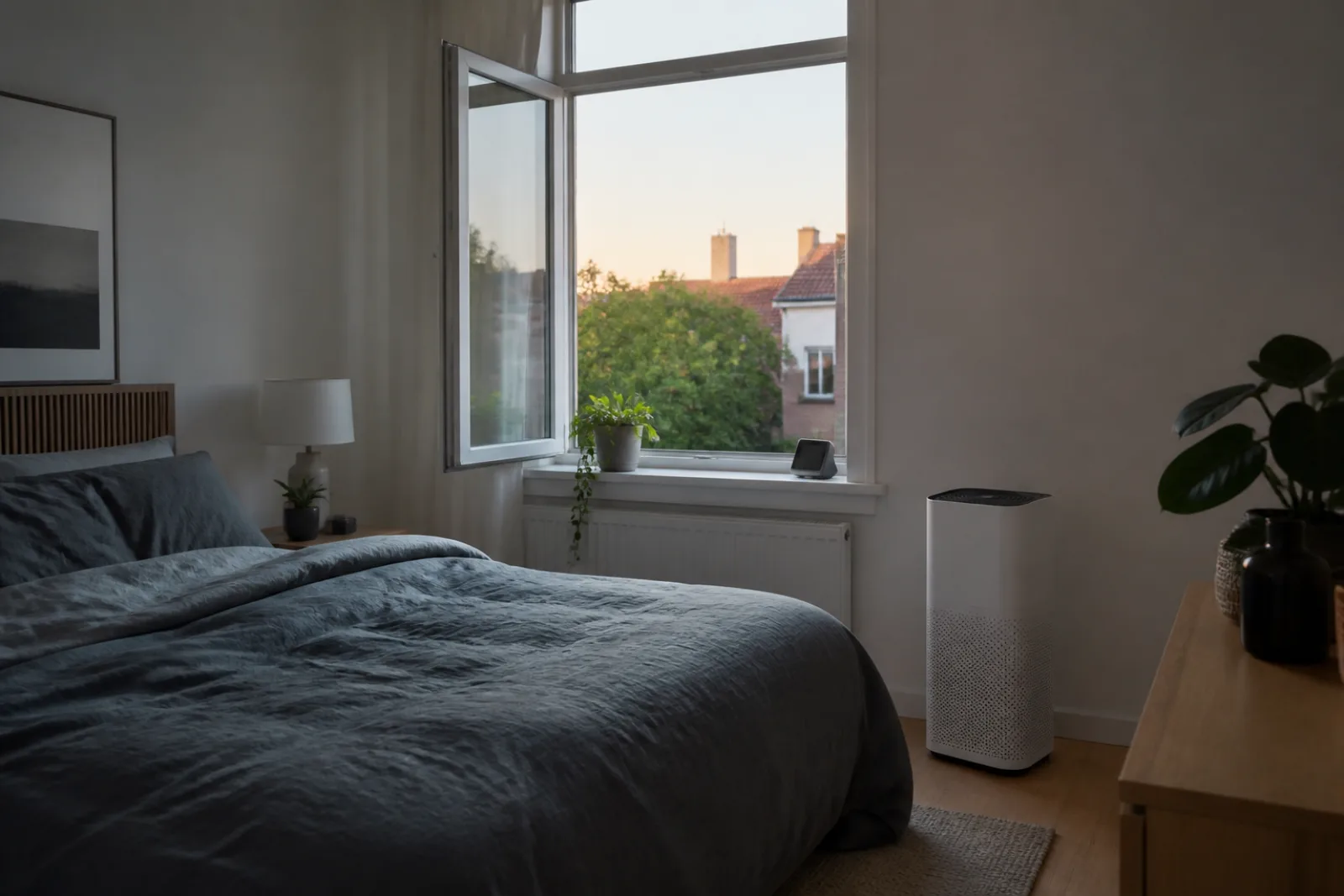
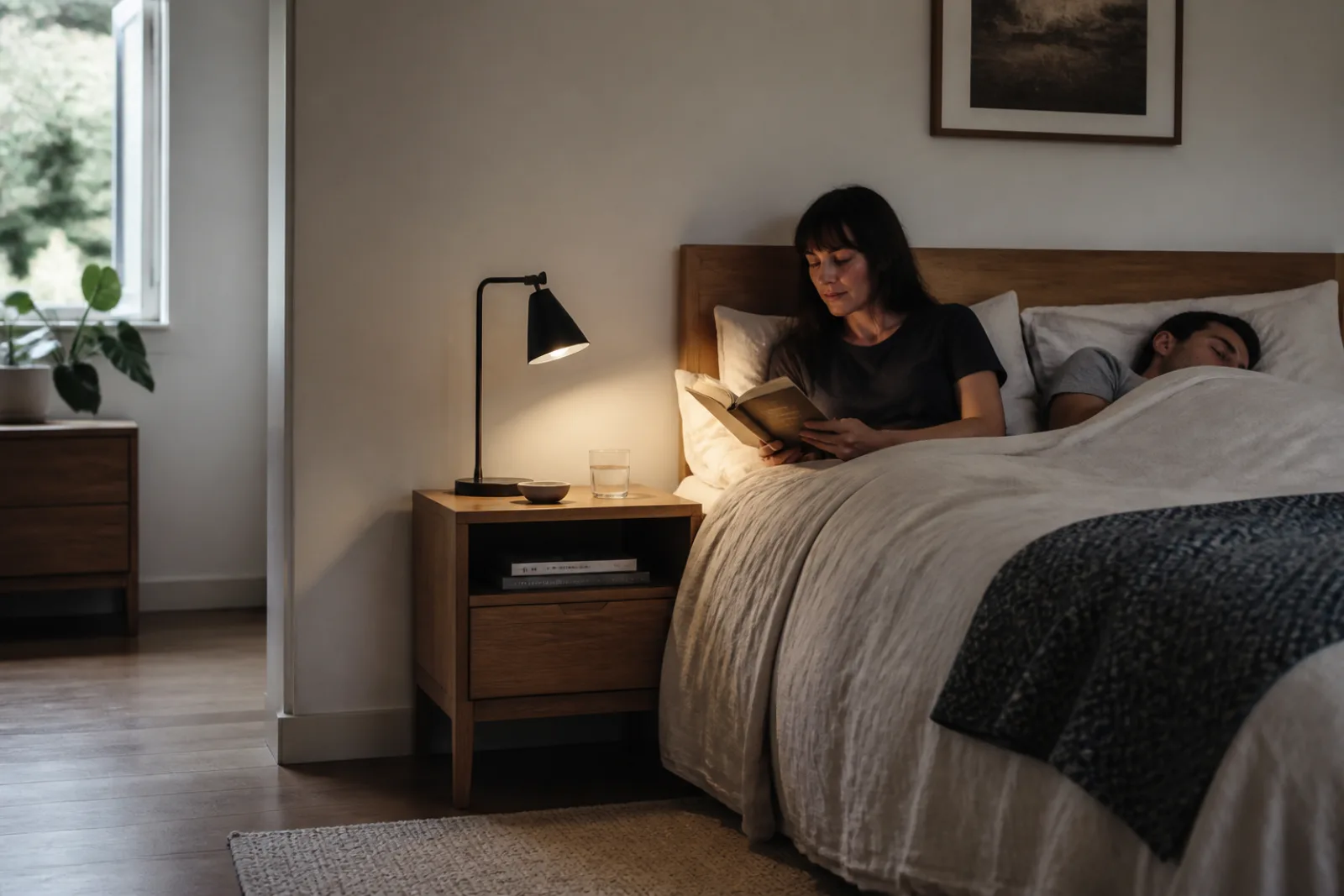
A bedside lamp has to do three things a living-room lamp does not. It has to keep most of its light off a partner's face if they are asleep a few feet away. It has to be operable by a hand that has not turned on the overhead light and is not going to, meaning by feel, not by sight. And unlike almost every other light in the house, it is typically on in the specific hour when the body is trying to wind down for sleep, so its color matters in a way a kitchen light's does not.
Brightness and style are what most bedside lamps get chosen on, and neither is what actually determines whether the lamp works at 11pm. Three physical properties do: how the shade contains or fails to contain the beam, where the switch sits and how it is operated, and what color temperature the bulb actually is.
Where the light actually goes depends more on the shade than the bulb. An opaque shade, one that blocks light from passing through the fabric itself, directs light down and out through the bottom opening, toward the page or the nightstand, rather than glowing through the shade and lighting the ceiling and walls. A translucent shade, common on linen or thin fabric styles, does the opposite: it lights the whole room, the wrong property specifically at a bedside, even though it looks identical to an opaque shade when the lamp is off. Some shades add a metallized or blackout liner for exactly this reason; if a listing mentions a liner, it is usually solving this problem on purpose.
An adjustable head or gooseneck arm that can be aimed at the actual reading surface, roughly the width of an open book or a tablet, does more for beam containment than shade material alone, because it lets the light be pointed at the page instead of at the room in general. Position matters too: the shade's bottom edge sitting at or slightly below eye level when sitting up against the headboard means the page is what gets illuminated, not the bulb itself glaring into the reader's, or a partner's, eyes. A lamp that only points straight down from a fixed position works for a book flat on the nightstand; it stops working the moment the book is held up at chest height, which is where most people actually hold one.
A switch that requires being seen to be operated fails at its one job, since the entire point of a bedside lamp is turning it on and off without turning on a brighter light first. A touch-sensitive base, where any contact with the metal or ceramic body cycles the light, solves the find-it-in-the-dark problem because the whole lamp is the target, not a small button on it; the tradeoff is that touch lamps typically cycle through fixed brightness steps in order, so going from high back to off means passing through the lower settings first. A large, fixed-position rocker switch on the base works by the same logic without that stepping tradeoff, but only if it is actually mounted on the base and not on a small inline switch partway down the cord, which moves and has to be located by patting down the cord each time. A pull chain is reliable but has a version of the same problem: it can swing out of reach or tangle unless it is routed and left in a consistent, memorized position.
A smart plug or a voice-controlled bulb removes the physical search entirely, at the cost of depending on Wi-Fi, an app, or a working voice assistant at exactly the moment a manual switch would have worked regardless. None of these mechanisms matters much if the lamp itself moves around the nightstand; keeping it in the same spot, same orientation, every single night is what actually lets a hand find the switch without looking, more than any specific switch design does on its own.
Style and brightness are what most listings lead with; these three physical properties are what actually matter once the lights are off.
- 01Shade
Opaque and downward-directing contains the beam to the page; translucent fabric lights the whole room and ceiling instead
- 02Switch
A full-base touch sensor or a large, fixed rocker on the base can be found by feel; a small inline cord switch or touchscreen panel cannot
- 03Bulb color temperature
2,700K or lower (warm white) does less to suppress melatonin at bedtime than a cool-white or daylight bulb at the same brightness
The color temperature choice is not a comfort preference; it has a specific physiological reason behind it. The brain's suprachiasmatic nucleus, the body's master clock, adjusts melatonin release based on the light the eyes take in, and light in the evening delays that release, according to the National Institute of General Medical Sciences. Not all light does this equally: research summarized by Harvard Medical School found that blue light suppressed melatonin for roughly twice as long as green light at the same brightness, a 3-hour circadian shift compared with 1.5 hours, and that light as dim as about 8 lux, roughly the output of a small table lamp, was enough to measurably affect melatonin timing. Warm white light, generally 2,700K or lower on the color temperature scale the Department of Energy uses to classify residential bulbs, carries proportionally less blue wavelength output than cool white or daylight-rated bulbs at 4,000K and above, which is why it is the recommended range for a bedside bulb specifically. Not because warm light is inherently more relaxing, but because it does measurably less to suppress the signal that is supposed to be building at that hour.
| Property | Right choice at the bedside | Wrong choice at the bedside |
|---|---|---|
| Shade | Opaque, downward-directing, ideally with a liner | Translucent fabric that glows through and lights the ceiling |
| Switch | Full-base touch sensor or a large fixed rocker on the base | Small inline cord switch or a touchscreen panel that needs to be seen |
| Bulb color temperature | 2,700K or lower, warm white, ideally dimmable | 4,000K or higher, cool white or daylight, often marketed as "crisp" or "energizing" |
Questions
- 01Does brightness matter at all, or only color and beam?
It matters less than the other two once a lamp is genuinely dim enough to read by without flooding the room; a well-shaded, warm-toned lamp at a moderate output beats a bright, unshaded, cool-toned one for both partner-friendliness and sleep timing, even at a lower lumen count.
- 02Is a warm-white bulb too dim to actually read by?
No; color temperature and brightness are independent specifications. A 2,700K bulb is available across the same range of lumen outputs as a 5,000K one, so warmth does not have to mean dim, it is a separate number on the same box.
- 03What about reading on a phone or e-reader instead of using a lamp?
Most phones and e-readers now include a night or warm-color mode that reduces blue output, which addresses the color-temperature issue, but the screen is still a small, close, direct light source rather than a shaded, diffused one, so it does not solve beam containment for a partner sleeping nearby the way a properly shaded lamp does.
The Short Version
- 01
An opaque, downward-directing shade contains the beam; a translucent one lights the whole room instead.
- 02
The switch has to be operable by feel: a full-base touch sensor or a large fixed rocker, not a small inline cord switch.
- 03
A bulb at 2,700K or lower does measurably less to suppress evening melatonin than a cool-white or daylight bulb at the same brightness.