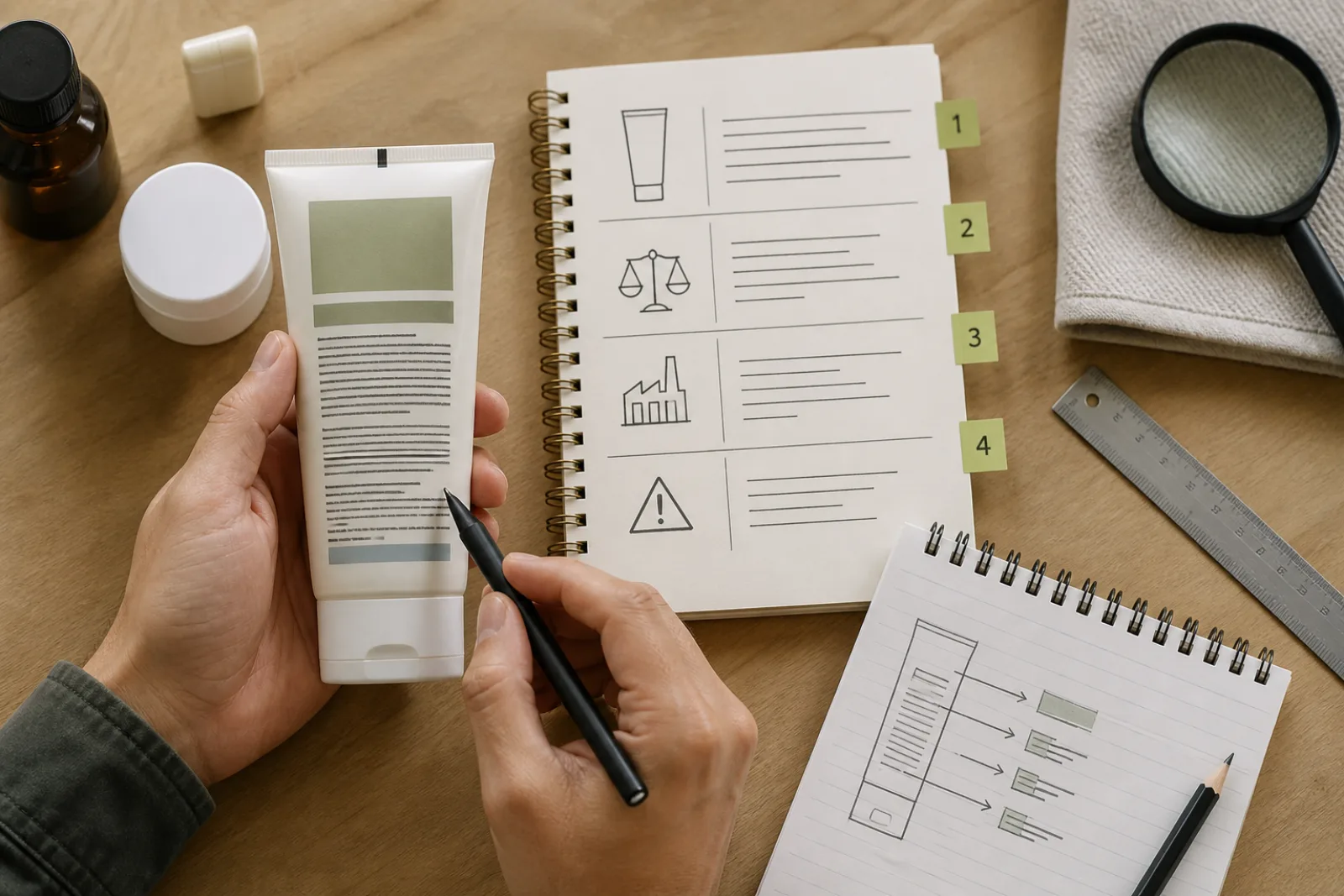
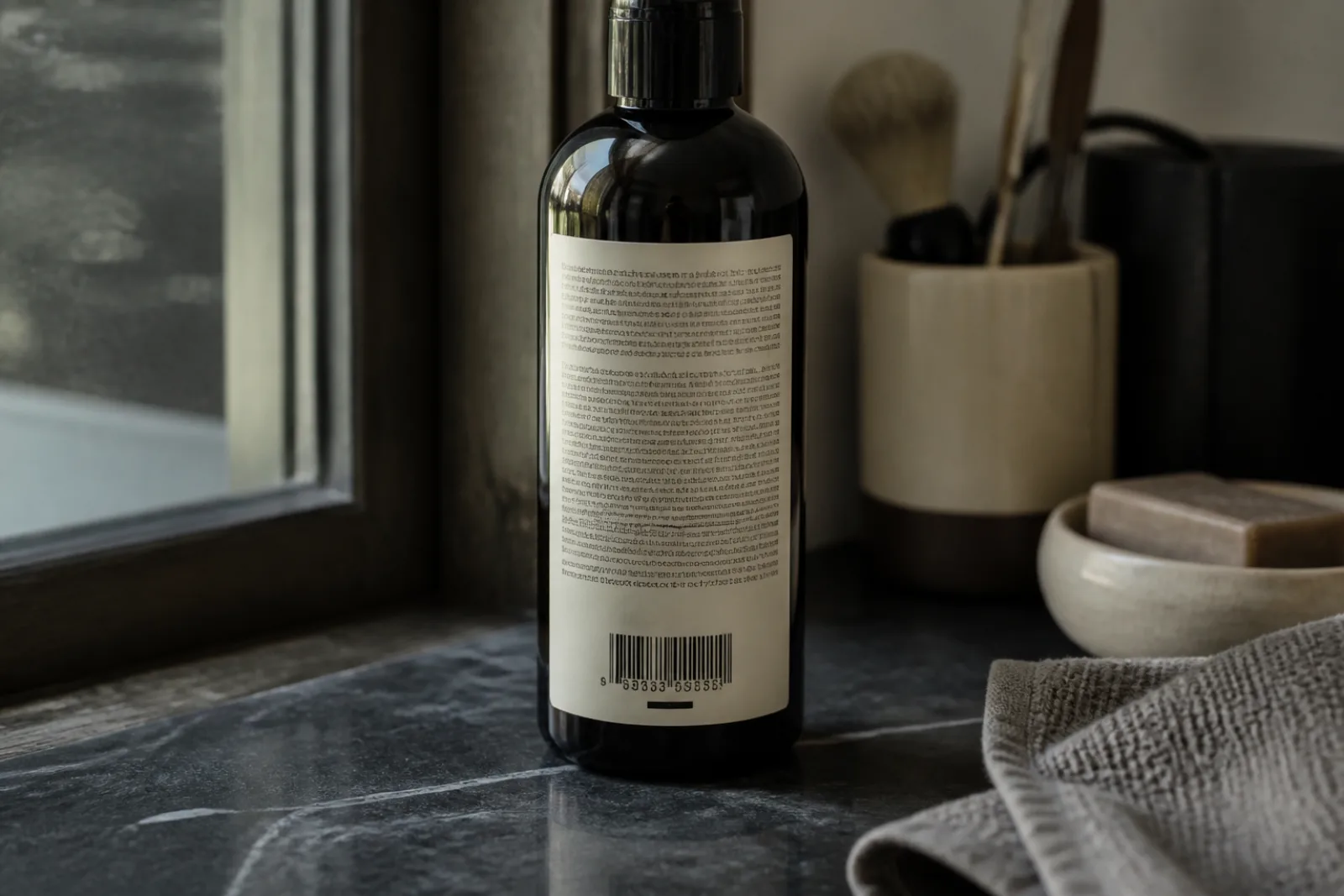
The ingredient list on a lotion is doing a specific legal job. It is not a potency ranking, not a marketing paragraph, and not a guarantee that the formula was reviewed by the Food and Drug Administration before it shipped. 21 CFR 701.3 says the package must declare each ingredient in descending order of predominance, with a short list of exceptions that are the whole reason people misread the back of the bottle.
If you want to know whether a product contains a material you react to, the list is the right tool. If you want to know how much niacinamide is in it, the list will usually refuse to say. Those are different questions, and the regulation was written for the first one.
Brands may list every ingredient in strict descending order. They may also use this grouped alternative, which is why the bottom of the list is a fog.
- 01More than 1%, not colors
Descending order by weight. This is the only block where position still means 'more than the name below it,' and even here you do not get percentages.
- 021% or less, not colors
Any order. A well-known 'hero' ingredient can sit above a preservative or below it with no concentration story attached.
- 03Color additives
Any order, after the other groups. 'May contain' is allowed for some color-matching and shaded-product cases in the same rule.
- 04Fragrance or flavor
May be listed as the word fragrance or flavor instead of the component ingredients, unless a specific ingredient is named. Trade-secret ingredients accepted by FDA may appear as 'and other ingredients' at the end.
Water (often written Aqua) sits first in a huge number of leave-on products because it is most of the weight. Glycerin, oils, and emulsifiers follow when they are the next largest pieces. That pattern is ordinary formulation, not proof of a 'watered down' scam. A rinse-off cleanser that is mostly water is still a cleanser. The useful read is the cluster of names after water: those are the structure of the product.
The 1 percent line is the trap. Below that threshold, order is optional. Internet advice that 'if it is not in the first five ingredients it does nothing' is not a regulation and is not chemistry. A UV filter in a cosmetic-only moisturizer, a fragrance allergen, or a preservative can be effective, irritating, or both at well under 1 percent. The list tells you they are present. It does not tell you the dose.
Names are supposed to be the established labeling names, which in practice are usually INCI-style identifiers (the Latin binomials and the technical names). That is why tocopherol is vitamin E and why a plant appears as a species plus a part (leaf extract, seed oil). Learn the INCI for the few materials you care about (a fragrance allergen, a specific oil, a preservative family) and search the panel for those strings. Do not reverse-engineer a folk name from a pretty front label and assume it must appear that way on the back.
| Question | Can the list answer it? | Why |
|---|---|---|
| Is this material in the product? | Usually yes, if it is not hidden inside fragrance or a declared trade secret | Each ingredient must be named, with those exceptions |
| Is there more water than oil? | Often, if both are in the >1% block | Descending order still applies above 1% |
| What percent is the '10% vitamin C' claim? | Not from the list alone | No percentages are required on the INCI panel. Front-of-pack claims are a separate, often marketing, statement |
| What is in the fragrance? | Not unless the brand lists components | 701.3(a) allows the word fragrance |
| Did FDA approve this formula? | No, and the list is not that approval | FDA does not pre-approve most cosmetics. Color additives are the main pre-market exception |
If the product is also a drug (sunscreen is the everyday example), the Drug Facts box lists active ingredients with percentages, and the cosmetic ingredient list is the rest. Do not look for SPF in the INCI paragraph. Look for the Drug Facts panel. A 'moisturizer with SPF' that lacks that panel is a labeling problem, not a reading-comprehension problem.
Warnings and the intended use still matter more than a trendy extract's position. A product that gets into the eyes, is for children, or makes a drug claim is in a different regulatory bucket. The ingredient list will not save you from a product used other than as directed, and it will not disclose exact concentration for most cosmetics, which is the caveat the old template kept repeating because it happens to be true.
Read it as a predominance list
- 01
Above 1%, order still means more-to-less. At 1% and below, order may mean nothing.
- 02
Fragrance can be a single word covering many materials. Search the list for the specific INCI you need to avoid.
- 03
The panel tells you presence, not dose, and not FDA pre-approval.
Questions
- 01Why do European bottles list extra fragrance allergens?
The EU requires disclosure of certain fragrance allergens above set thresholds. U.S. 701.3 still allows the collective word fragrance. A U.S. label can be thinner on that point even when the formula is the same. If you need those names, look for an EU-style list or a brand that publishes the breakdown.
- 02Is 'unscented' the same as fragrance-free?
Not reliably. Unscented products sometimes include masking fragrance so the base does not smell. Fragrance-free is the claim that means no added fragrance materials, and you still check the list for parfum, fragrance, and aroma.
- 03The front says 20% something. The INCI has it near the end. Which is lying?
Maybe neither, if that 20% is a solution (20% of a 10% solution is 2% in the formula) or if the name on the front is a blend. Maybe the front is marketing. The INCI will not settle a percentage fight. Treat large front-of-pack percentages as claims to verify with the brand, not as something the ingredient order can confirm.