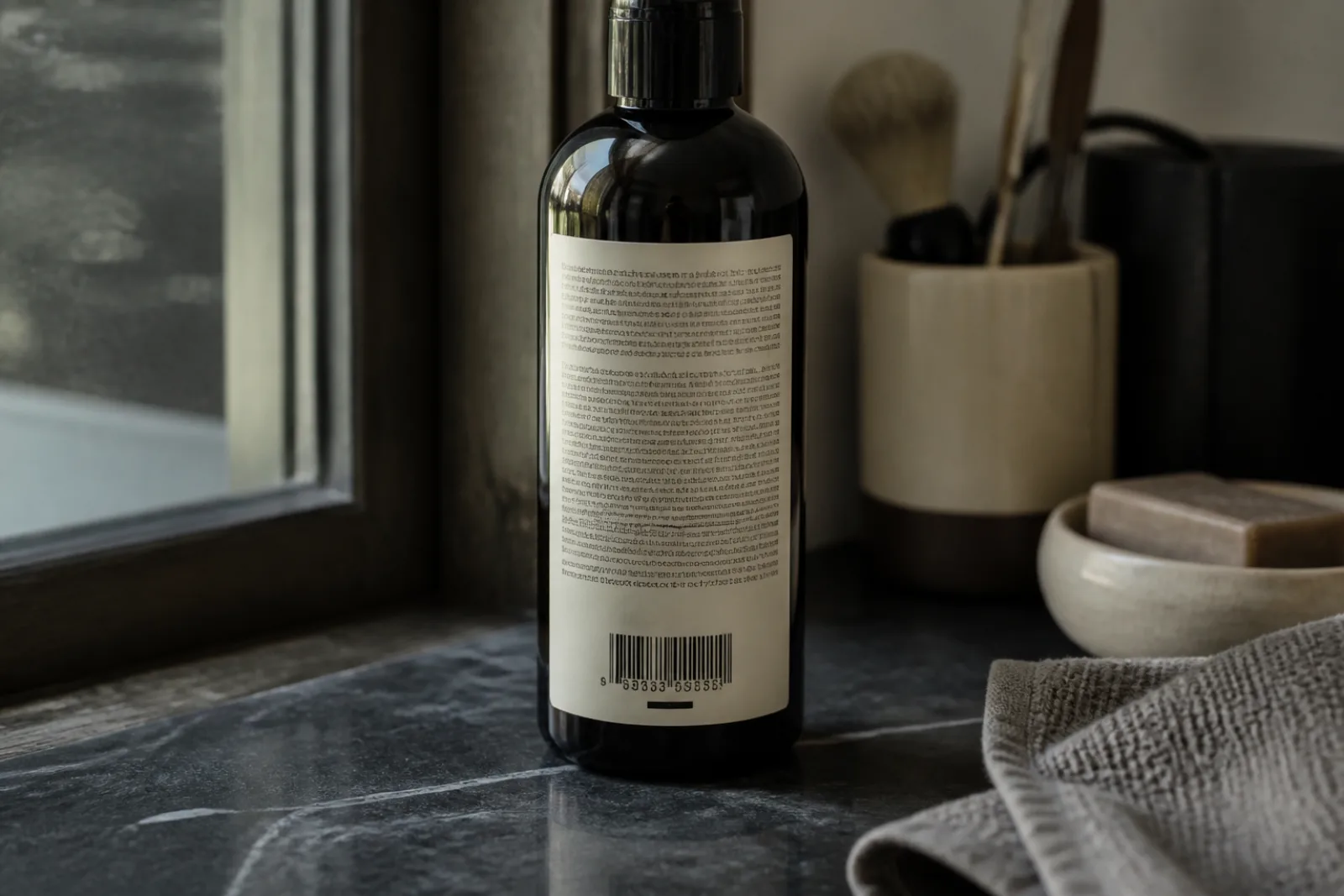
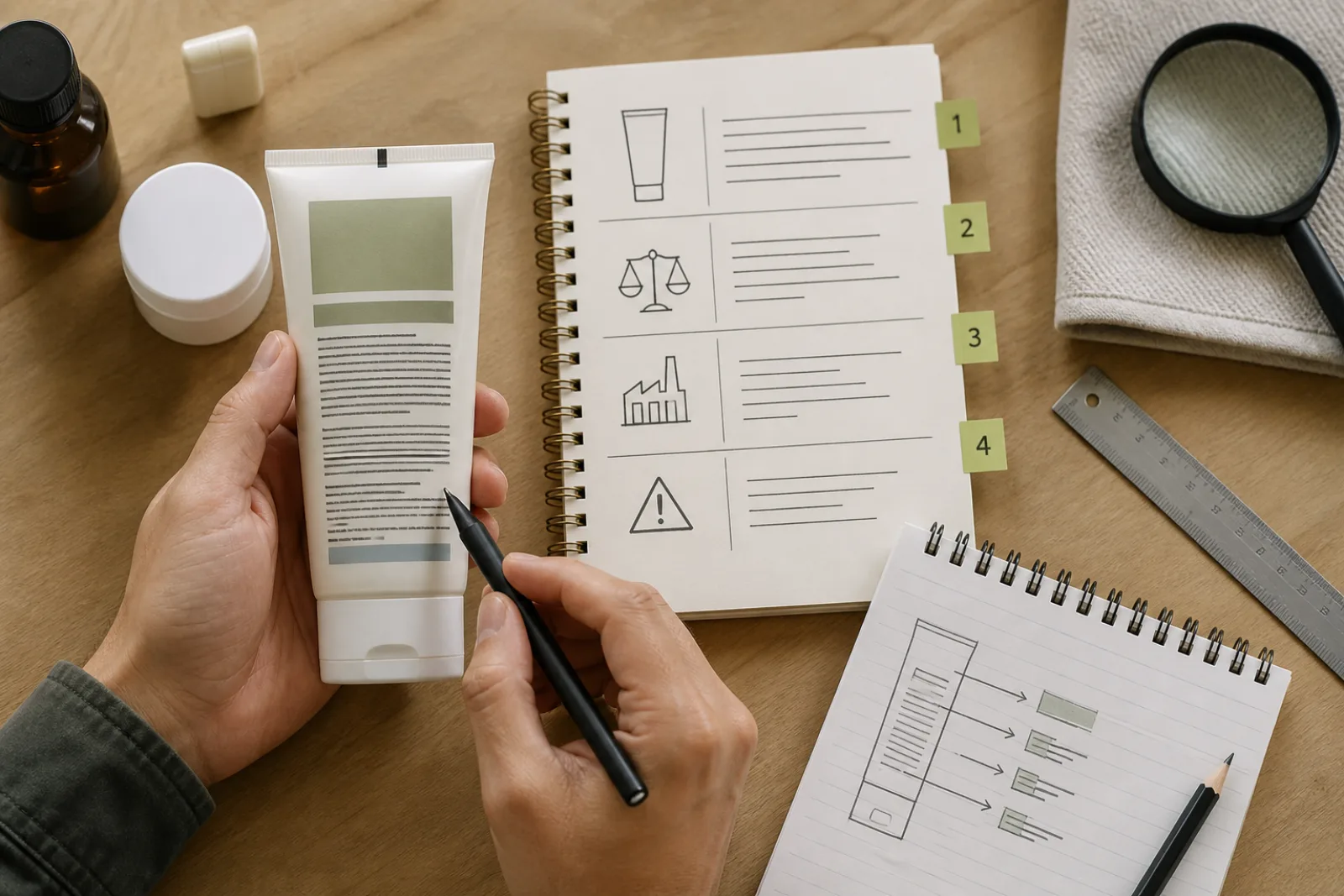
Most people open a cosmetic by flipping it over and hunting for a villain in the ingredient list. That is a reasonable instinct, and it is a different article. This page is the rest of the package: the identity line, the net-quantity statement, the responsible firm's name, and the warnings that actually have legal force. Those lines tell you what you bought, how much of it there is, and who to write if something goes wrong. They do not tell you that the Food and Drug Administration sat with the formula before it shipped.
Under the Federal Food, Drug, and Cosmetic Act, cosmetics (with the important exception of color additives) are not subject to FDA premarket approval. Firms are responsible for safety and for truthful labeling. A complete, boring label is the consumer's main window into that system. A glamorous front with no quantity, no identity, and no address is not a vibe. It is how a product gets called misbranded.
U.S. cosmetic labeling splits the package into the face you see on the shelf and the panel that carries the firm's identity and the ingredient declaration.
- 01Principal display panel
The part most likely to be shown at retail. 21 CFR 701.11: a statement of identity in bold type, reasonably related in size to the most prominent print, parallel to the base. 21 CFR 701.13: net quantity, generally in the bottom 30 percent of that panel, not dressed up as a giant pint.
- 02Information panel
Usually the panel to the right of the PDP. Name and place of business of the manufacturer, packer, or distributor (21 CFR 701.12). Ingredient declaration (21 CFR 701.3). Required warnings and directions when the rules demand them.
- 03What is missing on purpose
An FDA approval number. A percentage breakdown of every extract. A guarantee that 'natural' means anything in federal cosmetic law. Those absences are the legal design, not a printing error.
Identity is the product's name for legal purposes, not the campaign slogan. 21 CFR 701.11 allows the common or usual name (shampoo, lip gloss), a descriptive or fanciful name the public already understands, or an illustration of the intended use. If the front says 'elixir' and you cannot tell whether it is a face oil or a drink, the identity statement has failed. That failure is how FDA warning letters describe misbranded cosmetics: no statement of identity the public can use.
Net quantity is how you compare two jars without being hustled by bottle shape. Liquids are declared by fluid measure, solids and viscous products by weight, unless a firmly established custom says otherwise. The declaration must be a distinct item, separated from other copy, and it must not use qualifying words that exaggerate the amount. 'Giant' next to a unit of measure is the example the regulation itself kills. For packages under four pounds or one gallon, you will often see ounces plus a parenthetical in pounds or quarts. That dual statement is for value comparison, which is the Fair Packaging and Labeling Act's original point.
The firm line is the adult in the room. 21 CFR 701.12 requires the name and place of business of the manufacturer, packer, or distributor. If the label says 'distributed by' a company in New Jersey, that is who FDA and you can find. A brand that exists only as an Instagram handle is not a substitute. Street address may be omitted if the firm is listed in a current city or telephone directory, which is a 1970s sentence still in the Code. In practice, look for a real city, state, and a way to send mail.
| Question | Typical cosmetic | If it is also (or instead) a drug |
|---|---|---|
| Did FDA approve this formula before sale? | No, except color additives used in cosmetics | Over-the-counter drugs follow a monograph or an application. That is a different statute and a different label. |
| What must the front say? | Identity and net quantity | Drug facts, active ingredients, and uses, in addition to identity and quantity rules that still apply |
| Can it claim to treat a disease? | Not without becoming a drug in FDA's intended-use analysis | Yes, if the claim and the active ingredient match the drug rules |
| What if safety was not substantiated? | 21 CFR 740.10: conspicuous warning that safety has not been determined, or the product is misbranded | Drug safety and labeling follow drug law, not this cosmetic warning shortcut |
21 CFR 740.10 is the sentence almost nobody quotes and everybody assumes. Each ingredient and the finished cosmetic must be adequately substantiated for safety before marketing. If that work was not done, the principal display panel must carry a conspicuous warning that the safety of the product has not been determined. You will rarely see that warning on a Prestige counter, which does not prove the file exists. It proves the brand is not volunteering the warning. Absence of 740.10 language is not an FDA gold star.
Some products must carry specific warnings regardless: certain aerosols, coal-tar hair dyes, feminine deodorant sprays, children's bubble bath. Those are in 21 CFR Part 740. If the product could be unsafe when used incorrectly, directions for safe use are a material fact. A peel that says 'leave on overnight' with no caution about eyes is not being mysterious. It is being thin.
A sunscreen that claims to protect against sunburn is a drug, even if it also moisturizes. A toothpaste with fluoride is a drug. A lotion that only moisturizes is a cosmetic. Intended use, including the claims on the label and in ads, is how FDA draws that line. If you are reading a 'serum' that promises to treat eczema, you are no longer only in cosmetic-label land. That is why this page stays on identity, quantity, responsible firm, and warnings, and sends ingredient-order questions to the companion piece.
Read the required lines first
- 01
Identity and net quantity on the front. Firm name and address on the information panel. Then the ingredient paragraph.
- 02
No FDA premarket approval for most cosmetics. Color additives are the main exception. A pretty label is not a review.
- 03
A 740.10 warning means safety was not adequately substantiated. No warning does not mean FDA checked.
Questions
- 01Why is the net weight in the bottom third of the front?
21 CFR 701.13 generally puts the quantity statement in the bottom 30 percent of the principal display panel, parallel to the base, so you can find it the same way on every package. Tiny packages (5 square inches of PDP or less) get some relief from that placement rule.
- 02The jar looks huge. The label says 1.7 oz. Who is lying?
The quantity statement is the legal amount, exclusive of wrappers. Bottle shape is marketing. Compare ounces, not silhouettes.
- 03Is 'unscented' a required term?
No. Unscented can still contain fragrance materials used to mask odor. Fragrance-free is the stronger everyday claim, and even that is not a defined federal cosmetic term with a single test. Read the ingredient list for the word fragrance.