A small bathroom is really two different environments sharing one room. The area around the sink is humid but fairly stable. The shower is a humidity spike: running hot water pushes the room's relative humidity up into the 70 to 90 percent range within minutes, according to medical guidance on medicine storage. That gap matters more than square footage when deciding where anything actually goes.
The fix is to sort by two things at once: how often you reach for an item, and how much moisture it can tolerate. Daily, moisture-tolerant items stay closest to the sink and shower. Backups get consolidated in one place instead of scattered across three half-open boxes. And anything humidity-sensitive, especially medicine, leaves the bathroom entirely.
Daily items belong on an open shelf, the front shelf of a medicine cabinet, or a shower caddy, somewhere that takes no more effort to use than to put back. That means a toothbrush and toothpaste, daily face wash, a razor, and daily moisturizer stay out in the open, not tucked behind other things in a cabinet. A multi-tier shower caddy, hung from the shower head or a tension pole, holds the three to five products used every single shower: shampoo, conditioner, body wash, and a razor. Caddies with drain holes matter here; a solid-bottomed basket just becomes a shallow pool that keeps bar soap wet and lets mildew build up underneath the bottles.
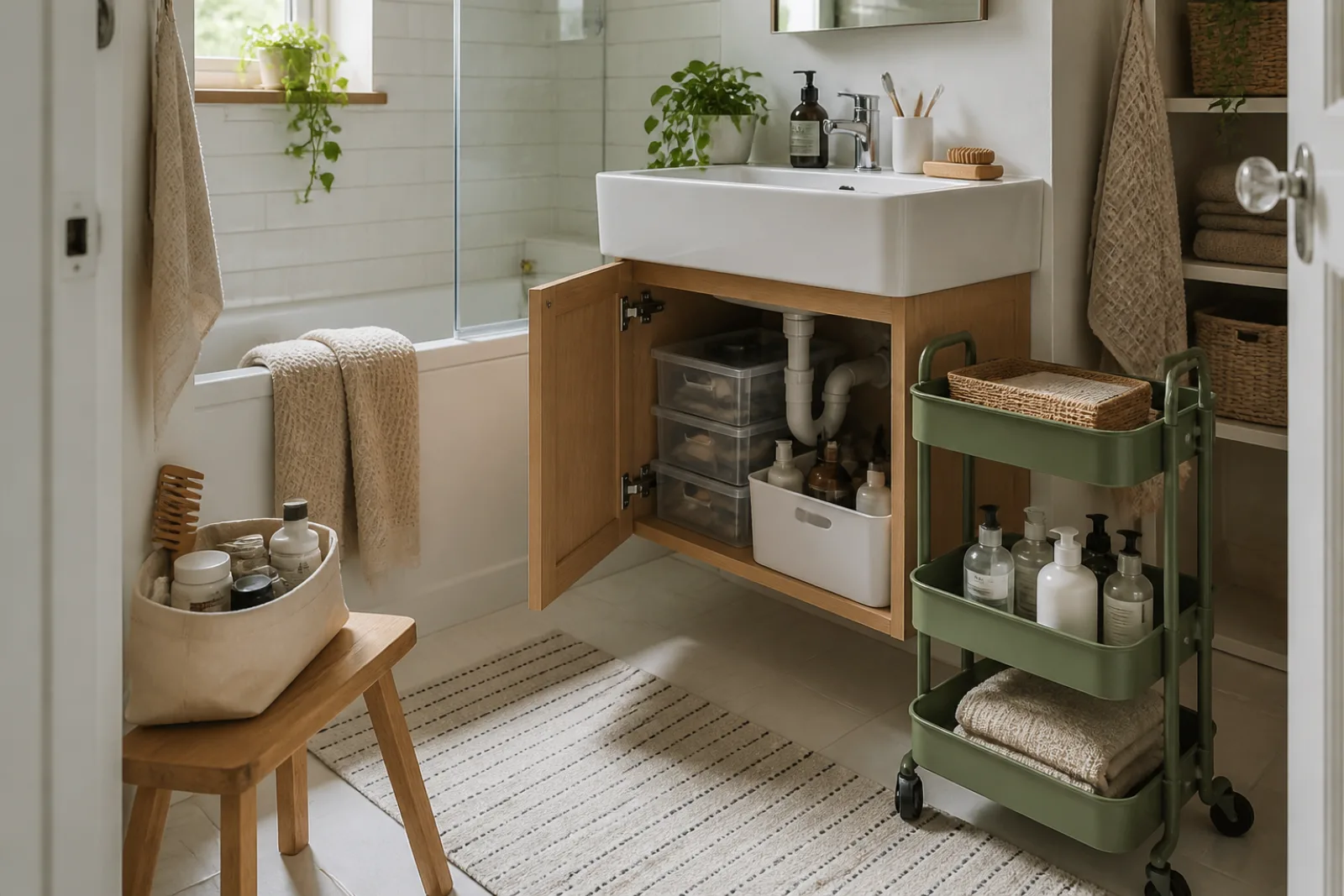
Overstock, extra toilet paper, a spare tube of toothpaste, backup razors, an unopened bottle of shampoo, should live in exactly one bin, not spread across the back of a cabinet, a drawer, and a closet shelf. A single under-sink bin or one shelf in a hall linen closet works fine. Put new stock behind old stock, the same first-in-first-out rule grocery stores use, so nothing expires unnoticed behind a newer bottle of the same product.
The FDA doesn't require cosmetics to carry expiration dates or period-after-opening symbols in the United States (that labeling is required in the European Union, not here), so a bottle of foundation won't tell you when to toss it. But heat and humidity still degrade opened products faster than sealed ones, which is exactly the environment next to a shower. As a rough guide: liquid eyeliner and mascara last about 3 to 6 months after opening, liquid foundation around 12 months, cream or lotion products 6 to 12 months, and pressed powders 1 to 3 years. If there's room, store opened liquid cosmetics in a closed drawer rather than an open shelf directly across from the shower.
Four zones based on how often an item is used and how much humidity it can handle.
- 01Sink-side shelf or medicine cabinet front
Daily use, moderate moisture: toothbrush, toothpaste, razor, daily moisturizer
- 02Shower caddy with drain holes
Full moisture exposure, used every time: shampoo, conditioner, body wash
- 03Under-sink bin or linen closet shelf
Backups and overstock, moderate moisture, sealed containers, rotated first-in-first-out
- 04Bedroom drawer or hall closet
Medicine and anything moisture-sensitive; stays out of the bathroom entirely
- 05Closed drawer away from the shower
Opened liquid cosmetics, protected from direct steam
Small Bathroom Organizing Checklist
- 01Daily items (toothbrush, razor, daily moisturizer) live on an open shelf or cabinet front, not behind other items
- 02Shower caddy has drain holes, not a solid bottom
- 03One bin or shelf holds all backups, in one place, rotated oldest-first
- 04Prescription medicine moved to a bedroom drawer or hall closet, out of the bathroom
- 05Cotton balls removed from pill bottles
- 06Opened liquid cosmetics stored in a closed drawer, not an open shelf facing the shower
Questions
- 01Is it really necessary to move medicine out of the bathroom?
For anything you want to keep at full strength past its expiration date, yes. Heat and moisture can break down a capsule's coating or chemically split active ingredients, and a daily hot shower is one of the more extreme humidity swings in most homes. A bedroom drawer or hall closet stays far more stable.
- 02What about a bathroom with no linen closet nearby?
An under-sink bin still works fine for backups, since unopened bottles and sealed packages tolerate humidity better than medicine does. The item that actually needs to leave the room is medicine, not everything.
- 03How do I know if a product has gone bad if there's no expiration date?
Watch for separation in liquids, a change in smell or color, or a texture that's gone grainy or watery. Mascara and liquid eyeliner are worth tossing on a schedule regardless, about 3 to 6 months after opening, since they're used close to the eyes and pick up bacteria fastest.
The Short Version
- 01
Sort by two variables at once: how often you use something, and how much humidity it can survive.
- 02
Daily items stay in arm's reach; backups get consolidated into one bin instead of scattered across several.
- 03
Medicine should leave the bathroom entirely; showers regularly push humidity into a range that degrades pills and capsules.