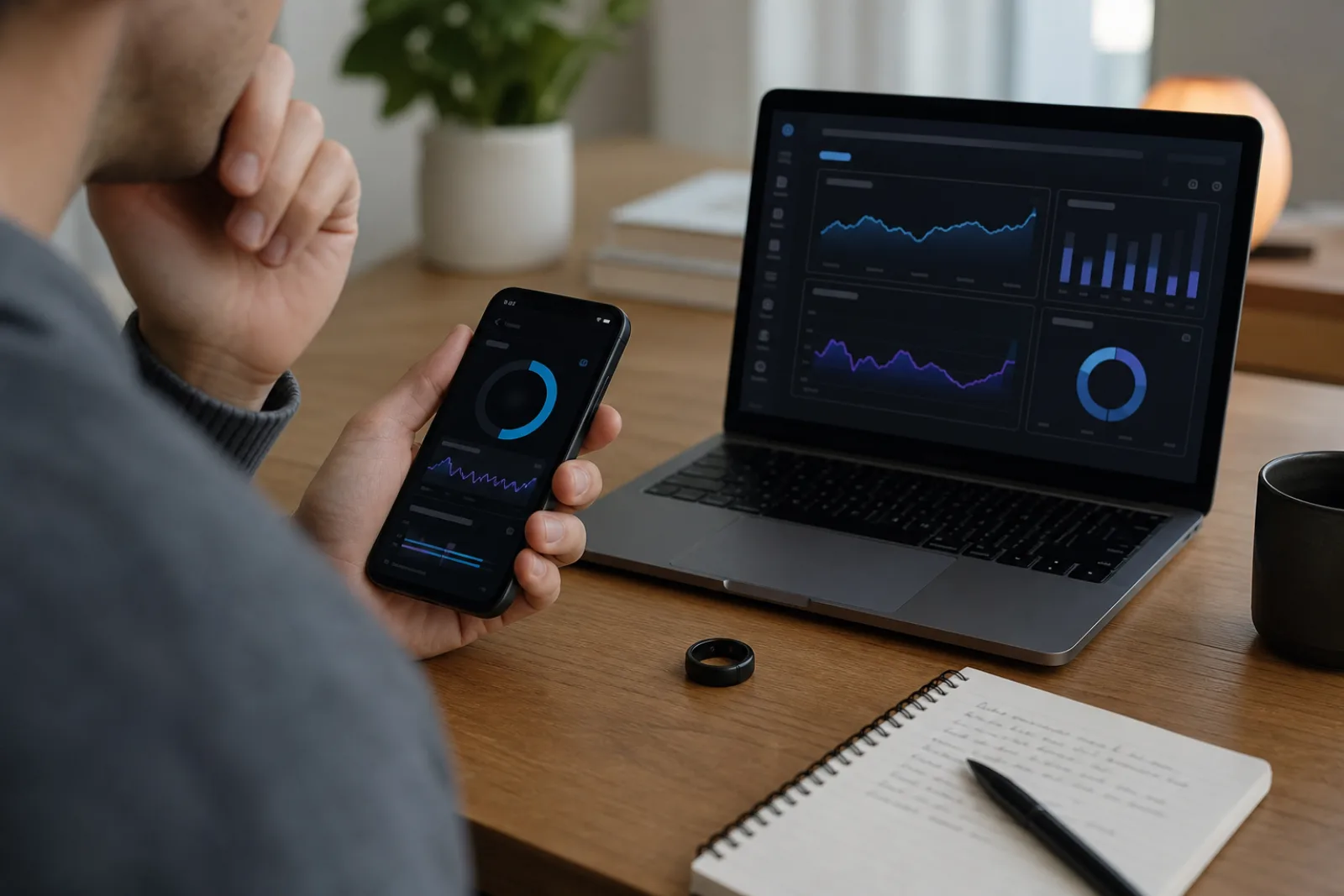
A recovery score is a compression algorithm with a personality. The ring measured something (pulse, temperature, motion). Software turned it into a number you can argue with. That number is not a VO2 max test, not a polysomnogram, and not a doctor's note. It is a mirror with a brand. Used as a mirror, it can catch a week of too little sleep. Used as a priest, it will bless rest days you wanted anyway and scold you for living.
FDA's general-wellness policy is the legal neighborhood most of these apps occupy: lifestyle, not diagnosis. If the marketing sounds like a clinic, that is the marketing.
| Use | Fair | Not fair |
|---|---|---|
| One morning | A prompt: did I drink, fly, fight a cold, or train late? | A diagnosis, a skipped prescription, or a fight with a partner about 'what the ring said.' |
| Two to four weeks on the same ring | Your baseline. Direction matters more than the absolute 0-100. | Comparing your 82 to someone else's 94 on a different brand. |
| HRV | A noisy autonomic hint, overnight, in one posture | A clinical HRV study, or proof your heart is 'young' or 'old.' |
| Sleep stages | A rough split of still versus stir | A sleep-lab hypnogram. Rings guess. They do not EEG. |
When to listen, when to shrug, when to get help
Is the score a one-off, or a week-plus change, and how do you feel?
- 01One low morning, you know why (late night, alcohol, travel, hard workout)
The ring noticed. You already knew. Do not build a theology. Sleep and eat like an adult.
- The app says 'rest' and you feel fineYou may still train easy. Blind obedience is how people skip lives they enjoy.
- 02A week of lower scores and you feel off
Look at load, illness, mood, and alcohol. If you are sick, rest because you are sick, not because of the badge.
- Chest pain, fainting, breathlessness, or thoughts of self-harmClinician or emergency care. The ring is not in this paragraph.
- 03Scores look great and you feel terrible
Believe the body. Wearables miss. Depression, anemia, and overtraining are not obligated to show up as a red badge.
- You keep adding strain because the score is greenThat is the device using you. Put it in a drawer for a week and see if you still know how you slept.
Temperature deviations are one of the more concrete ring signals: a rise can accompany illness or the luteal phase. It is still not a thermometer you would use to decide on a baby's fever. Cycle features are estimates. Confirm anything that would change a medical decision with a test meant for that decision.
If the graphs that explain the score sit behind a membership, you are paying to interpret a number the hardware already captured. Are smart rings useful without a subscription is that product question. Smart rings compared is fit, battery, and that fee. The quantified self at home is the culture of living by the badge.
Take the ring off one night a week if the score has started to run the morning. A tool that you cannot ignore is no longer a tool.
Trend, same device, then the body
- 01
Compare yourself to last week on the same ring.
- 02
A single score is a prompt, not a diagnosis.
- 03
If you feel wrong and the ring is green, believe the feeling.
Questions
- 01Should I train if recovery is low?
If you feel ill, no. If you feel fine and the number is low after a party, an easy session is allowed. Elite sport has coaches. You probably do not need a $6-a-month coach to skip a walk.
- 02Why did the score drop when I slept eight hours?
Duration is not the only input. Alcohol, heat, a sick kid, a new finger, a loose fit, and a firmware change all move the sausage machine. Read the component graphs if you have them.
- 03Can I use two rings to check accuracy?
You will get two proprietary scores. Disagreement proves they are not a lab. It does not tell you which is true.