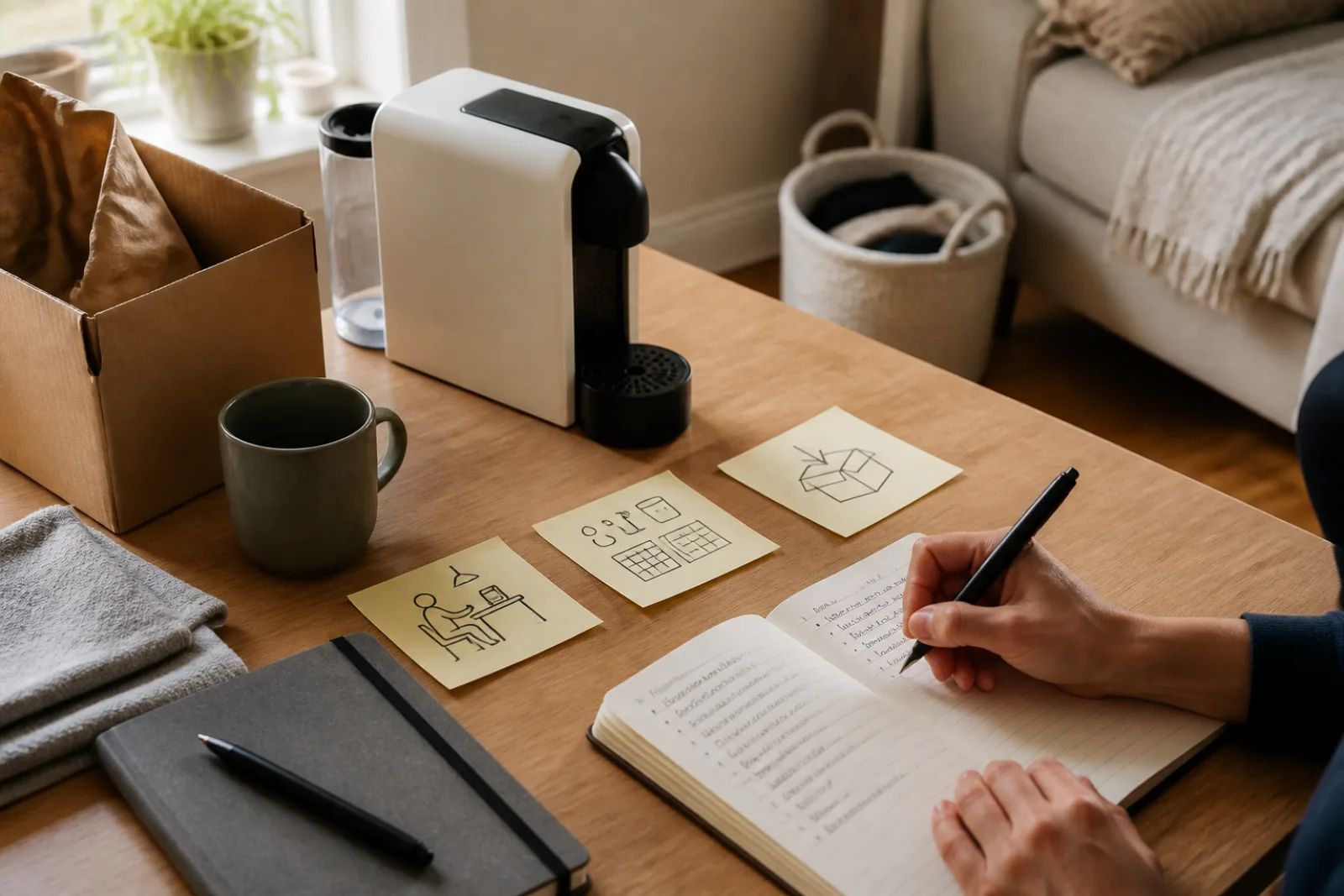

A ten-minute reset fails for one of two reasons. Either it was never given a real boundary, so "reset the house" turns into wiping down the stove, refolding a blanket, and starting a load of laundry because all of it is technically tidying, or it has no way to end other than someone deciding they are tired of doing it, which on a bad night means it stops after ninety seconds and nothing actually gets reset. A version that holds up needs both a fixed, short task list and a way to end that does not depend on how much energy is left at 9:40pm.
Three tasks earn a place inside ten minutes: clearing the kitchen's one working surface, returning stray objects to wherever they actually live, and staging tomorrow's first move. Together they run close to ten minutes on a normal night. When one of them consistently runs long, that is not a sign to try harder tomorrow. It is a specific, diagnosable sign about what is wrong upstream, in the sink, in the storage, or in how many decisions got left for the last ten minutes of the day.
Ten minutes is short enough to survive a bad night and long enough to cover exactly these three tasks if the rest of the household's systems are working. It also has a specific place in the evening: before the wind-down starts, not as part of it. The CDC's sleep guidance recommends a relaxing routine in roughly the last 1.5 hours before bed and turning off screens and devices at least 30 minutes before lights out, with light kept low through that window. A brisk, task-focused ten minutes of carrying dishes and switching off lights does not fit that description; it is closing up shop, not winding down. Run it right before the relaxing part of the evening starts, not during it, and not as the very last thing before the bedroom light goes off.
The Ten-Minute Sequence
- 01Clear the kitchen's one working surface (about 4 minutes)
Dishes into the dishwasher or washed and racked, counter wiped, sink empty. This is the task most likely to blow the budget, because food residue left all day hardens and a full sink takes real time to clear in one sitting.
- 02Return stray objects to their homes (about 2 minutes)
Shoes, bags, mail, chargers, cups from the living room, carried back to wherever each one actually lives, in one sweep through the main rooms.
- 03Stage tomorrow's first move (about 3 minutes)
One thing only: the coffee maker loaded and set, or the next day's clothes laid out, or the bag packed by the door, whichever is the household's actual first friction point in the morning.
- 04Closing gesture (the stopping cue)
The same small action every night, such as starting the dishwasher or switching off the overhead kitchen light, done in the same order each time so it becomes an automatic signal that the reset is over, whether or not everything looks finished.
The stopping cue cannot be a feeling, because the whole point of keeping the routine to ten minutes is to make it survive nights when there is no energy left to judge whether the kitchen "looks done." A kitchen timer or a phone timer set the moment the reset starts is the plain version: when it goes off, the reset is over, whatever state the counter is in. The other version is a fixed last task performed in the same order every night, starting the dishwasher, or switching off the overhead light and leaving one lamp on, so the action itself becomes the signal, the way turning a doorknob signals the day is over regardless of the exact time. Pick one mechanism and keep it identical every night; a stopping cue that changes each time is not actually a cue, it is just another decision to make at 9:40pm.
A single task blowing its budget points to a specific, fixable cause rather than a discipline failure. If the kitchen surface routinely takes twelve or fifteen minutes instead of four, dishes are accumulating all day instead of getting rinsed or loaded as they are used, so the reset is absorbing a full day's backlog in one sitting instead of one evening's worth. If returning stray objects takes five minutes of standing in the middle of a room deciding where things go, those objects do not have a fixed home yet, which is a storage problem, not a laziness problem, and no amount of trying harder fixes it. If staging tomorrow's first move stalls out, it is usually because a decision is being made at the reset that should have been made earlier in the day: which outfit, what is for lunch, where a specific item went missing.
Treat two or three nights of overruns on the same task as a diagnosis, not a streak of bad luck, and fix the actual cause: run the dishwasher every night regardless of how full it is, give the five most common stray objects a labeled spot near where they get dropped, or decide the next day's clothes and lunch earlier, at dinner instead of at the reset. The ten-minute limit is doing its job here; it is supposed to make the mismatch visible instead of quietly absorbing it.
Setting Up a Reset That Holds
- 01One working surface identified as the reset's kitchen task, not the whole kitchen
- 02A stopping mechanism chosen and fixed: a timer, or a closing gesture done in the same order every night
- 03The five objects most often left out named, each with one specific spot
- 04Tomorrow's first move decided at dinner, not at the reset
- 05A start time set early enough to finish before the household's actual wind-down begins
Questions
- 01What if the sink alone would take fifteen minutes tonight?
Do the ten-minute version anyway and let the rest go. A single bad night does not need to break the routine; it needs the backlog treated as its own separate task, scheduled for daytime, not folded into tonight's reset.
- 02Can the three tasks be split between two people?
Yes, and splitting by task rather than by room tends to hold up better: one person always does the kitchen surface, the other always does stray objects and tomorrow's prep, so neither task depends on remembering whose turn it is.
- 03What if there is no dishwasher?
Shrink the kitchen task's time budget expectation, not its priority. Hand-washing what accumulated in a single day usually still fits in four to five minutes if it happens every night; it is a two-day backlog that pushes it past ten.
The Short Version
- 01
Only three tasks belong in the ten minutes: the kitchen's main surface, stray objects returned to their homes, and tomorrow's first move staged.
- 02
The stopping cue has to be external and physical, a timer or a fixed last task, not a feeling of being done.
- 03
A single task blowing the budget points to a specific upstream cause: dishes piling up all day, objects without a fixed home, or decisions deferred to 9pm.