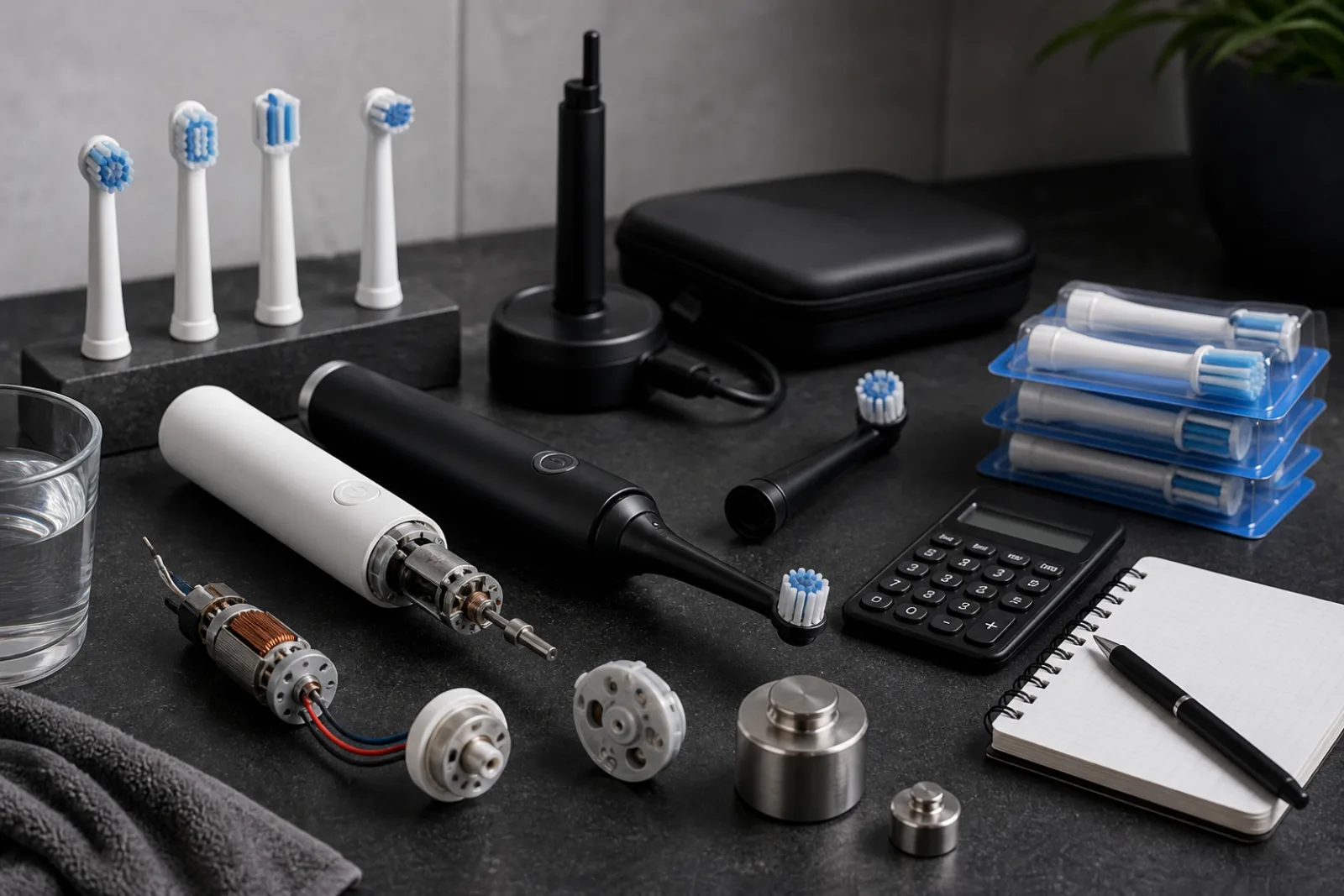
An electric toothbrush is a small motor with a replaceable brush on top. The marketing around it is a brand war. The engineering is a mechanism difference: a round head that oscillates and rotates in short arcs, or an elongated head that vibrates side to side at high frequency. Both designs can earn the American Dental Association Seal of Acceptance. Neither design is something Culture Column has clinically tested. This is a specification-literate reading of what the ADA, Cochrane, and the manufacturers themselves actually document, not a ranking of named winners from a bathroom trial.
If you already brush well with a soft manual brush for two minutes twice a day, the ADA's own oral-health topic says either style can be used effectively. The case for spending more is narrower than the box art: a timer that makes two minutes automatic, a sensor that tells you when you are scrubbing too hard, and a refill ecosystem that will still sell heads for the handle you bought. The app is optional. The heads are not.
The ADA Seal is not a league table. The Council on Scientific Affairs awards it after reviewing clinical or laboratory evidence that a product is safe and effective for the claims on the package, typically plaque removal and gingivitis reduction for toothbrushes. The Seal is granted for a five-year period. If the product changes, the manufacturer has to come back with updated data. Powered brushes that earn the Seal also go through ANSI/ADA Standard No. 120 tests for electrical safety, tuft retention, and mechanical strength, plus a clinical study showing they are safe on hard tissue, soft tissue, and restorations. Plenty of brushes without the Seal may still clean well. The Seal is the one third-party mark that tells you a specific model was actually submitted and reviewed, not that it beat every other handle on the shelf.
Cochrane's 2014 review of powered versus manual brushing is the largest independent synthesis still cited in this category: 56 randomized trials, 5,068 people, unsupervised use for at least four weeks. Powered brushes reduced plaque about 11% at one to three months and about 21% after more than three months, using the Quigley-Hein (Turesky) index. Gingivitis fell about 6% and 11% at those same intervals on the Löe and Silness index. The evidence was judged moderate quality. Heterogeneity was high. The authors' own conclusion is the sentence most shopping guides skip: the clinical importance of those percentages remains unclear. Rotation-oscillation brushes supplied the largest share of the trials (27 of them) and showed a statistically significant benefit versus manual brushes at both time points. That is a statement about the volume of evidence, not a license to treat every other mechanism as unproven junk.
These are pooled relative reductions from Cochrane, not Culture Column measurements. The review authors state that the clinical importance of differences this size is still unclear.
Yaacob et al., Powered versus manual toothbrushing for oral health, Cochrane Database of Systematic Reviews 2014 · accessed 2026-08-12 · Cochrane Oral Health Group systematic review of 56 randomized trials (51 with meta-analysis data, 4,624 participants in the analyses). Short term is 1 to 3 months; long term is greater than 3 months. Values are the review's reported percentage reductions on named clinical indices, not independent re-analysis.
Head-to-head among powered designs is thinner. A 2010 Cochrane review compared modes of action against each other: 17 trials, 1,369 participants. Rotation-oscillation brushes reduced plaque and gingivitis more than side-to-side brushes in the short term (plaque SMD 0.24; gingivitis SMD 0.35), from seven trials the authors rated at unclear or high risk of bias. They called the difference small and its clinical importance unclear. Cost and reliability were not reported at all. Later industry-adjacent meta-analyses have argued for a larger oscillating-rotating advantage; those papers are useful as a literature map and should be read as such, not as a substitute for Cochrane's more cautious head-to-head. For a buyer, the honest summary is: powered beats manual by a modest, well-replicated margin; oscillating-rotating has the most trial data and a small short-term edge over sonic-style side-to-side action that may or may not matter in a mouth that is already being brushed twice a day.
| Feature | Oscillating-rotating | Sonic (side-to-side) |
|---|---|---|
| Head shape | Small round head, typically one tooth at a time | Elongated head closer to a manual brush |
| Motion | Short arcs of rotation, often with a pulse along the bristles | High-frequency side-to-side sweep |
| Usual technique | Guide the round head from tooth to tooth; do not scrub | Guide the long head along the gumline; do not scrub |
| Cochrane head-to-head (2010) | Small short-term plaque and gingivitis advantage versus side-to-side; clinical importance unclear | Classified as side-to-side action in that review |
| ADA Seal | Available on specific oscillating-rotating models that submitted evidence | Available on specific sonic models that submitted evidence |
The feature that most clearly maps onto gum safety is pressure feedback. The ADA recommends soft bristles and gentle pressure because hard scrubbing is a documented route to gingival abrasion. Manufacturers implement that warning in different ways, and those implementations are documented, not mysterious. Philips Sonicare's support pages describe a sensor that measures applied pressure and, when you push too hard, changes the handle's vibration. Depending on the model, a light at the base, a flashing brush-head reminder LED, a sound, or a pulsing sensation may accompany that change. Oral-B's iO professional materials describe a smart pressure sensor that lights green in what the company calls an optimal range and red when pressure is excessive, with oscillation speed decreasing above that threshold. Those color and speed behaviors are Oral-B's documented design, not independent lab readings from Culture Column. What a spec sheet can tell you is whether a pressure warning exists at all. Many inexpensive handles omit it. If you are a hard brusher, that omission is more important than a fifth cleaning mode.
Replacement heads are the running cost, and they are also the lock-in. The ADA says to replace a toothbrush every three to four months, or sooner if bristles are matted or frayed. That cadence is about four heads a year, every year, for as long as you keep the handle. Before you buy the handle, look up whether the matching heads are sold as a commodity (many stores, several price tiers, including store brands) or as a closed family. Oral-B states that iO replacement heads are exclusive to iO handles. Older Oral-B rechargeable lines (Pro, Smart, Genius, Vitality) share a different snap-on system. The two families do not mix. If you already own a drawer of standard Oral-B heads, an iO handle makes them leftover parts. If you buy iO, you are betting that Oral-B will keep making iO heads for the life of the motor. Philips BrushSync heads use a microchip to talk to some Sonicare handles for replacement reminders and mode pairing; a generic head may still fit the stem and still clean, but it will not drive those reminders. None of that is a reason to pick a brand. It is a reason to price four years of heads, not one handle.
The two-minute timer is the other feature that maps onto ADA guidance rather than onto a marketing slide. The ADA recommends two minutes twice a day. Most rechargeable handles pause or beep every 30 seconds (a quadrant pacer) and stop or signal at two minutes. That is not a clinical invention by the brands. It is a way of making the ADA interval automatic. Charging is a convenience layer on top: an inductive puck that lives on the sink, a USB cable for travel, a claimed two-week charge. Those details matter if you travel weekly. They do not change plaque scores. Bluetooth apps that paint a map of your mouth can be motivating for some people and ignored by everyone else. Cochrane did not measure apps. The ADA Seal does not require one.
Choosing a handle from the spec sheet
Do you already brush two minutes twice a day with a soft manual brush and have no dexterity limits?
- 01Manual may already be enough
The ADA says either manual or powered can be used effectively. A powered brush is optional, not mandatory, if technique and time are already in place.
- I still want a powered brush for the timer or because dexterity is an issue
- I will stay with a soft manual brush and replace it every 3 to 4 monthsBuy a soft-bristled ADA-accepted manual brush. Spend the electric-brush money on fluoride toothpaste and floss you will actually use.
- 02Look for the ADA Seal on the specific model
The Seal is awarded to named products, not to a brand family in the abstract. Check the ADA's product search or the package statement.
- The model has the Seal (or I accept a well-documented mechanism without it)
- No Seal and no published clinical summary I can findTreat it as an unreviewed gadget. A cheap timer-only handle can still help with two-minute compliance, but you are not buying reviewed efficacy.
- 03Does the handle warn when you press too hard?
If you are a hard brusher, or a dentist has flagged recession, a pressure sensor is the feature that maps onto gum safety.
- Yes: light, vibration change, or speed drop is documented
- No pressure sensorOnly proceed if you already brush gently. Otherwise keep looking. Extra modes will not substitute for a force warning.
- 04Can you buy matching heads easily, and will they still fit in three years?
Price a year's supply. Confirm the handle family (for example, Oral-B iO versus standard Oral-B snap-on) before you assume last year's refills will work.
- Heads are widely sold and the family is clearly identifiedBuy the handle. Use the two-minute timer, replace heads every 3 to 4 months, and ignore the app unless you like it.
- Heads are proprietary, scarce, or subscription-only with no open retail pathWalk away unless you are comfortable with that lock-in. A stranded handle is a manual brush with a dead battery.
Before you buy
- 01
Confirm the ADA Seal on the specific model if you want a third-party efficacy review, then confirm a pressure warning if you tend to scrub.
- 02
Price four years of replacement heads and check handle-family compatibility. Oral-B iO heads do not fit older Oral-B snap-on handles.
- 03
A two-minute quadrant timer is the feature that matches ADA brushing time. An app is optional.
Questions
- 01Is an oscillating-rotating brush better than a sonic one?
They are different mechanisms. Cochrane 2010 found a small short-term plaque and gingivitis advantage for rotation-oscillation over side-to-side action, and called the clinical importance of that difference unclear. Both types appear on the ADA Seal list. Pick the head shape you will actually seat correctly, with a pressure warning and available refills.
- 02Do I need the Bluetooth app?
No. The ADA's recommendations are two minutes, twice a day, soft bristles, gentle pressure, and a new head every three to four months. An app can coach those habits. It is not what the Seal evaluates.
- 03Can I use store-brand replacement heads?
If they physically fit and the bristles are soft, they can do the mechanical job. Chip-based reminders (such as Philips BrushSync) and some pressure or mode features may not work. Check the handle family's published compatibility before you buy a bulk pack.