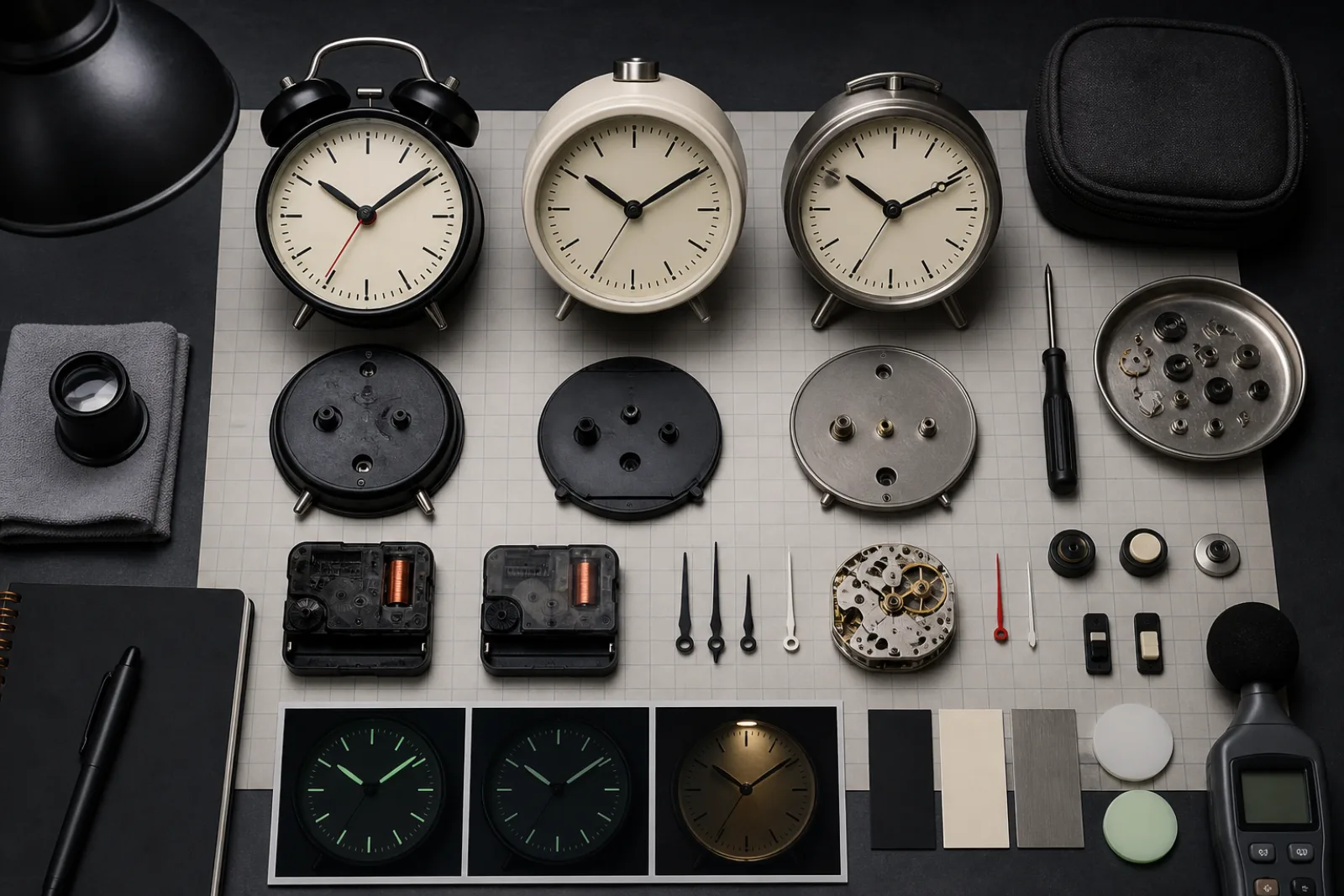
An analog alarm clock is a small machine with hands. It is not a sleep program, not a melatonin protocol, and not a substitute for the room conditions NIOSH and NHLBI actually name: dark, quiet, and cool. People buy analog clocks to get the phone out of reach and to avoid a display that stays lit. Those are product reasons. Culture Column has not sat in a dark room scoring ticks or bells. This is a specification reading of movement type, face design, and alarm hardware, written as a buying page for analog clocks. The companion page on digital alarm clocks covers dimmers, battery backup, and USB ports. The Living article on making a bedroom more supportive of sleep covers the room. The Culture essay on the sleep-product market covers why gadgets outrun evidence. This page is the analog clock.
If sleep is still difficult after the room is dark and the schedule is stable, NHLBI's next step is a clinician, not a more expensive movement. A quieter clock can remove one sound. It cannot treat insomnia, apnea, or a body clock you reset every weekend.
The sound you are buying is the movement, then the alarm. Almost every new analog bedside clock is quartz. Inside that family there are two common second-hand behaviors. A stepping movement jumps once a second. That jump is the tick people mean when they say a clock is loud at 2 a.m. A sweep movement drives the second hand continuously, which listings call silent or whisper-quiet because there is no once-per-second click. Sweep is still a motor. It is not silence in a laboratory sense. It is the absence of a step. Mechanical wind-up clocks are a third product: a spring, a tick from the escapement, and often a twin-bell or single-bell alarm that does not need a battery to ring. They run down. They are louder as objects. They are also the one analog type whose alarm still works in a power cut without a backup cell, because there is no mains and no display driver, only a spring you wound.
Listings that say 'silent sweep' are describing that continuous second hand. They are not citing NIOSH. NIOSH's sleep-environment page for shift workers asks for a very dark, quiet, cool room and names clocks with white or blue lit dials as light sources to block or remove. An analog clock with no always-on lamp meets the light half of that sentence by architecture. It does not automatically meet the quiet half. A stepping quartz on a hollow plastic case can tick like a metronome. A sweep movement in the same case can still buzz if the rotor is cheap. You cannot hear that from a spec sheet. You can refuse stepping movements if tick is the complaint, and you can refuse clocks that add a night-light you cannot switch off, because that reintroduces the lit-dial problem analog was meant to avoid.
| Category | Stepping quartz | Sweep quartz | Mechanical wind-up |
|---|---|---|---|
| Second hand | Jumps once per second | Glides continuously | Ticks with the escapement; some have no second hand |
| Idle sound | The tick. Case resonance can make it louder. | No step-tick. May still hum. | A mechanical tick, usually louder than quartz |
| Typical alarm | Electronic beep, sometimes crescendo, sometimes with snooze | Same electronic beep family | Bell or hammer on a gong. No snooze unless the design includes one. |
| Power | Usually one AA. Timekeeping dies with the cell. | Usually one AA | A spring you wind. No battery for time or bell. |
| Always-on light | None, unless the maker added a lamp you cannot fully disable | None, with the same caveat | None |
Dark-room legibility on analog is not a display brightness number. It is whether you can tell 2:10 from 6:10 without turning on a lamp. High-contrast numerals on a plain face beat decorative, low-contrast art. Phosphorescent paint on hands and indexes glows after it has been charged by room light or a lamp. It fades. Product copy that says luminous hands 'may not last all night' is describing that physics, not a defect. A button that lights the dial for a few seconds is the other analog solution: you choose the photon. A clock that combines a sweep movement with a button light and no always-on lamp is the analog product that most closely matches NIOSH's instruction to remove white or blue lit dials, while still letting you read the time on purpose.
Travel analog clocks are the same three parts in a smaller case. A folding cover that protects the hands in a bag is useful. A tiny dial you cannot read without a phone flashlight is not, because then you have brought the phone back into the problem. Dual-time analog faces are a different product, for people who keep a second zone. They do not change tick, lume, or alarm-hand logic. If the travel clock's alarm is a feeble beep, test whether you will hear it in a hotel, or pack a plan that does not depend on it. Culture Column has not sat in hotel rooms with these clocks. The spec you can still demand is a visible alarm hand and an on/off that will not flip in a suitcase.
Vintage radium paint is not a feature of clocks sold new. It is a collector and disposal problem for old instruments. New analog bedside clocks use non-radioactive phosphorescent pigment that needs charging. Do not buy a 'glow' claim as an all-night lamp. If you need a continuous path light, NIOSH names a dim red nightlight for the bathroom route, not a brighter clock face.
If you cannot set tomorrow's alarm in the dark with one hand, the clock will lose to the phone. These are the parts, not a brand ranking.
- 01Alarm hand
A fourth hand, often a different color, that you move to the wake time. If you cannot see it against the face, you cannot confirm the setting.
- 02Time-set and alarm-set knobs
Two knobs, or one knob with a pull-to-set-alarm action. Nested 'mode' buttons belong on digital clocks. On analog they are a sign the designer gave up.
- 03Alarm on/off
A slider or button on the back or top that you can find by feel. If the only off is a sequence of beeps, you will knock the clock onto the floor.
- 04Snooze
A large top button is usable half-asleep. Absence of snooze is a preference, not a defect. Mechanical bells often have none.
- 05Button light
Momentary illumination of the dial. Prefer this over a lamp that stays on. Confirm you can disable any night-light mode.
- 06Battery door
A door you can open without a screwdriver, with polarity marked. Analog quartz dies without drama when the cell is empty. Keep a spare AA in the drawer.
Alarm-setting clarity is the feature analog still has over a phone, and it is the feature cheap analog clocks throw away. The classic layout is an alarm hand you can see, a knob that moves only that hand, and a switch that arms it. You can confirm 6:30 by looking. Digital clocks hide the same fact in a blinking set of digits. If an analog listing shows a blank decorative face, no alarm hand, and a beep you program with a recessed button, you have bought digital logic in a round case. Crescendo beeps that get louder are a documented feature on some quartz analog models. They are easier on a shared room than a twin-bell. They are also easier to sleep through if the speaker is a 10-millimetre disc in plastic. A mechanical bell is harder to ignore and harder on a partner. Neither sound is a clinical intervention.
Face size and contrast do more for 2 a.m. reading than a 'luminous' sticker on the box. A 10 to 12 centimetre dial with Arabic numerals, a thick minute hand, and a distinct alarm hand can be parsed in a glance. A 6 centimetre decorative face with no numerals cannot, lume or not. If you wear glasses to bed, buy the larger dial. If two people share the nightstand, put the clock where both can see the alarm hand, or you will argue about whether it was set. A rubber or weighted base that does not walk when the alarm fires is a mechanical detail, not a style note. Clocks that skate across a nightstand on a hard plastic foot will be on the floor, still beeping, which is a sound profile you did not choose.
The nightly ritual is part of the product. Analog quartz asks you to check the alarm hand and the on/off slider before you lie down. That check is slower than a phone, which is the point if the phone is what kept you awake. It is also how analog fails: you move the time-set knob by mistake, or you leave the alarm off after a weekend. A slider with a real detent, and an alarm hand in a color that is not the same as the minute hand, reduces that class of error. Mechanical wind-up adds a winding step. If you will not wind it, do not buy it. A stopped mechanical clock is a silent object. It will not save a Monday.
This is the place to keep analog and digital from collapsing into one 'alarm clock' essay. Digital clocks, covered in the companion Reviews article, are a display, a dimmer, a backup-battery behavior, and often a USB charging port. Their problem is light that stays on and ports that die. Analog's problem is tick, fade of lume, and whether the alarm hand is actually there. Do not shop analog for a USB charger. Do not shop analog for a display you can read from across a dark room without lume or a button. Do not shop analog as a fix for the sleep-product market described in 'the promise of perfect sleep.' That essay is about trackers, supplements, and a therapy that does not ship in a box. This clock does not close that gap.
Whether an analog clock is even the right product
Is the problem a glowing screen and a phone in reach, or is sleep still difficult after the room is already dark and quiet?
- 01Product problem or sleep problem
NHLBI: if you still cannot sleep, talk with a doctor. A new movement will not substitute.
- I want the phone out of the room and no always-on digits
- Sleep is still hard after schedule and a dark roomStop shopping clocks. Use the sleep-environment article as a checklist, then see a clinician. An analog clock can still be the timekeeper. It is not the treatment.
- 02Will a once-per-second tick bother you?
Stepping quartz ticks. Sweep quartz does not step. Mechanical ticks and rings a bell.
- Tick would bother me: look for sweep quartz, and confirm any night-light can be fully off
- I want a bell that works without batteries: mechanical wind-upBuy a wind-up with a face you can read and a winding routine you will keep. Accept the tick. Wind it. This is not a quartz beep.
- 03Can you read and set it in the dark?
High-contrast numerals, a visible alarm hand, a set knob, an on/off by feel, and either charged lume or a button light.
- Yes: contrast, alarm hand, button light or lume, no always-on lampBuy that clock. Put the phone in another room. Do not expect the movement to treat insomnia.
- Decorative face, no alarm hand, or a lamp that stays onKeep looking, or read the digital-clock article if what you actually want is dimmable digits and a backup cell.
Before you buy
- 01
Pick the movement on purpose: stepping quartz (tick), sweep quartz (no step), or mechanical (tick plus bell, no battery).
- 02
Require a high-contrast face, a visible alarm hand, an on/off you can find by feel, and either charged lume or a momentary button light. Refuse an always-on lamp.
- 03
If sleep remains difficult, stop adding clocks. That is a clinical question, and a room question, not an analog-versus-digital question.
Questions
- 01Is a sweep-movement analog clock better for sleep than a digital clock?
It removes two things digital clocks often add: a stepping tick, and an always-on emissive display. NIOSH names clocks with white or blue lit dials as light to block. Analog architecture can avoid that light. It does not treat insomnia. NHLBI still wants a consistent schedule and a dark, quiet, cool room.
- 02Will luminous hands last until morning?
Phosphorescent paint glows after it is charged and then fades. Some product notes say brightness depends on prior light and may not last all night. A button light is the reliable analog way to read 4 a.m. on purpose.
- 03Should I buy analog to avoid USB charging ports?
Analog clocks generally have none. If you want a USB rail on the nightstand, that is a digital-clock feature, and it is also a separate failure point. See the digital alarm-clock article.