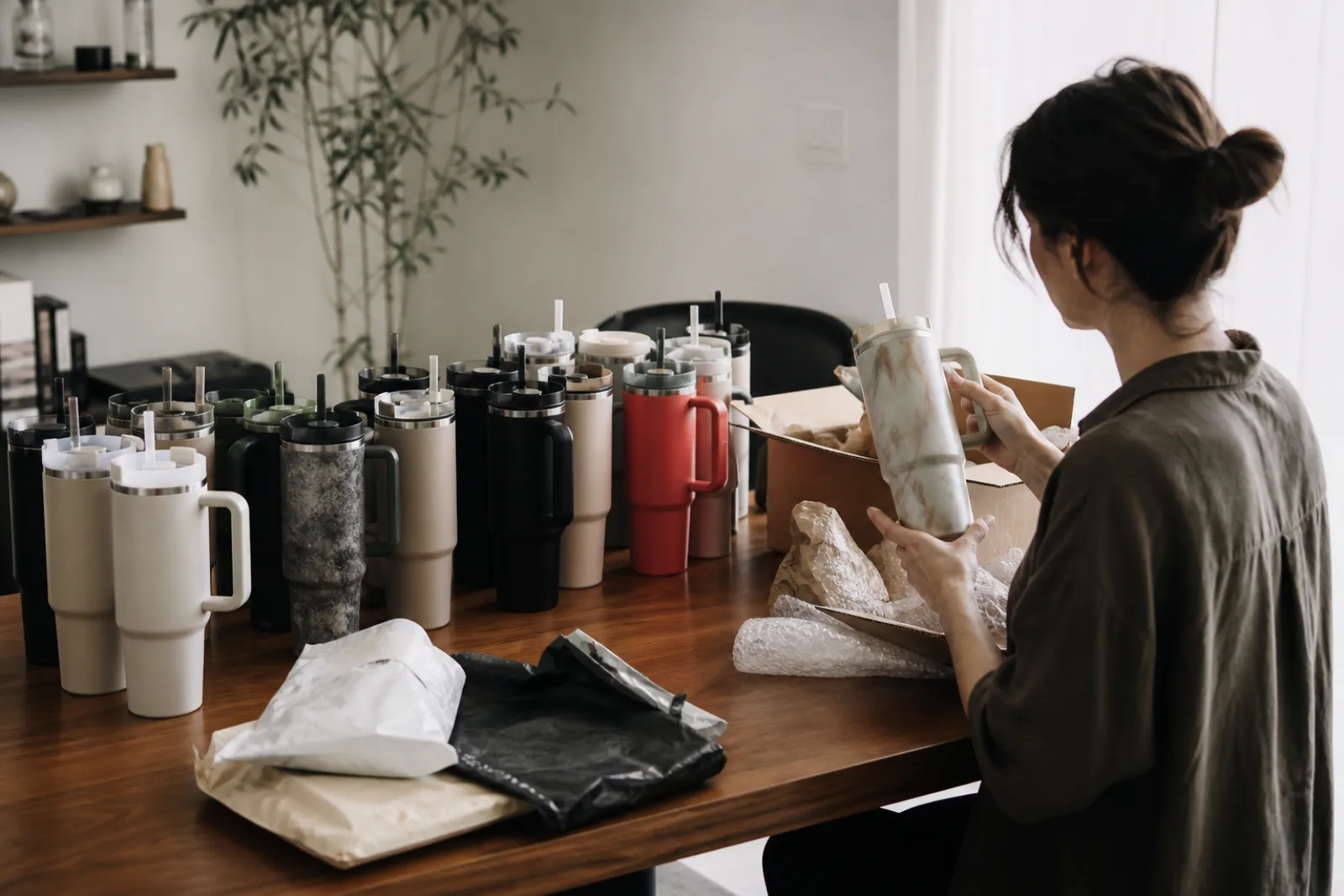
A Stanley Quencher does not hold more water than a $12 bottle from a sporting goods store. It does not keep a drink meaningfully colder than insulated bottles have for decades, including the ones the Stanley company itself was already selling to hunters and construction workers long before 2020. What changed between 2019 and 2024 is not the object. It is what owning one, then several, then a specific limited color of one, is understood to do for the person carrying it.
Stanley's tumbler business grew from $73 million in sales in 2019 to more than $800 million in 2024, a trajectory that runs almost entirely through TikTok, a former Crocs executive, and a marketing structure borrowed directly from sneaker culture: limited colors, timed drops, and manufactured scarcity that turns a mass-produced object into something worth camping outside a Target for. The bottle barely changed. What it is sold as did.
What changed
Hydration was the claim. The object was replaceable.
Limited colors and a sneaker playbook turned a tumbler into something people camp for. Thirst was not the business model.
The pivot point has a name and a date. Terence Reilly joined Stanley as president in 2020 after running marketing at Crocs, where he had already shown that a utilitarian object, a foam clog originally sold to boaters and gardeners, could be turned into a collectible through limited collaborations and a customization system (the Jibbitz charm) that let owners signal individual identity through a mass-produced base object. At Stanley, Reilly applied the same structure to the Quencher, a tumbler that had existed in the product line since 2016 with modest sales. The redesign was mostly cosmetic: new colors, a rotating drop schedule, and a marketing budget aimed at TikTok rather than outdoor-gear retailers. Sales did not respond gradually. They responded to specific viral moments.
The clearest of those moments arrived in November 2023, when a TikTok user posting as @danimarielettering shared a video of her car after it caught fire, with her Stanley Quencher sitting intact in the wreckage, ice reportedly still inside. The video drew roughly 94 million views. Stanley's president responded within two days, offering to replace her car. The campaign that followed generated an estimated 3.3 billion earned media impressions, a 220 percent increase in Stanley's TikTok following, and a 275 percent year-over-year jump in Quencher sales that quarter, pushing the company into its best quarter in its history. Two months later, a limited Target exclusive, a Winter Pink 40-ounce Quencher co-branded with Starbucks, sold out within minutes at stores nationwide, with widely reported crowding and lines before dawn. Neither event was really about the product. Both were about a specific, time-limited version of the product becoming unavailable, which is the exact condition that makes an object worth chasing.
Stanley's revenue grew more than tenfold in five years, and the growth is not smooth. It clusters around specific viral moments, the 2020 Reilly-era relaunch and the November 2023 car-fire video in particular, rather than rising the way demand driven by ordinary hydration habits would.
Stanley Cup Craze Floods TikTok Feeds, Raises $750 Million In Revenue · accessed 2026-08-12 · Figures are company-disclosed or press-reported sales totals rather than audited public filings, since Stanley is privately held; the 2024 figure is corroborated by Retail Dive's trade reporting.
Stanley is not the first water bottle to do this, which is itself evidence that something structural is happening rather than one company getting lucky. In 2019, The Atlantic's Amanda Mull reported on S'well, a company that had grown from a single blue bottle design in 2010 to more than 200 color and finish combinations by 2019, interviewing a young buyer who described choosing a bottle by asking herself which one looked like the kind of person she wanted to be. That same summer, Hydro Flask became the defining accessory of the VSCO girl aesthetic, typically covered in sea-turtle stickers that signaled environmental consciousness as much as the bottle held water. By 2024 and 2025, Owala's FreeSip, marketed explicitly around tri-tone Color Drops, had overtaken Stanley in social media engagement among Gen Z, with a single Rose Quartz unboxing video drawing 1.4 million TikTok likes. Four brands, fifteen years, the same underlying behavior: a plain object made collectible through color variation and manufactured scarcity.
The mechanism is worth naming precisely, because it explains why this happened to water bottles and not, say, toasters. First, color is inherently filmable in a way most functional upgrades are not. A fifteen-second video unwrapping a new colorway requires no explanation and translates instantly across a feed; a genuine improvement to a lid seal does not. Second, limited drops create a resale market almost automatically, and by November 2023, StockX, the platform built in 2015 to formalize sneaker reselling through authenticated bid-ask pricing, had added Stanley tumblers as a listed category, explicitly importing sneaker-drop infrastructure onto a kitchenware object. Third, creator economics reward the behavior: affiliate commissions and platform bonuses pay out on hauls and unboxings, which are structurally easier to produce around a new color than around a durability claim. None of this required a single consumer to need a new bottle. It only required that a new colorway be sellable as content, and that scarcity make chasing it feel urgent.
| Edition | Retail price | Resale price |
|---|---|---|
| Stanley Rose Quartz Quencher (2022) | $35 | $150 to $200 on eBay and Poshmark |
| Stanley x Starbucks Winter Pink 40oz (Jan. 2024 Target exclusive) | About $45 | Up to $250 on Poshmark; rare Starbucks red-cup editions reported as high as $800 |
| Stanley x Lainey Wilson Watermelon Moonshine 40oz | About $45 | $215 average resale price on StockX |
| Stanley x Starbucks pink 40oz | About $45 | $186 average resale price on StockX |
The beneficiaries of that structure are not mainly the people buying bottles. Stanley and Owala capture the primary sale regardless of what happens after; resale platforms like StockX, Poshmark, and eBay collect listing and transaction fees on every markup, meaning they profit from the scarcity whether or not a given buyer got a good deal; and creators who built followings on unboxing content monetize a new color drop the same way they would any other reliably viral format. The people worse off are less visible but not hard to find: shoppers who paid four to five times retail price chasing a specific Starbucks collaboration cup, and the shoppers present for the actual release events, several of which involved widely reported crowding and rushed store displays when doors opened. There is also a quieter irony underneath the whole cycle. Reusable bottles, S'well and Hydro Flask included, were originally marketed on replacing single-use plastic with one durable object. A collecting habit organized around owning five, ten, or dozens of bottles in rotating colors runs directly against that original pitch, even when each individual bottle is, on its own, more durable than the plastic it was meant to replace.
By late 2024, the same data that had documented Stanley's rise began to show the shape of a slowdown. Circana, which tracks US point-of-sale data, recorded water bottle and insulated container sales growth at sporting goods retailers falling from 38 percent in 2023 to 14 percent in 2024, a 24-percentage-point deceleration in a single year even as the category kept growing in absolute terms. Teen trend surveys began listing Stanley among items on their way out. Stanley's own global president, Matt Navarro, has since described the company's task in explicitly post-viral terms, telling Retail Dive, "We're not just a hot cup company," and pointing to expansion into coolers, new bottle formats, and international markets as the plan for the next stage rather than another color drop. That is close to an admission that the mechanism which built the business, drop-driven scarcity on a single hero product, has a shelf life, and that surviving past it requires becoming something closer to an ordinary durable-goods brand. Owala, sitting in roughly the position Stanley occupied in 2022, has not yet had to answer the same question.
What actually changed
- 01
The object did not change. Insulated tumblers have existed for decades; what changed is the marketing structure wrapped around them, imported from sneaker-drop scarcity rather than invented for hydration products.
- 02
A real secondary market formed around specific colorways, with resale prices running three to five times retail on the rarest editions, and StockX formally listing Stanley tumblers as a resale category starting in November 2023.
- 03
The pattern predates and outlasts any single brand: S'well, Hydro Flask, Stanley, and Owala each rode a version of the same cycle across fifteen years, each one compressing faster than the last.
- 04
Growth data and the brands' own public statements now show early signs of the cycle ending for Stanley specifically, while Owala occupies the position Stanley held two years ago.
Questions
- 01Are Stanley or Owala bottles actually better at insulation than cheaper alternatives?
Independent testing generally finds premium insulated tumblers perform similarly to other well-made double-wall stainless steel bottles at holding temperature. The price and resale premiums on specific editions track color and scarcity, not measurable insulation performance.
- 02Why did StockX, a sneaker resale platform, start listing water bottles?
StockX added Stanley tumblers as a listed category in November 2023 after resale activity for specific colorways was already happening informally on eBay and Poshmark. The platform's authenticated bid-ask pricing model, built for sneakers, transferred directly onto an object with the same limited-drop, secondary-market dynamics.
- 03Doesn't collecting multiple bottles undercut the original sustainability pitch for reusable water bottles?
That tension is real and largely unaddressed by the brands themselves. S'well, Hydro Flask, and Stanley all built early marketing around replacing single-use plastic bottles with one durable object. A collecting habit built around owning many bottles in rotating colors works against that original premise, even though any individual reusable bottle still outlasts the plastic bottles it was designed to replace.