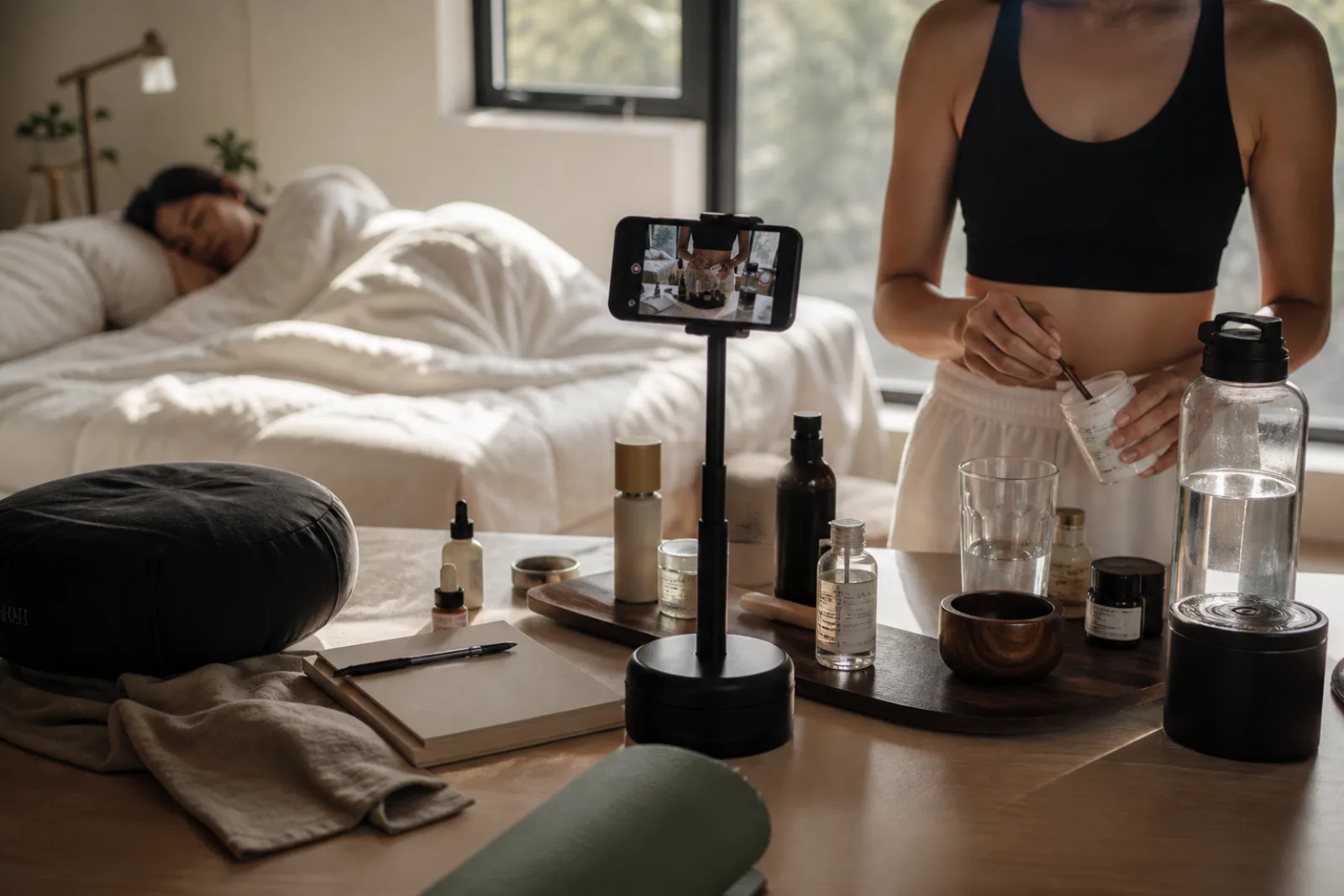
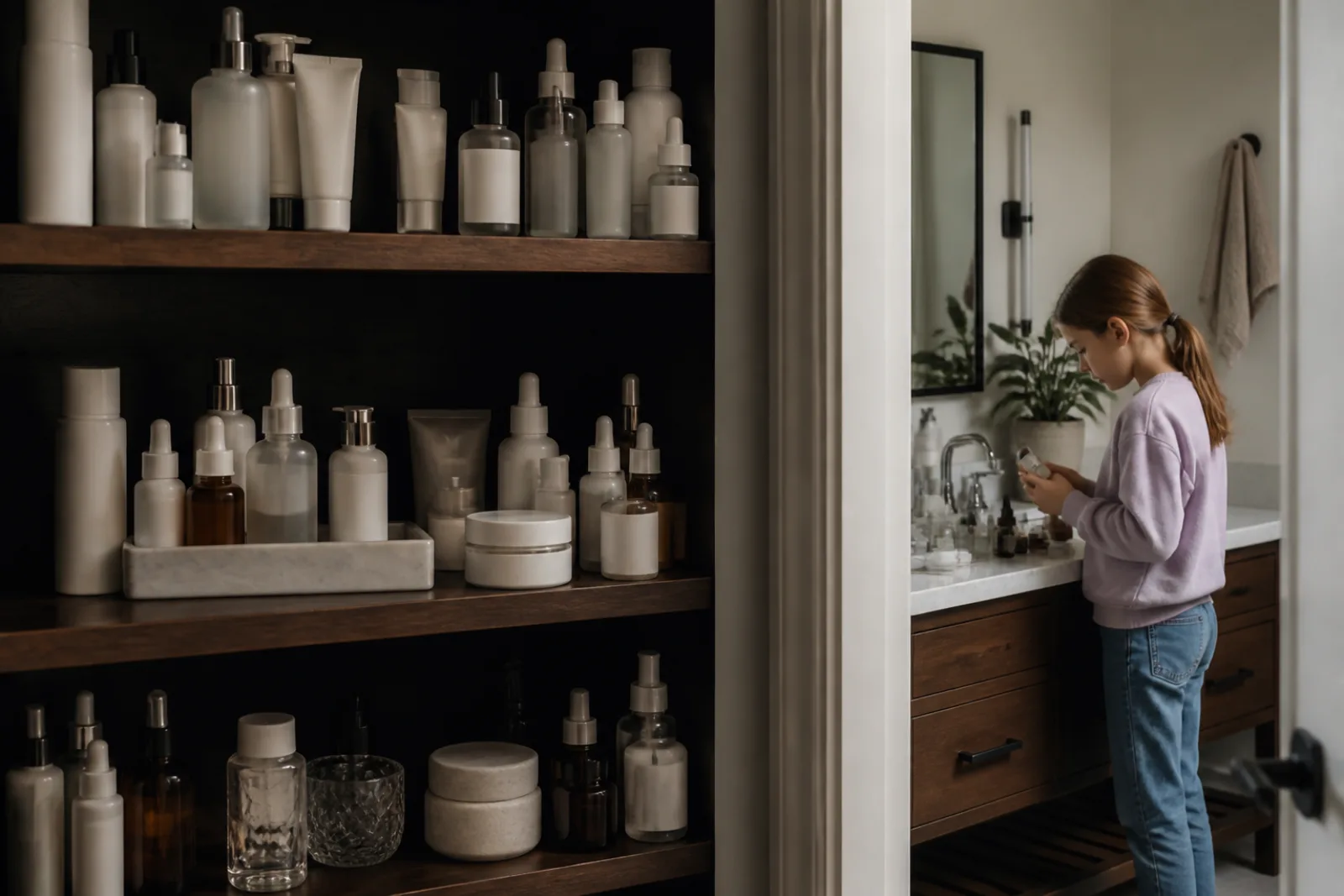
A bathroom medicine cabinet used to be the one part of a home nobody photographed. It held the unglamorous evidence of a person's actual habits: whatever acne cream worked, an expired sunscreen, a razor. Sometime in the last decade, that shelf became a set. Serums get turned label-out. Bottles are grouped by color and height like a small retail display. The arrangement has a name, the shelfie, a portmanteau describing a photograph of a shelf styled specifically to be photographed, and it has turned one of the least public rooms in a home into one of the more performed corners of a social media feed.
What changed is not that people started caring about skincare. It is that skincare brands ran into a marketing problem makeup brands never had: results that are slow, cumulative, and invisible in any single frame. The shelfie solved that by making the collection of products, rather than any visible result, the thing worth photographing. That same visual solution later pulled in a far younger audience than the format was built for, tweens arranging and buying adult anti-aging products dermatologists say their skin does not need.
What changed
Color, coverage, and a before-and-after photograph were the product. The bathroom was private.
Results are slow and mostly invisible, so the collection itself became the image. The shelfie is that workaround.
The format has a traceable origin. In 2010, Emily Weiss, then an intern at Vogue, started a blog called Into The Gloss and built its most popular recurring feature around a simple premise: she would sit on the bathroom floor of an editor, model, or other public figure and photograph whatever sat on their top shelf, asking them to talk through what they actually used. The column, called Top Shelf, was intimate specifically because it was unstyled: real bottles, half-used, in whatever order their owners kept them. When Instagram gained a mass audience, the same premise translated into the hashtag itgtopshelfie, and from there into the wider, genericized shelfie. Weiss then built directly on the blog's audience and premise to launch Glossier in 2014, a beauty brand whose early identity centered on the idea of the real, functional shelf rather than an aspirational, brand-controlled one. Glossier went on to reach a reported billion-dollar valuation within five years, evidence the shelfie was never just a photo trend; it was a viable acquisition channel that a company was built around.
By March 2018, the analytics firm Dash Hudson measured shelfie posts reaching an audience of 94 million across roughly 42,000 posts, a scale that had moved well past Into The Gloss's original readership into a genre other brands actively produced for. Beauty Independent's reporting on the trend lays out why brands leaned into it specifically: skincare, unlike color cosmetics, has no obvious visual proof of concept. A lipstick has a swatch. An eyeshadow palette has a blended look. A serum has, at best, a slow, hard-to-attribute improvement that no single photograph can show. The shelfie solved that by making brand recognition and curated ownership the visual payoff instead. Brands built entire campaigns around it: Biossance tagged retail partners like Sephora, which has 14 million Instagram followers, to borrow reach; the retailer Follain built a pop-up shop at Fivestory explicitly described as built for shelfies; and the skincare brand Monastery gained 200 new followers in three hours after a single blogger's shelfie post, a small but directly attributable return that is difficult to get from almost any other organic content format in beauty.
e.l.f.'s growth is one of the only fully audited, publicly reported figures in the youth beauty boom, and it shows the display-and-discovery-driven market converting into real revenue. The company also reported its 21st consecutive quarter of net sales and market share growth, alongside a 35 percent share of the female teen cosmetics market.
e.l.f. Beauty Posts 77% Growth in Fiscal 2024 · accessed 2026-08-12 · Fiscal 2024 figure is e.l.f. Beauty's reported audited net sales; the fiscal 2023 figure is calculated by dividing the fiscal 2024 total by the reported 77 percent growth rate, since a directly reported prior-year dollar figure was not available in the same source.
The mechanism scaled further once TikTok Shop collapsed the distance between the image and the purchase. Beauty and personal care was the platform's top-selling category in 2024, with more than 370 million units sold globally and an estimated $2.5 billion in beauty product sales in early 2025 alone. Seventy-one percent of consumers surveyed say they discover new skincare products through social media, and more than 80 percent of teenagers report watching beauty tutorials online. The audience for that content got younger at the same time it got larger: Sephora reported in 2023 that its customer base aged 9 to 12 had doubled over the preceding five years, a cohort industry press nicknamed Sephora kids, known for arriving in groups, testing and sometimes damaging in-store product displays, and posting shelfie-style hauls of routines built around retinol, vitamin C serums, and exfoliating acids, the same active ingredients adult skincare marketing has spent a decade normalizing as content.
| Displayed and marketed | What dermatology guidance actually recommends |
|---|---|
| A 10-plus product routine: cleanser, toner, multiple serums, exfoliating acid, retinol, eye cream, sheet masks, tools | The American Academy of Dermatology and practicing dermatologists generally point to three core steps for most skin: cleanse, treat as needed, and moisturize, with sun protection added for daytime |
| Anti-aging actives, retinol, exfoliating acids, vitamin C, featured prominently in tween and teen shelfie hauls | Dermatologists specifically advise tweens and teens to avoid these actives, since they target wrinkles, sun damage, and uneven tone, concerns children's skin does not yet have, and can cause redness, burning, or peeling on thinner, more sensitive developing skin |
| A large, color-coordinated, frequently refreshed product collection as a visual status marker | Dermatologists treating irritation increasingly report it is caused by layering too many active ingredients at once, which breaks down the skin barrier rather than improving it |
| New products added specifically to fix visible irritation, breakouts, or sensitivity | Clinicians describe this as a self-reinforcing cycle: barrier damage from over-layering gets treated with more products, which frequently worsens the same irritation it was meant to fix |
The brands and platforms on the winning side of this are straightforward to identify. Skincare companies get a marketing format that costs them almost nothing, a gifted product and an occasional regram, to produce content a paid campaign could not easily replicate, since its credibility depends on looking unpaid. Sephora and TikTok Shop both benefit from a customer base forming shopping habits years earlier than any prior generation of beauty consumers. Mass-market winners like e.l.f. captured a large share of that younger, more price-conscious segment by matching the aesthetic without the luxury price point. The people worse off are more specific than a vague sense that kids are growing up too fast. Dermatologists interviewed across multiple outlets point to a concrete physical mechanism: children's skin is thinner and more reactive than adult skin, active ingredients formulated for adult concerns provide no benefit against problems kids do not have, and the resulting irritation is a real, describable clinical outcome, not just a generational complaint. Store staff and other shoppers absorb a second-order cost, dealing with damaged testers and disrupted displays that industry press has covered as an operational problem for retailers, not only a parenting one.
A counter-movement arrived almost immediately, and its trajectory is its own piece of evidence about how thoroughly this economy absorbs correction. De-influencing videos, urging viewers to buy less and question whether a product was worth the hype, began appearing on TikTok in early 2023 as a direct reaction to the same overconsumption the shelfie format encouraged. Within roughly a year, reporting on the trend found de-influencing content had largely shifted from buy less to buy this instead, recommending cheaper dupes rather than reducing purchases overall. A parallel aesthetic, skinimalism, pitched paring a routine down to a handful of products as the actual dermatologically sound approach. Both corrections are real and grounded in the same clinical logic dermatologists have been citing directly, but both also became their own content categories, filmable, shareable, and monetizable in exactly the format they were reacting against. The fix, in other words, got productized too.
What actually changed
- 01
Skincare's core marketing problem, that its results are slow and invisible to a single photograph, got solved by making the product collection itself the visual content, a format traceable to a specific 2010 blog column.
- 02
That format scaled into a measurable business: e.l.f. Beauty's audited net sales grew 77 percent to $1.02 billion in fiscal 2024, evidence the aesthetic converts into real purchases, not just engagement.
- 03
The same visual culture reached a far younger audience than skincare marketing previously targeted, with Sephora's 9-to-12-year-old customer base doubling in five years.
- 04
Dermatologists describe a specific physical mechanism for harm, not just a generational complaint: active ingredients marketed for adult concerns irritate thinner, more reactive young skin, and the resulting damage often drives purchases of more product rather than fewer.
Questions
- 01Is it actually harmful for a tween to use retinol or other anti-aging skincare?
Dermatologists say these ingredients are formulated for concerns, like sun damage and fine lines, that children's skin does not have, and that their skin is thinner and more prone to irritation, so the likely outcome is redness, burning, or peeling with no corresponding benefit. In select cases a dermatologist may prescribe a retinoid for acne, but that is a medical decision, not a routine cosmetic one.
- 02Does a bigger, more elaborate skincare routine actually work better?
Not according to the dermatologists cited in coverage of the trend. Layering many active ingredients at once is a common cause of irritation and barrier damage, and most dermatologists recommend a simpler baseline, cleanse, treat, moisturize, over a large rotating collection.