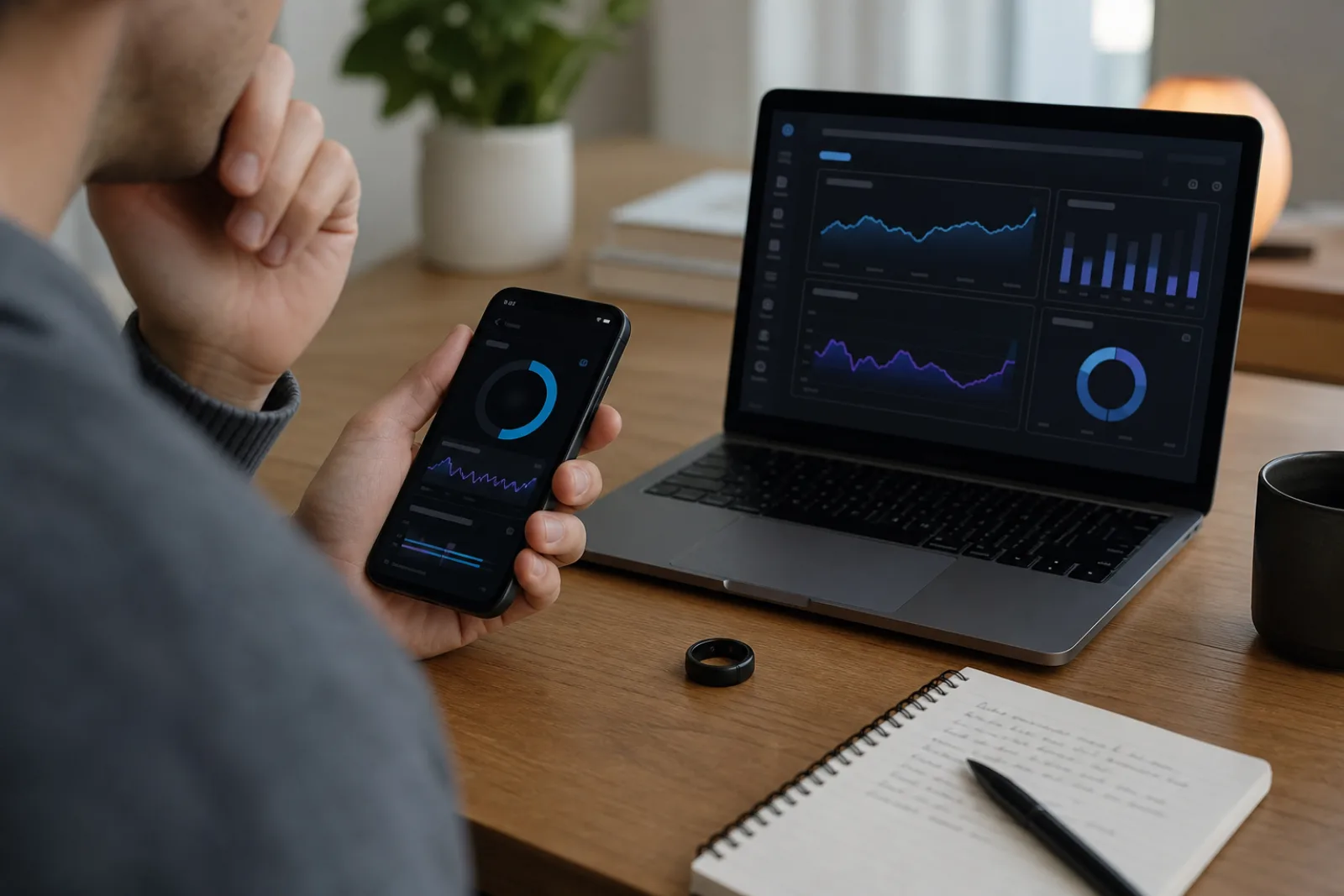
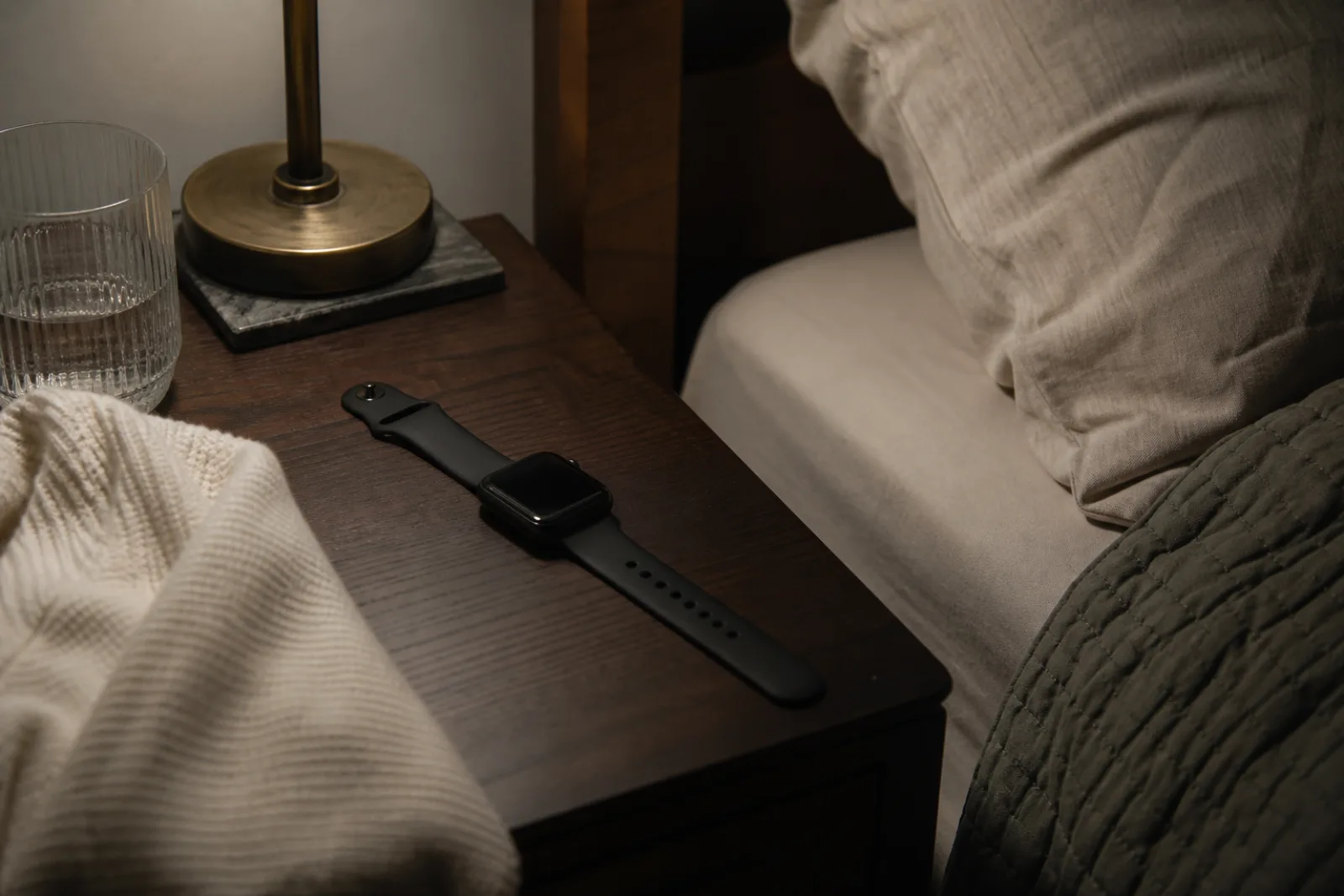
A clinical sleep study, polysomnography, is an overnight recording of brain waves, eye movements, muscle tone, breathing, and often blood oxygen, scored by a technician using agreed rules. It is expensive, inconvenient, and still the reference standard against which consumer gadgets are judged. A recovery score is a different object. A ring or a strap measures pulse with light and movement with an accelerometer, then an unpublished formula emits a number, often out of 100, that is easy to read before coffee.
The number feels like a vital sign because it is presented like one: a single index, a color, a trend arrow, sometimes a comparison to 'your baseline.' What changed is not that sleep science discovered a new stage of rest. What changed is that a lab procedure was replaced, in daily life, by a wrist sensor and a score, under a federal policy that treats most of those scores as wellness accessories rather than medical devices.
What changed
EEG, eye movement, and muscle tone. A clinical night is a different kind of fact.
Pulse and motion, compressed into a score with the visual authority of a readout. Stable is not the same as equivalent.
The cultural name for the earlier, nerdier version of this habit is dated. Gary Wolf and Kevin Kelly founded Quantified Self in 2007, a meetup culture of people who logged weight, mood, location, and sleep in spreadsheets and early gadgets, aiming at 'self-knowledge through numbers.' That project was voluntary, small, and often self-skeptical. The home version that followed is default software on a watch. You do not join a meetup. You wake up to a score you did not ask a clinician to interpret.
This is a different argument from the one about the sleep-product market. Mattresses, melatonin, and smart beds are a retail category. The quantified-self problem is epistemological: why a proprietary index is treated as a measurement of the body, and what the lab-to-wrist swap actually discarded.
| Element | Overnight polysomnography | Typical consumer wearable |
|---|---|---|
| Brain activity | EEG electrodes. Sleep stages are defined from brain-wave patterns, not from pulse. | None. Stages are inferred from motion and optical pulse, then labeled with the same words (light, deep, REM). |
| Eyes and muscle tone | EOG and EMG, which help separate REM from other stages. | Not measured. |
| Heart | Often ECG leads, a direct electrical signal. | Photoplethysmography (PPG): light shone into skin, pulse inferred from blood-volume change. Fine for many trends, not the same signal as ECG. |
| Output | A scored hypnogram plus respiratory events, produced under clinical protocols. | Minutes per stage, a sleep score, sometimes a recovery or readiness index with unpublished weights. |
| Regulatory status | A medical procedure in a regulated lab. | Usually a general-wellness feature, unless the company seeks clearance for a specific diagnostic claim (for example an ECG app). |
Validation studies keep finding the same split. In 2022, Miller, Sargent, and Roach put 53 healthy adults in a sleep laboratory for one night with six consumer devices and with polysomnography. For the two-state question, asleep or awake, agreement with the lab ran from 86 to 89 percent. For the multi-state question, which stage, or wake, agreement fell to 50 to 65 percent, with Cohen's kappa values that the authors read as slight to moderate. Their conclusion was specific: the devices were reasonable for field estimates of when sleep happened and how long it lasted, and not yet adequate for staging.
A 2024 Brigham and Women's study in Sensors compared Oura Ring Gen3, Fitbit Sense 2, and Apple Watch Series 8 against polysomnography in 35 adults without a diagnosed sleep disorder. Sleep-versus-wake sensitivity was 95 percent or higher for all three. Stage sensitivity ranged from 50 to 86 percent depending on device and stage. Oura was not statistically different from the lab on wake, light, deep, or REM duration in that sample. Fitbit and Apple Watch were, in opposite directions on light and deep sleep. The paper discloses funding from Oura Ring Inc. That does not make the measurements fake. It does mean the head-to-head should not be read as an independent ranking of brands, which this article will not provide.
The devices are much better at noticing that a night of sleep occurred than at naming the stages a recovery or sleep score is often built from. Consistency across your own nights is not the same as agreement with a lab.
Miller, Sargent, and Roach, Sensors 2022, DOI 10.3390/s22166317 · accessed 2026-08-12 · 53 healthy adults (mean age 25.4), one laboratory night, 9 hours in bed. Each participant wore six devices. Reference standard: polysomnography for sleep, ECG for heart rate. Agreement is epoch-level percent agreement with PSG, not a consumer 'accuracy' marketing claim. Devices are 2022-era hardware (Apple Watch Series 6, Oura Gen2, WHOOP 3.0), so later algorithms may differ. The pattern, two-state far above multi-state, has been replicated in later studies.
Recovery and readiness scores add a second compression. They typically mix overnight heart-rate variability, resting heart rate, and sleep duration or staging, then weight those inputs in a way the company does not publish as a clinical formula. Heart-rate variability from a good optical sensor can track in the same direction as ECG-derived HRV for many people, which is useful for noticing a trend after a hard week. It is not a diagnosis of overtraining, illness, or 'recovered enough to race.' WHOOP built a business on that index as a membership. Oura and Apple display adjacent scores. The cultural move is the same in each case: several noisy signals become one authoritative integer.
An integer can be reliable in the statistical sense of repeating itself. Wear the same ring, sleep in the same room, get 82 three days running. That reliability is what makes the number feel scientific. Clinical meaning is a different test: does 82 correspond to a construct a sleep physician would recognize, in a population that includes insomnia, apnea, and shift work, not only healthy volunteers in a lab? The validation papers above were run in healthy adults. They do not license the score as a fact about disease.
The regulatory gap is not a loophole someone forgot to close. It is written policy. In 2016, section 3060 of the 21st Century Cures Act removed certain software functions intended only to maintain or encourage a healthy lifestyle, unrelated to diagnosis or treatment, from the definition of a device. The same year, FDA's device center said it did not intend to examine low-risk general wellness products for device compliance. The 2019 guidance restated the two-part test: general wellness intended use, and low risk (not invasive, not implanted, no inherently dangerous energy). In 2026 the agency updated the policy again to address wearables that estimate physiologic parameters such as blood pressure, oxygen saturation, glucose, and heart-rate variability. Those products can still be wellness products if they stay on the wellness side of the line: not for diagnosis, not a substitute for a cleared device, not for medical management.
That 2026 update matters because it is the opposite of a crackdown. As sensors got closer to clinical quantities, FDA clarified that some of those quantities can still be sold as lifestyle numbers. The score culture did not outrun the regulator by accident. It grew inside a category the regulator defined.
From meetup to default score
- 2007Quantified Self is founded
Gary Wolf and Kevin Kelly start a community around self-tracking tools. The ethic is n-of-1 experiment, not a mass-market morning number.
- 2016Cures Act and FDA wellness policy
Congress carves certain healthy-lifestyle software out of the device definition. FDA states it will not examine low-risk general wellness products as devices.
- 2017Orthosomnia is named
Baron and colleagues describe patients who present with tracker-driven sleep anxiety, sometimes preferring the device to a sleep study. The paper estimates that about 10 percent of US adults then used a wearable tracker regularly.
- 2018Apple ECG is cleared as a device
DEN180044 puts a medical-grade function on a consumer watch, tightening the association between the wrist and clinical truth.
- 2026Wellness guidance covers more sensors
FDA's update explains how non-invasive estimates of blood pressure, oxygen, glucose, and HRV can remain general wellness if they do not cross into diagnosis or substitute for cleared devices.
Quantified Self; Federal Register 2016-17902; Baron et al., J Clin Sleep Med 2017; FDA DEN180044; CRS IN12657 on the 2026 guidance.
Population sleep, measured the old way, did not become a solved problem in the years the scores proliferated. The CDC's National Health Interview Survey found that in 2024, 30.5 percent of US adults averaged less than seven hours of sleep in a 24-hour period, the American Academy of Sleep Medicine's recommended minimum. Only 54.8 percent said they woke feeling well-rested most days or every day. Those are survey answers, not ring data. They are also a reminder that a culture of nightly scores can expand while the share of people who sleep enough does not move in any dramatic way.
In 2017, Kelly Baron's group at Rush and Northwestern described patients who arrived at clinic because a tracker said their sleep was inadequate, including people whose lab studies did not match the device's story. They called the pattern orthosomnia, on the model of orthorexia: a perfectionist quest for 'correct' sleep. It is not an official diagnosis. It is a clinical observation that the score can become the symptom. The quantified self at home is that observation at population scale. The lab never sent a 0-100 recovery index home. The market did, under a wellness policy that asked the score not to claim it was medicine, and did not ask it to stop looking like medicine.
How to read a score without pretending it is a lab
- 01
Treat night-to-night direction (much worse than your usual) as a prompt to notice alcohol, illness, or a schedule change. Do not treat a stage minute-count as architecture a sleep lab would sign.
- 02
A cleared function (ECG, a specific apnea feature) and a wellness score can share a device. Check which claims the company is actually allowed to make.
- 03
If the number is making sleep worse, that is a documented pattern, not a personal failure of discipline. Baron's 2017 cases were people who did what the interface invited: they believed it.
Questions
- 01If the score is consistent, isn't that good enough?
Consistency means the algorithm is stable on you. Clinical meaning means the algorithm matches a construct measured another way, in the people who have the problem. You can have the first without the second. A bathroom scale that is always two pounds heavy is consistent. It is still wrong about weight.
- 02Should I throw the ring away?
Not on the evidence here. Duration and timing are the parts that track the lab most closely, and they are the parts sleep-regularity research actually cares about. The part to downgrade is the staged, scored, 'recovered' narrative.
- 03Is FDA saying these devices are unsafe?
No. The wellness policy is about not running them through medical-device review when they stay on the lifestyle side of the line. Unsafe would be a different finding. The cultural risk is misplaced certainty, not a shocking from the charger.