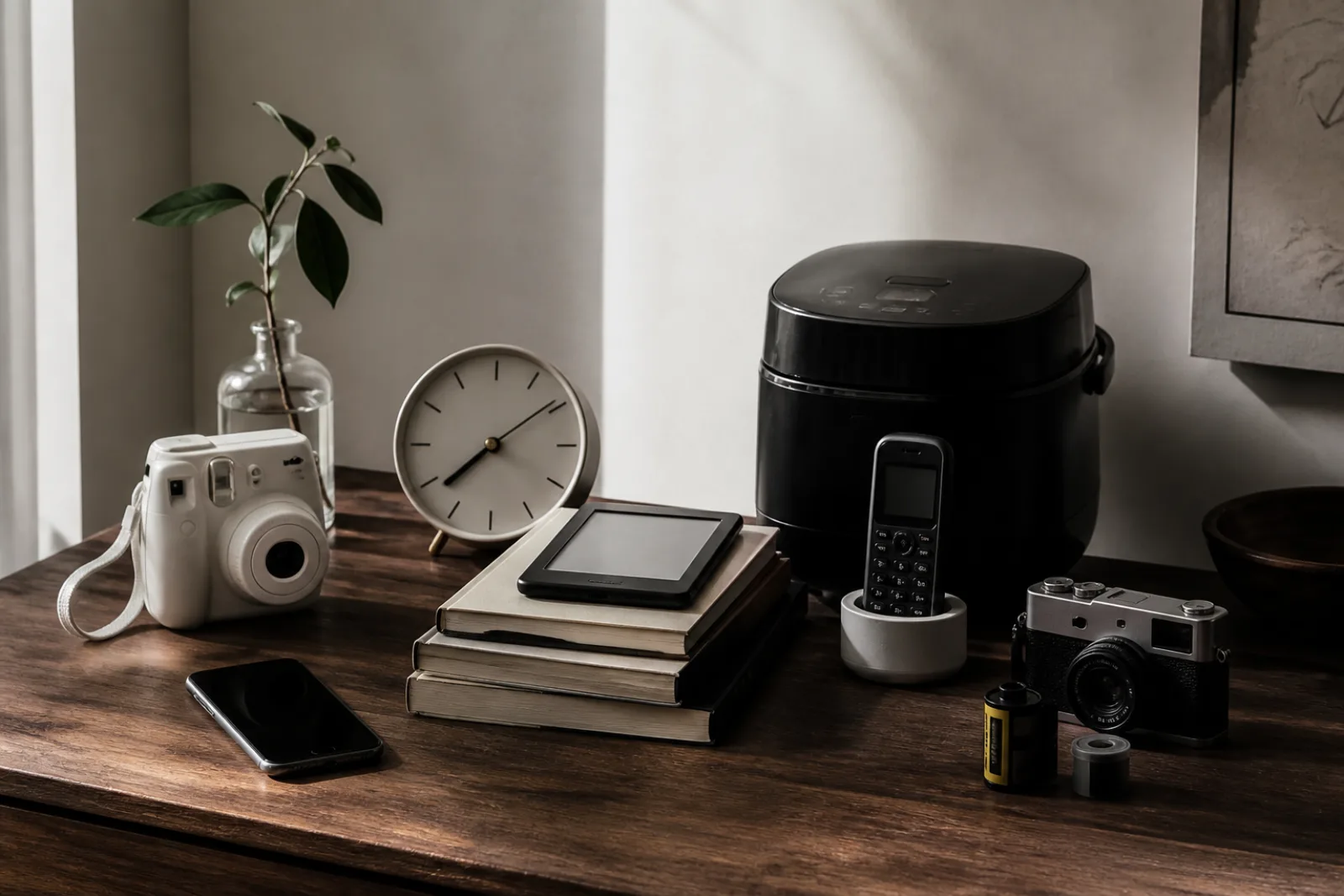
A rice cooker has one job, and you can see it from across the kitchen. A smartphone has dozens, and most of them are invisible until a notification arrives. That contrast is now sold as a philosophy. Film cameras, analog alarm clocks, single-purpose e-readers, and so-called dumb phones are marketed as a way to get a function back from the slab that absorbed it. The pitch is legibility: this object does this, and nothing else will interrupt it.
The pitch is not a census. Pew Research Center's 2025 mobile fact sheet, based on a survey of 5,022 U.S. adults from February to June 2025, finds that 91 percent of adults own a smartphone, the same share as in 2024, up from 35 percent in the Center's first smartphone survey in 2011. Ninety-eight percent own a cellphone of some kind. The dedicated object is not replacing that machine. It is being purchased, by a much smaller set of people, as a second object whose job is to keep the first one from doing too much.
What changed
Camera, clock, notes, and books collapsed into a phone most adults already carry.
The selling point is refusing extra jobs. That is a small market, not a mass analog renaissance.
What changed is not that analog life came back. What changed is that the phone finished swallowing a set of everyday tools, and a market formed around putting some of those tools back on the table as separate hardware. The iPhone shipped in 2007 with a camera, a clock, notes, and a web browser. Within a few years it was also a map, a boarding pass, a bank, and a library. Each of those jobs had previously belonged to an object you could point at. Once they lived in one pocketable computer, the remaining dedicated versions had to justify the space they claimed. Some never needed a revival because they never left: a Zojirushi rice cooker still cooks rice better than a phone, and it never pretended otherwise. Others, cameras and clocks especially, had to reappear as a choice rather than a default.
The dedicated object is a reaction to near-universal smartphone ownership, not a reversal of it. Nine in ten U.S. adults still carry the device that absorbed the camera, the alarm, and the book.
Pew Research Center Mobile Fact Sheet · accessed 2026-08-12 · National Public Opinion Reference Survey of 5,022 U.S. adults, Feb. 5-June 18, 2025, conducted by SSRS for Pew using address-based sampling and a web, mail, and phone protocol. Earlier years used phone polling; Pew notes a mode shift in 2023.
The e-reader is the cleanest test of the argument, because it is digital, single-purpose, and still being manufactured at scale. Amazon does not publish Kindle unit totals. In its fourth-quarter 2024 earnings release, dated February 2025, the company said it had 'the biggest Q4 for Kindle device sales in over a decade, with a new lineup of Kindles driving a 30% year-over-year increase in devices sold.' That lineup included a refreshed Paperwhite, an entry-level Kindle, a second-generation Scribe, and the first color Kindle, the Colorsoft. The sentence is a hardware bounce after a refresh and a holiday quarter. It is not a claim that Americans stopped reading on phones. Statista's e-reader topic page still describes a market that 'suffered from a rapid drop-off in sales' as readers moved to tablets and smartphones, even as Amazon and Kobo keep issuing new models. Both facts can be true: dedicated reading hardware can have a good quarter, and most digital reading can still happen on a phone.
A Kindle is also a reminder that 'one job' is a marketing claim, not a technical one. The device still connects to a store, a subscription, a web browser on some models, and a phone app that syncs your place. What you are buying is a screen that does not want to show you anything except a page, plus a battery that lasts weeks instead of hours. That is a real constraint, and it is why the object works. It is not purity. It is a deliberately worse computer.
| Object | Job the phone already does | What the dedicated version adds | What it costs besides money |
|---|---|---|---|
| E-reader (Kindle, Kobo) | Books, articles, and a backlight in your pocket. | A screen that is bad at everything except reading, and a battery measured in weeks. | Another device to charge, a store lock-in on many models, and a bag slot. |
| Film or instant camera | Unlimited photos, instantly shareable. | A finite roll, a delay, and a print you can hold. Fujifilm's Instax line is the commercial version of that delay. | Film, processing or instant stock, and a camera that does not back up to the cloud. |
| Analog alarm clock | Alarms, timers, and the time, plus everything else on the nightstand. | A clock that cannot open a feed. The phone can leave the room. | A second object on the nightstand, batteries or a winding ritual, and no backup if you forget to set it. |
| Premium 'dumb' phone (Light, Punkt) | Calls, texts, maps, mail, and the rest of a computer. | A handset priced like a midrange smartphone whose software is built to end interactions. | A second phone or a painful week of missing library apps, two-factor codes, and work tools. |
| Rice cooker | Nothing. The phone never cooked rice. | A heating cycle designed for one grain. No revival required; the object never left. | Counter space, and the temptation to buy a multicooker that promises every other job too. |
Film is the example most often inflated into a megatrend. The honest version is smaller and stranger. Fujifilm, in an April 8, 2025 news release, said cumulative global sales of its Instax line of instant cameras and smartphone printers had passed 100 million units since 1998. That number includes analog cameras, hybrid cameras, and printers that turn phone photos into Instax film. It is a real business. It is also, in part, a way of printing the phone rather than leaving it. Kodak is the other named survivor. CNBC reported in August 2025 that the company posted a $26 million net loss in the second quarter even as its film operation was described as growing. The same article notes that then-general manager Ed Hurley told NBC in 2020 that Kodak made more than twice as many film rolls in 2019 as in 2015, and that CEO Jim Continenza later said film sales had increased enough to justify upgrading the Rochester factory. Rising film demand inside a financially strained company is not 'analog won.' It is a niche that can grow from a very low base while the parent still has a going-concern problem.
The camera you actually see on a night out is as likely to be an Instax mini as a Nikon F3. Instant film is a dedicated object with a party job: it makes a print in a minute and asks people to wait for it. That is a social constraint, which is why it sells. A fully manual 35mm body is a different purchase, closer to a craft tool. Collapsing both into 'the return of film' is how a content cycle gets mistaken for a census.
The phone swallowed the jobs. The dedicated objects that remained had to reprice themselves.
- 2007-2011The smartphone becomes the default pocket computer
The iPhone ships in 2007. Pew's first smartphone survey, in 2011, finds 35 percent of U.S. adults own one. Cameras, clocks, notes, and maps begin living in the same object as the phone call.
- 2015-2017Light Phone and the premium refusal
Light, incubated out of Google Creative Lab, ships its first models in 2017. The product is not a cheap flip phone. It is a high-priced object whose software is designed to end the session.
- 2019-2020Film production ticks up from a low base
Kodak later said it made more than twice as many film rolls in 2019 as in 2015. That is growth from a collapsed industry, not a return to 1990s volumes.
- 2023-2024Feature phones stay a sliver; Kindles get a refresh
Counterpoint, cited by the BBC, puts U.S. feature phones at 2 percent of the 2023 handset market, about 2.8 million units. Amazon's 2024 Kindle refresh produces the company's biggest Q4 device sales in more than a decade.
- 2025-2026Instax hits 100 million; EU repair rules take effect
Fujifilm announces 100 million cumulative Instax units in April 2025. The EU's Directive 2024/1799 on repair of goods is to be applied from 31 July 2026. Longevity becomes a legal category for some products, not a vibe.
Pew Research Center; Amazon Q4 2024 earnings; Fujifilm, April 2025; BBC Future citing Counterpoint, May 2024; European Commission, Directive on repair of goods.
The dumb phone is where the culture argument and the market argument split most sharply. BBC Future, in May 2024, cited Counterpoint Research figures from August 2023: feature phones were 2 percent of the U.S. handset market, with about 2.8 million units expected to sell in the United States that year. Counterpoint's own gloss, as quoted, was that demand was 'steady' for simple, affordable, or rugged devices, not that a spike was coming. A large share of those units are inexpensive phones for people who want a low price or a tough shell, including older adults and workers who need a handset that survives a job site. That is not the same customer as the person paying several hundred dollars to go 'light.'
Light's own site, as of 2026, says that over ten years more than 100,000 people have 'gone light.' That is a company figure, not an audited shipment number, and even taken at face value it is two orders of magnitude below a single year of U.S. feature-phone sales. The BBC piece priced the Light Phone at $299 in 2024 and quoted co-founder Joe Hollier: the company was not trying to create a dumb phone but 'a more intentional phone, a premium, minimal phone.' Punkt was offering a simplified smartphone at $750. The economics are the point. A cheap Nokia-style handset is a leftover product. A $300 to $800 object that refuses Instagram is a status object whose status is restraint. You can want that object. You should not confuse it with a population shift.
There is a further catch, which the BBC reporter ran into in a week: jobs, library apps, two-factor authentication, and maps still live on the computer in your pocket. Many people who buy a dedicated phone keep a smartphone somewhere. The dedicated object then becomes a weekday costume, which is a legitimate use and a different claim from 'I left the internet.'
Repair is the part of the old template that holds up, with a limit. The Open Repair Alliance's 2025 data release logged 441,068 repair attempts from 31,436 events run by 1,482 groups in 32 countries. Electrical and electronic items, about two thirds of the log, were successfully repaired 54 percent of the time. Non-electrical items, textiles, bicycles, household goods, were repaired 83 percent of the time. Clocks and radios show up among the electrical objects people actually bring. Sewing machines, which are specialized and mechanical, have one of the higher electrical success rates at 71 percent. The pattern is blunt. An object with one visible job is easier to keep alive when you can open it, find a part, and see what failed. A sealed consumer computer, even one that only displays books, is still a sealed consumer computer.
The European Union's Directive 2024/1799 on the repair of goods, adopted 13 June 2024, is to be applied from 31 July 2026. Manufacturers of listed products that already face EU reparability requirements, including some household appliances and, under related ecodesign rules, smartphones and tablets, must repair within a reasonable time and at a reasonable price, and must not use tricks that block repair without an objective reason. Community repair groups are acknowledged in the directive's platform design. That is a policy fact, not a design philosophy. It does not make a $400 e-ink phone virtuous, and it does not make a rice cooker a political act. It does mean that longevity is being written into law for some categories at the same moment that other categories are being sold as 'one job' lifestyle objects. Those two developments rhyme. They are not the same.
“What we're trying to do with the Light Phone isn't to create a dumb phone, but to create a more intentional phone, a premium, minimal phone, which isn't inherently anti-technology.
Joe Hollier, Light co-founder, as quoted by BBC Future, May 2024
Space is the criterion the marketing never prices. A dedicated object claims a surface: nightstand, counter, bag, shelf. The phone claimed those surfaces by being small enough to live on all of them at once. Putting a Braun-style alarm clock back on the nightstand is a spatial argument that the phone should charge in another room. That argument can be sound for sleep. It is still an extra object, an extra battery, and an extra thing to set. A rice cooker that does one grain well is worth the footprint if you cook rice often. A film camera that you use four times a year is a hobby, which is fine, and a poor candidate for a story about how 'we' live now.
Visible function is real, and it is easy to over-moralize. You can see that a kettle boils water. You cannot see that a phone is also an alarm, a camera, and a to-do list until it interrupts you. The interruption is the design. Dedicated objects sell the absence of that interruption. They do not automatically last longer, repair more easily, or deserve the drawer they occupy. A focused object can be badly made, unnecessary, or a second phone in disguise. The useful test is narrower than a worldview. Does this object do its one job well enough, and often enough, to justify the space, the maintenance, and the fact that you already own a computer that will do a worse version of the same job for free?
What the dedicated object is for
- 01
Treat it as a constraint you are buying, not as a personality. The Kindle works because it is bad at the internet. The clock works because it cannot open a feed.
- 02
Check the scale before you call it a movement. 91 percent smartphone ownership, 2 percent U.S. feature-phone share, 100,000 Light users over a decade, and 100 million cumulative Instax units are different magnitudes.
- 03
Ask whether you can open it. Repair data is kinder to mechanical, specialized objects than to sealed electronics, even 'simple' ones.
Questions
- 01Is buying a Kindle or a film camera a rejection of the smartphone?
Usually no. Most of those buyers still own a smartphone. The dedicated object is a second device that constrains one job. Amazon's 2024 Kindle bounce and Fujifilm's Instax totals are compatible with people who also shoot and read on phones.
- 02Are dumb phones replacing smartphones?
Not in the United States as a mass product. Counterpoint's 2023 figures, as reported by the BBC, put feature phones at 2 percent of the U.S. handset market. Premium models like Light are a much smaller, more expensive slice of that already small category.
- 03Does a focused object last longer?
It can, if it is mechanical or has parts. Open Repair Alliance data shows non-electrical items succeeding far more often than electronics. A sealed e-reader or a glued-together 'simple' phone does not inherit longevity from the fact that it has fewer apps.