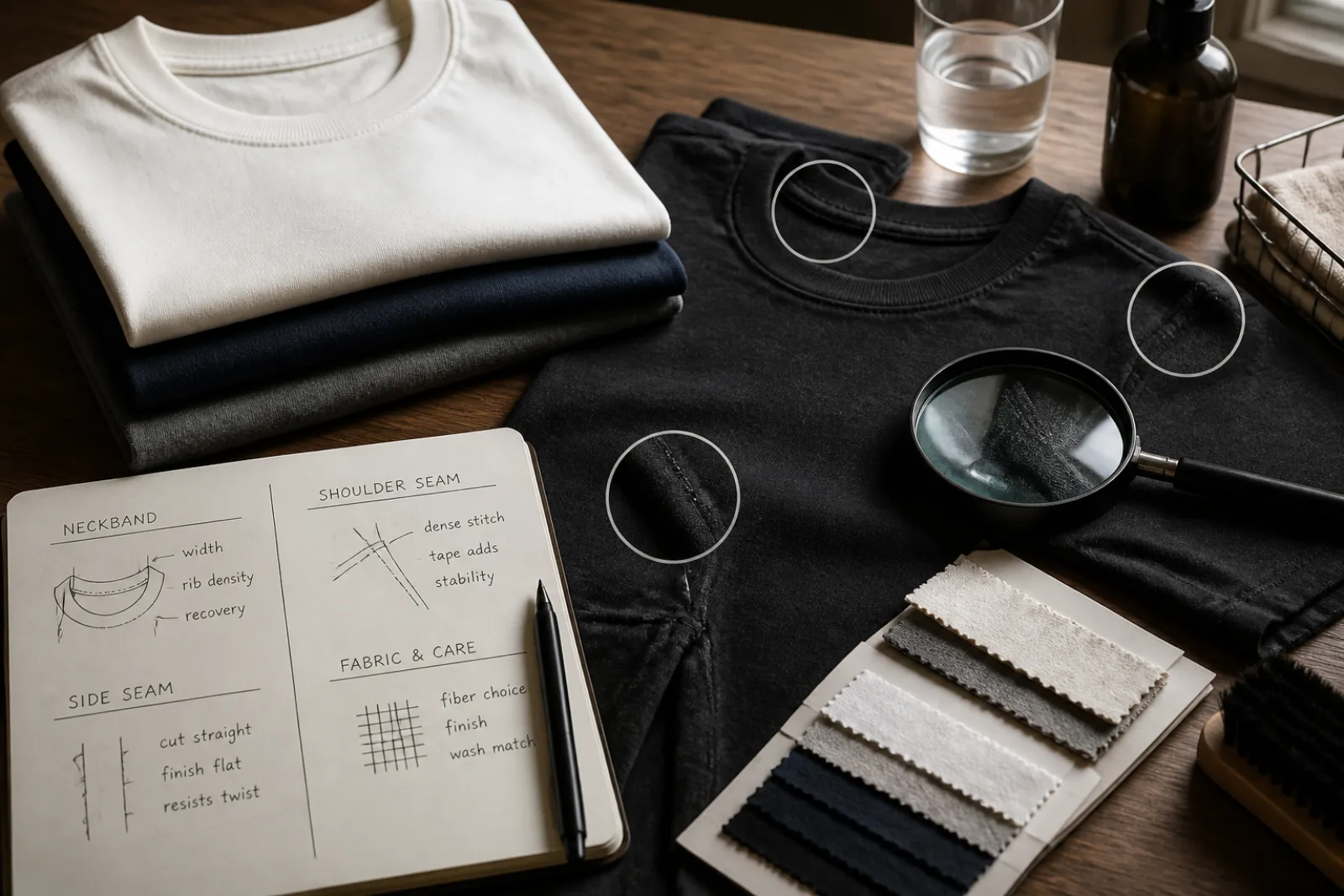
A heavyweight T-shirt can still open at the neck, twist so the side seams crawl around your ribs, and come out of the dryer a size smaller than it went in. Weight is not a scam, but it is not the thing people think it is. What you are buying, in grams per square meter or ounces per square yard, is how much fiber sits in a given area of knit. That changes drape, opacity, and whether the shirt feels like underwear or like a sweatshirt. It does not tell you whether the collar will recover, whether the knit was compacted so it will not spiral, or whether the cotton was finished to limit shrinkage.
Mills measure that mass with a standard method (ASTM D3776). The hangtag that says 220 gsm is using that kind of measurement, or a close cousin. Treat the number as a comfort signal. Then ignore it long enough to check construction, because construction is what you will still be looking at after five washes.
In the hand, a lighter jersey (roughly 120 to 150 gsm) drapes closer to the body, shows heat more, and can go translucent if the knit is open or the yarn is thin. A midweight (roughly 160 to 190 gsm) is what most people mean by a normal T-shirt: opaque enough to wear alone, not so stiff it stands away from the shoulder. A heavyweight (200 gsm and up, sometimes 240 to 300) feels substantial, hides more, and can be hot in humid weather. None of those ranges is a quality grade. A cheap 220 gsm tee with a skinny, unstable rib and untaped shoulders will look worse in a month than a 160 gsm tee with a dense rib, a taped shoulder, and a compacted knit.
Opacity is the one weight-adjacent check worth doing in the store. Hold the chest panel up to the light, or stretch it over your hand. If you can read your palm through a 'heavyweight' shirt, the knit is open or the yarn is fine, and weight is coming from somewhere that is not coverage. If a lighter shirt is still opaque when slightly stretched, the knit is tighter than the gram number suggests.
Work top to bottom on a shirt still on the hanger, then take it down and hang it from the shoulders so the side seams can fall plumb.
- 01Neckband (rib collar)
Should be a true rib (you can see the vertical columns) with enough width to sit flat. Stretch the opening toward the size of your head and release. It should snap back. A neck that stays oval, or a binding that is just a strip of the same jersey, will grow first.
- 02Shoulder seam and tape
Look for a strip of fabric (tape) sewn into the shoulder seam from neck to sleeve. Count stitches along an inch of that seam: a dense line holds stretch better than a sparse dashed line. Untaped shoulders stretch into a slope.
- 03Side seams
Hang the shirt. The seam from underarm to hem should drop straight. If it spirals toward the front or back on a new garment, the knit has residual torque. Washing usually makes that worse, which is why mills test skew and garment seam twist after laundering (AATCC TM179, TM207).
- 04Hem and sleeve hem
A coverstitch (two or three parallel rows on the face, a looper underneath) stretches with the knit. A cheap lockstitch hem can pop. The hem should sit level, not hike on one side, which is another twist tell.
- 05Fiber and care label
Cotton, cotton-polyester, and Pima or Supima are different bets on shrinkage, wrinkle, and pilling. The care line tells you whether the maker is willing to put this knit through a machine dry. 'Tumble dry low' and 'lay flat' are not the same product.
Neckband recovery is the check that saves the most shirts. A T-shirt collar is usually a rib knit, 1x1 or 2x2, sometimes with a little elastane. Rib has more recovery than the jersey body because of how the loops are arranged. The store test is crude and good: open the neck as if you were putting your head through, hold for a second, let go. It should return to a circle, or close to one. If it stays as an oval, the rib is under-constructed, the yarn has no spring, or the collar was stretched on the machine and never recovered. ASTM D2594 is the lab version of this idea for knits: stretch under a known load, then measure growth after the load comes off. You cannot run D2594 in a fitting room. You can refuse a collar that already grew in your hands.
Side-seam twist, also called torque or spirality, is a weft-knit problem. Circular-knit jersey is made in a tube. Yarn twist and the way loops lean can leave residual torque in the fabric. If that torque is not relaxed in finishing (compaction, and sometimes torque-balanced yarn), the garment's vertical seams rotate after the first washes. You see it as a shirt that looks fine on the hanger in the shop and, after laundry, has side seams that have walked around toward your navel or your spine, and a hem that will not sit level. AATCC TM179 measures skew change in fabric after home laundering. AATCC TM207 measures seam twist on finished garments with vertical seams, which is the T-shirt you are holding. In the store, hang the shirt from the shoulders, let it drop, and look. Fold it in half down the center back. The side seams should stack. If they already disagree on a new shirt, do not buy it hoping the dryer will fix it. The dryer is what reveals it.
| What the label says | What you are usually getting | Typical failure in wear |
|---|---|---|
| 100% cotton (Upland) | Standard short-to-medium staple cotton jersey. Soft, breathable, takes dye well. | Shrinkage if not compacted or pre-shrunk; wrinkling; possible side-seam twist; neck growth if the rib is weak |
| Cotton-polyester (often 50/50 or 60/40) | Polyester in the blend reduces shrinkage and wrinkling and can add durability. | Clammy hand in heat; pilling if the polyester yarn is low quality; stains can set differently than on cotton |
| Pima or extra-long-staple cotton | Longer fibers (American Pima is G. barbadense, distinct from Upland). Smoother yarn, often less pilling. | Still shrinks and twists if the knit is not finished well. Fiber length is not a construction warranty. |
| Supima | A trademark for American-grown Pima used under license. A fiber-origin claim, not a shirt-construction claim. | Same as other ELS cotton if the neckband, seams, and compaction are poor |
| Cotton with a few percent elastane | Body or collar has stretch and better snap-back. | Heat in the dryer can kill the elastane's recovery over time; follow the care line |
Cotton is not one fiber. Most T-shirts are American Upland or equivalent short-to-medium staple cotton (Gossypium hirsutum). Extra-long-staple cotton, sold as Pima and, when it is American-grown under that trademark, as Supima, comes from G. barbadense. Cotton Incorporated's classification overview treats American Pima as extra-long-staple G. barbadense, with fibers in the neighborhood of 1 1/4 to 1 9/16 inches, distinct from shorter-staple Upland (G. hirsutum), which is most of what a standard cotton T-shirt is made from. Longer fibers spin into smoother, stronger yarn, which is why a good Pima tee pills less and feels less fuzzy after washing. It is still cotton. It still needs compaction or pre-shrinking, a decent rib, and straight seams. 'Pima' on a label without those is a fiber upgrade on a poorly made shirt.
Cotton-polyester is a different bargain. Polyester does not swell and relax the way cotton does, so the blend usually shrinks less and comes out of the dryer looking more like it went in. It also does not absorb sweat the way cotton does, which is why a 50/50 can feel fine in an air-conditioned office and sticky on a humid walk. Pilling is a yarn and finish problem more than a fiber-purity problem: a loosely spun polyester can pill on a 'premium' blend. If you want easy care and you live in a dryer, the blend is often the honest choice. If you want a shirt that feels like cotton after an hour on your back, start with cotton and check construction.
Shrinkage is measurable. AATCC TM135 tracks length and width change after specified home-laundering cycles. Negative change is shrinkage. Knits that were compacted or pre-shrunk in finishing move less. A cotton jersey that was never relaxed can drop several percent, which on a T-shirt is the difference between covering your belt and not. You cannot run TM135 in a shop. You can read the care label and the fit. If the shirt is already skimming your body in a fiber that the label says can be tumble dried hot, assume it will get shorter. If the label says wash cold and dry low or flat, the maker is telling you the knit is not finished for a hot dryer. Believe them. Size for the body you have after that care, not for a 'it will stretch' story. Cotton jersey eases a little in wear and then tightens again in the wash. It does not grow into a new size chart.
Stitch density at the shoulder is the unglamorous check. Put a ruler or your thumbnail against an inch of the shoulder seam and count the needle penetrations. A sparse seam looks like a dashed line and opens under the stretch of putting the shirt on. A dense seam looks like a solid thread path. Shoulder tape, a narrow strip caught in that seam, stops the jersey from stretching lengthwise so the shoulder does not droop. You can see the tape if you open the shirt and look at the seam from the inside. If it is missing on a shirt sold as heavyweight or premium, you are paying for grams, not for structure.
Buy the shirt in the size that fits after you have done these checks, not before. A twisted, weak-necked medium will not become a good large. If you are between sizes, prefer the one that still has a little ease through the chest after you raise your arms, because a knit that is already at full stretch on your torso has nowhere to go except out of shape.
Fitting-room T-shirt checks
- 01Stretched the neck opening and watched it return
Oval that stays oval will be worse after washing
- 02Hung the shirt and confirmed side seams drop straight
Spiral on a new shirt is a no
- 03Looked inside the shoulder for tape and a dense stitch line
- 04Checked opacity with the chest panel stretched over a hand
- 05Read fiber content and drying instruction together
Hot dry on untreated cotton is a shrinkage bet
- 06Raised both arms and sat down
Hem should still cover the belt; sleeves should not bind the armpit
Questions
- 01Is a heavier T-shirt always more durable?
No. Durability in a jersey tee is yarn quality, knit density, finishing (compaction), and seam construction. A heavy, loosely knit, untaped shirt can bag and twist faster than a lighter, tighter, well-finished one.
- 02Should I size up for cotton shrinkage?
Only if the care label and the brand's own notes say the knit will shrink, and only after you have checked that the larger size still has a neck and shoulders that sit correctly. A too-big shirt with a weak rib just becomes a bigger, baggier shirt. Pre-shrunk or compacted cotton in your actual size is the cleaner bet.
- 03Does 'ringspun' or 'combed' on the tag replace these checks?
Those words describe yarn preparation (smoother, more aligned fibers). They can mean a nicer hand. They do not replace a recovering neckband or straight side seams.